



A lug nut size chart is only useful if it carries the five numbers that decide whether a nut fits: thread, seat, hex, height and finish. This guide sets out the size families we publish, how to verify a vehicle against them, and where fitment data stops and guesswork starts.
TL;DR
- A fitment chart has to resolve five things: thread diameter and pitch, seat type, hex size, overall height and finish, because a nut can be the right thread and still not fit the wheel.
- Our published lug nut families cover imperial threads of 7/16, 9/16 and 1/2, and metric threads of 12×1.25, 12×1.50, 12×1.75 and 14×1.50, with hex sizes of 3/4″, 13/16″, 2/3″ and 7/8″.
- Seat type decides compatibility: we publish 60° conical, spherical, flat seat with open end and flat seat with attached washer families, and they are not interchangeable on the same wheel.
- Overall height decides clearance, not thread, and our range runs from 0.71″ to 1.86″ tall across the open-end, acorn, bulge acorn, dualie acorn and attached-washer families.
- We publish sizes and part numbers rather than a guessed vehicle list, and we would rather confirm the row with you than hand over a fitment we cannot trace to a product page.
Most lug nut problems that reach us are not wrong thread sizes. They are right thread, wrong seat: the nut bottoms out on a wheel that expects a ball seat, or a flat seat nut is fitted to a wheel whose centre bore area is conical. A thread gauge tells you what the stud is, but not what the wheel expects.
Our wheel lug nut range is published as sizes, styles and part numbers, because those are the facts a distributor can act on. Everything below comes from our own product pages.
What a Lug Nut Size Chart Has to Resolve
A usable lug nut size chart resolves five fields for every line: thread diameter and pitch, seat type, hex size, overall height, and finish or material. A chart with only diameter and pitch sends someone to the right thread with the wrong seat, and that failure shows up in the workshop rather than on the shelf.
- Thread. Nominal diameter plus pitch, for example 12×1.50 mm. Imperial families use 7/16, 9/16 and 1/2; our metric options are 12×1.25, 12×1.50, 12×1.75 and 14×1.50.
- Seat. How the nut meets the stud and the wheel. We publish 60° conical, spherical, flat seat with open end and flat seat with attached washer. The wheel decides the seat, not the vehicle badge.
- Hex. The tool size, published as 3/4″, 13/16″, 2/3″ and 7/8″. Hex decides the socket, not the fit.
- Overall height. From the seating face to the top of the nut, published from 0.71″ to 1.86″. Height decides whether the nut clears the wheel, brake and arch.
- Finish and material. We publish cold forged, heat treated steel with chrome plating and salt spray testing.
Because the seat is chosen by the wheel and the thread by the stud, and because a distributor usually learns about the wheel first, the correct working order is to identify the wheel and then the stud, not the other way round. It is also why the same vehicle can take three different nuts across three model years or three markets, and why a single-row fitment sheet per vehicle is a shortcut that eventually costs a return.
The Size Families We Publish
Our lug nut catalogue is organised by style, and each style carries its own height, hex, seat and thread options. The table is taken from the published product pages, with the part numbers we list against each thread size.
| Published product | Hex | Overall height | Seat | Thread sizes published (part number) |
|---|---|---|---|---|
| OPEN-END BULGE | 3/4″ | 0.75″ | 60° conical | 9/16 (1116S), 7/16 (1102S), 1/2 (1104S) |
| OPEN-END BULGE | 13/16″ | 0.83″ | 60° conical | 9/16 (1760), 7/16 (1752), 1/2 (1754), 12mm 1.25 (1756) |
| OPEN-END BULGE | 13/16″ | 1.00″ | 60° conical | 9/16 (1760L), 7/16 (1752L), 1/2 (1754L), plus 12mm 1.25, 12mm 1.50, 12mm 1.75 and 14mm 1.50 |
| OPEN-END SPHERE LUG NUTS | 3/4″ | 0.71″ | Spherical | 7/16 (SR1102M), 1/2 (SR1104M), 12mm 1.25 (SR1106M), 12mm 1.50 |
| OE MEDIUM MAG W/ATTACHED WASHER | 13/16″ | 1.21″ | Flat seat with open end | 12×1.50 mm |
| MEDIUM MAG W/ATTACHED WASHER | 13/16″ | 1.44″ | Flat seat | 12×1.50 mm |
| TOYOTA LONG MAG W/ATTACHED WASHER | 13/16″ | 1.86″ | Flat seat | 12mm 1.50 (98-0002), 12mm 1.25 (98-0002-06), 14mm 1.50 (98-0002-09) |
| ACORN and BULGE ACORN families | 3/4″, 13/16″, 2/3″ | 1.00″ to 1.75″ | Acorn, bulge, grooved | Per product page |
| DUALIE ACORN families | 3/4″, 13/16″ | 1.10″ and 1.20″ | Acorn, two-piece sets | Per product page |
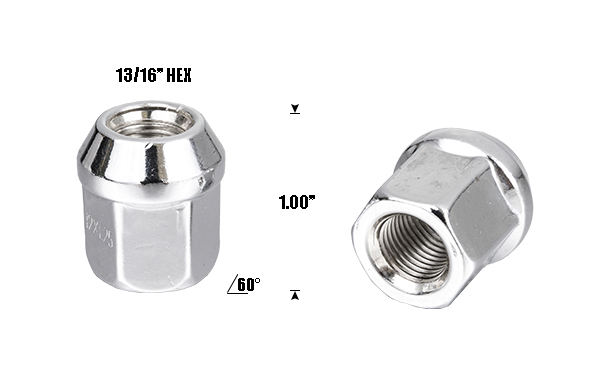
Two rows are worth reading twice. The open-end bulge family publishes imperial threads 9/16, 7/16 and 1/2 against part numbers in the 11xx and 17xx series, and the 0.83″ and 1.00″ heights additionally publish 12 mm and 14 mm metric options. The TOYOTA LONG MAG line is where we publish a vehicle name against the thread table, with 12 mm 1.50 as part 98-0002, 12 mm 1.25 as 98-0002-06 and 14 mm 1.50 as 98-0002-09.
How to Verify a Vehicle Against the Chart
Five checks in this order will confirm a vehicle before a single nut is picked. It is the shortest path from a wheel on the floor to a part number that matches it.
- Identify the wheel first. A conical centre bore area means a 60° conical seat nut, a ball or rounded seat means the spherical family, and a machined shoulder means the attached washer families. On an alloy wheel, check whether the manufacturer specifies a ball seat before assuming a 60° taper.
- Read the thread. A thread gauge on the stud gives the size directly. If the stud is unavailable, the vehicle service data or the wheel stamping is the next source.
- Count the pattern. Our steel wheel programme is published as 5 Lug in 16″ and 17″ sizes, so for steel wheel and trailer work the 5-lug pattern is where our published lines line up.
- Measure the height you need. Overall height decides whether the nut clears the wheel and arch, and our published heights from 0.71″ to 1.86″ are the range to work through.
- Match the part number. Once thread, seat, hex and height are confirmed, the part number follows from the published table.
Because the wheel decides the seat and the stud decides the thread, and because a distributor ordering for a customer usually sees the wheel before the hub is stripped, verifying in this order removes the most common source of a return: a nut ordered from the vehicle badge alone. The wheel nut standard that governs the hardware in this market is SAE J2530 for wheel studs and wheel nuts, and it is worth having to hand when a customer asks why the fitment has to be confirmed rather than assumed.
Five Mistakes We See Repeatedly
Five fitment mistakes account for most of the rework our customers see, and all five are avoidable at the order stage.
- Conical seat onto a ball seat wheel. The nut sits proud, the wheel does not centre, and the load never reaches the seating face.
- Flat seat nut on a conical hub. The nut reaches full height before it is seated, holding the wheel off the hub.
- Right thread, wrong height. A 0.71″ nut where the arch or brake needs 1.21″ will not clear, and a 1.86″ nut where 1.00″ is needed may foul the steering arm on full lock.
- Wrong hex for the tool. A 13/16″ nut where the service tool is 3/4″ means a stopped job, so hex belongs on the chart next to the size.
- Mixing part numbers across a set. Each thread size carries its own part number, so a set assembled from two lines has two invoices and two quality histories.
Because every one of these five errors is visible at the order stage and invisible on the pallet, the chart has to carry the fields that prevent them, which is why seat, hex, height and part number are published together rather than a size list on its own.
Material, Finish and What We Publish About Them
Our published product pages state the process rather than leaving it as a claim, because finish is what a distributor has to defend to the customer. The pages describe cold forged steel construction with a heat treatment process, strength and resistance to scratches or fragmentation, precision machined threads, and chrome plating with salt spray testing recorded on the product data.
Salt spray testing is a defined laboratory procedure rather than a vague promise, and it is specified in ISO 9227 for corrosion tests in artificial atmospheres, which is the reference behind the test we cite on the plated lines. For the wider wheel programme, ETRTO is the European technical body for tyres, rims and valves, and its standards cover the rims and valves our catalogue sits alongside.
Because a plated nut that corrodes at the seat does not fail as a thread problem but as a fitment problem, the finish and the seat have to be qualified together, which is why we publish them on the same page.
Ordering From Us: What to Send
Seven details let us return a part number rather than a catalogue page.
- Vehicle make, model and year, or the wheel and hub references.
- Thread size and pitch, or confirmation that it is unknown.
- Seat type, confirmed from the wheel rather than assumed.
- Hex size and the overall height needed.
- Quantity per part number, and whether sets are needed.
- Destination market, and packaging, labelling or private brand requirements.
- Application, so a trailer, ATV or steel wheel line is not quoted against the wrong family.
We supply distributors and wholesalers across Europe, the USA, Russia, the UK, France, Australia, the Middle East, South America, Africa and Southeast Asia, and we support wheel lug nuts together with wheels, plastic coated wheel weights, AW wheel weight and passenger car wheels as a one-stop purchase. Ningbo Fortune Auto Parts was founded in 1996 and manufactures wheel balance weights, tire valves and tool accessories, with a team of over thirty engineers, warehouses and offices in North America since 2014, and products sold to OEM and aftermarket customers across the Americas, Europe, Japan, Asia and Oceania. Every product goes through strict inspection, packaging is checked in-line, and before each shipment we verify that the order quantity matches the delivery slip.
We do not publish prices on this page. Thread, seat, hex, height and packaging decide the number, so the useful answer is a quotation against a confirmed configuration. Because the fitment is what we can stand behind, we would rather confirm the row first and quote against it.
One practical recommendation
Ask for a photograph of the wheel centre and one of the stud end before ordering. Two photographs settle seat type, hex and thread faster than a description, and give you a record if the part is questioned.
Frequently Asked Questions
1. What thread sizes do you publish for lug nuts?
Our published lines cover imperial threads of 7/16, 9/16 and 1/2, and metric threads of 12×1.25, 12×1.50, 12×1.75 and 14×1.50. Not every family carries every size, so read the thread table on each product page: the open-end bulge lines publish imperial sizes with 11xx and 17xx series part numbers, and some publish metric options too.
2. What is the difference between a 60° conical seat nut and a spherical seat nut?
The seat is the surface where the nut meets the wheel. A 60° conical seat nut tightens onto a tapered centre bore area, and a spherical seat nut matches a rounded ball seat. They are not interchangeable on the same wheel, and a 60° nut on a ball seat wheel will not centre the wheel correctly.
3. How do I know if a vehicle needs a flat seat nut with an attached washer?
A flat seat family is used where the hub or wheel has a machined shoulder rather than a taper, and the washer carries the clamping face. Our published examples are the OE MEDIUM MAG and TOYOTA LONG MAG lines with attached washers at 1.21″ and 1.86″ tall with a 13/16″ hex, and the TOYOTA LONG MAG table lists 12 mm 1.50 as part 98-0002, 12 mm 1.25 as 98-0002-06 and 14 mm 1.50 as 98-0002-09.
4. Which hex size will I need, 3/4″ or 13/16″?
Hex size is a tool decision rather than a fitment decision, and it is published on every product page so you can match it to the service tool in use. Our range covers 3/4″, 13/16″, 2/3″ and 7/8″, with 13/16″ the most common across the open-end, acorn and washer families.
5. Do you publish a vehicle-by-vehicle fitment chart?
We publish sizes, styles, part numbers and the vehicle references we can support, such as the TOYOTA LONG MAG line with its thread and part number table. We do not publish a row for a vehicle we cannot trace to a product page, because an unverified row comes back as a return. Send us the model and the wheel reference and we will confirm what we hold.
6. Can you supply in our own packaging or under our brand?
Tell us the packaging, labelling and branding requirement with the order and we will confirm what we can run against your specification. Production control already checks packaging in-line and verifies order quantity against the delivery slip before shipment.
Bobby
Manager, Ningbo Fortune Auto Parts Manufacture Co., Ltd.
Founded in 1996, Fortune is now one of the leading professional manufacturers of wheel balance weights, tire valves, and tool accessories. My work at the desk is mostly fitment and order questions from distributors, so this guide is built from the sizes and part numbers published on our own product pages, and I would rather confirm a row with you than send a fitment we cannot trace.
Post time: Nov-02-2026