



Lug Nuts and Lug Bolts: Seat, Thread, and Length Selection
A practical guide for distributors, wheel shops, and parts buyers
A lug nut clamps a wheel onto studs. A lug bolt does the same job by threading into the hub. Either part can look acceptable and still be wrong for the wheel.
If the seat, thread pitch, or engaged length is wrong, the fastener can show tight before it has clamped the wheel on the correct face. Installation guidance warns that an incompatible seat may lose torque and can lead to wheel loss.
This guide covers Fortune catalog pages 54-59: how to read the lug-nut and lug-bolt range, and what to check before a fastener is sold or installed. Spacers, adapters, and hub-centric rings share the chapter, but they are a separate selection problem.
What Has to Match
Three features decide whether a fastener belongs on a wheel:
| 1 | Seat. The contact face must match the seat in the wheel. |
| 2 | Thread. Diameter and pitch must match the stud, or the threaded hole in the hub when the vehicle uses bolts. |
| 3 | Length and drive. The fastener needs real thread engagement, must not bottom out, and must turn with the correct socket or spline key. |
Hex size and coating matter for service and appearance. They do not replace those three checks. Chrome and black parts in one family can share a thread list. Coating is not a strength grade. This chapter does not publish material grade, proof load, or a vehicle list, so none of those should be inferred from a part number.
Seat Geometry: Acorn and Ball
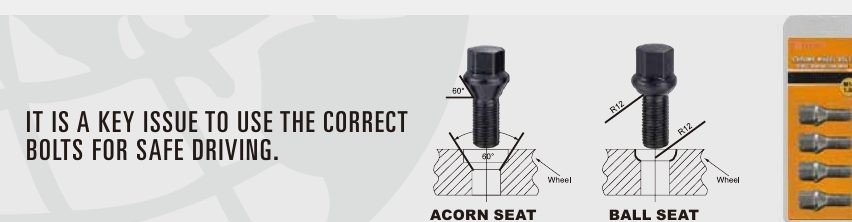
Catalog page 57. The acorn seat is marked 60 degrees and the ball seat is marked R12.
Fortune drawings use two seat names: acorn seat and ball seat.
An acorn seat is the taper under the hex. Most acorn drawings in this chapter are marked 60 degrees, which is the usual conical seat described in wheel-installation guidance, including 60-degree acorn and bulge forms. Two drawings are different. FN00106-F and FN00904-F are marked 90 degrees. Read the angle from the drawing for that part number.
A ball seat is a radius. Fortune's ball-seat bolt drawings are marked R12. Installation guidance treats a spherical or ball seat as a separate family from a conical seat. They are not interchangeable. A conical fastener in a ball-seat wheel, or the reverse, can show a torque reading before the wheel is clamped on the correct face. The only compatible fastener is the one that matches the seat.
The lug-bolt page states it directly: "It is a key issue to use the correct bolts for safe driving." Start with the wheel, not with the fastener already in the drawer. Bulge acorn lock nuts are a taller conical form, and their drawings are marked 60 degrees, but the truck, car, OE, and factory-style bodies are not one shape.
Thread: Diameter and Pitch Are Both Mandatory
Nut threads are labeled THREAD (F), the internal thread. The options that recur in the nut tables are 7/16, 1/2, 9/16, M12x1.25, M12x1.5, M14x1.5, and M14x2. A line in a family list is an ordering option, not a claim that one nut body is made in every thread.
Pitch is the usual miss. M12x1.25 and M12x1.5 will not substitute for each other. Neither will M14x1.25, M14x1.5, and M14x2. A nut that almost starts is a warning. Forcing it damages both parts.
Lug bolts follow the same rule in the other direction. On page 57, 6-spline and acorn-seat hex bolts list M12x1.25, M12x1.5, M14x1.5, and M14x1.25. Ball-seat hex bolts list only M12x1.5 and M14x1.5. A hub that uses M12x1.25 or M14x1.25 is not served by the ball-seat list, even when the seat and hex look right.
Acorn Lug Nuts
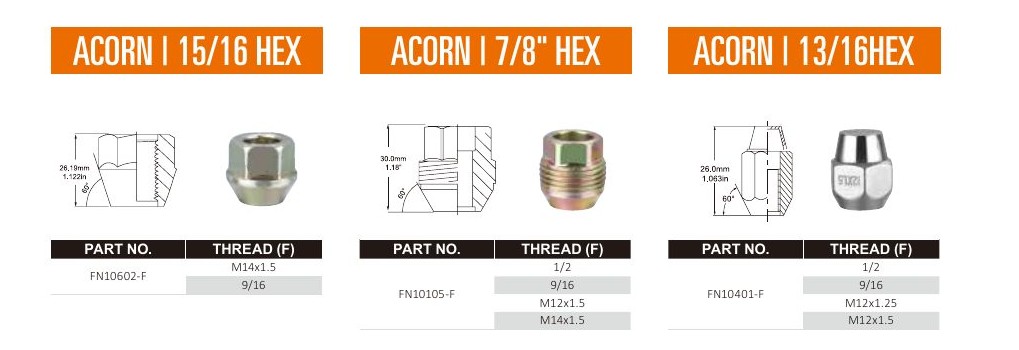
Catalog page 54. Acorn lug nuts are grouped by hex size, with a separate thread list for each part number.
Catalog pages 54 and 55 organize acorn nuts by hex size. The hexes shown are 15/16, 7/8, 13/16, and 3/4 inch. Hex size must match the service socket. It is independent of thread: the same 13/16-hex family can be offered in several threads, and two nuts with the same thread can require different sockets.
| Part No. | Hex | Threads listed for the family |
|---|---|---|
| FN10602-F | 15/16 | M14x1.5, 9/16 |
| FN10105-F | 7/8 | 1/2, 9/16, M12x1.5, M14x1.5 |
| FN10401-F | 13/16 | 1/2, 9/16, M12x1.25, M12x1.5 |
| FN20101-F | 13/16 | 1/2, 9/16, M12x1.25, M12x1.5, M14x1.5 |
| FN20703-F | 3/4 | 1/2, 9/16, M12x1.25, M12x1.5, M14x1.5 |
| FN30107-F | 13/16 | 1/2, 9/16, M12x1.25, M12x1.5 |
| FN00701-F | 13/16 | 7/16, 1/2, M12x1.25, M12x1.5, M14x1.5, M14x2 |
| FN00106-F | 13/16 | 1/2, 9/16, M12x1.25, M12x1.5, M14x1.5, M14x2 |
| FN10803-F | 3/4 | 1/2, 9/16, M12x1.25, M12x1.5, M14x1.5, M14x2 |
| FN00706-F | 3/4 | 7/16, 1/2, M12x1.25, M12x1.5 |
| FN20306-F | 7/8 | M14x1.5, 9/16 |
| FN00705-F | 3/4 | 7/16, 1/2, M12x1.25, M12x1.5 |
| FN00704 | 3/4 | 7/16, 1/2, M12x1.25, M12x1.5, M14x1.5 |
| FN10802 | 13/16 | 7/16, 1/2, M12x1.25, M12x1.5, M14x1.5 |
| FN00804-F | 3/4 | 7/16, 1/2, M12x1.25, M12x1.5, M14x1.5 |
| FN00904-F | 3/4 | 7/16, 1/2, M12x1.25, M12x1.5, M14x1.5, M14x2 |
| FN00101-F | 7/8 | M14x1.5, 9/16 |
| FN00008-F | 13/16 | M14x1.5, M14x2 |
FN00704 and FN10802 are printed without the -F suffix used nearby. Order them exactly as printed. Drawing height and seat-angle callouts belong to that drawing only. Do not copy a 16 mm or 44.5 mm body height onto another part in the same hex group. Carded sets on page 55 are a sales pack; the fastener inside still has to match the wheel and stud.
Spline Nuts, Spike Nuts, and Keys
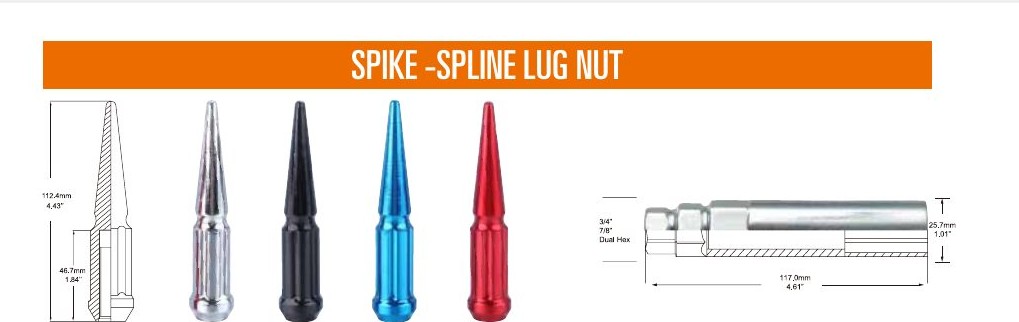
Catalog page 56. Spike spline lug nuts share one thread block. The coating changes the part number, not the thread list.
Page 56 is driven by a spline or a removable adapter, not by an ordinary hex socket. The catalog names the adapter for each nut. A nut sold without that key cannot be removed with a standard socket.
Spike spline lug nuts, FNSK01 series. One thread block covers 1/2, 9/16, M12x1.25, M12x1.5, M14x1.5, and M14x2. Coatings are Chrome (FNSK01-F), Black (FNSK01BK-F), Blue (FNSK01BL-F), and Red (FNSK01R-F). The drawing shows a long spiked profile, with callouts of about 112.4 mm overall and 46.7 mm on the body. Color changes the coating, not the thread list.
Spline spike adapters. FNA001 is a hex adapter for 3/4 and 7/8 drive. FNA002 is a spline adapter for the same 3/4 and 7/8 drive. These keys are separate part numbers from the nuts.
Closed spline lug nuts.
| Family | Part numbers | Adapter called out | Threads listed |
|---|---|---|---|
| Car, 6-sided | FNSN01-F chrome; FNSN01BK-F black | FNA003-6 | 1/2, 9/16, M12x1.25, M12x1.5 |
| OE car, 6-sided | FNSN02-F | FNA003-6 | 1/2, 9/16, M12x1.25, M12x1.5 |
| Truck, 6-sided | FNSN03-F chrome; FNSN03BK-F black | FNA004-6 | 1/2, 9/16, M12x1.25, M12x1.5, M14x1.5, M14x2 |
| Truck, 7-sided | FNSN04-F chrome; FNSN04BK-F black | FNA004-7 | 1/2, 9/16, M14x1.5, M14x2 |
The adapter table distinguishes the keys by spline count and drive:
- FNA003-6: 6 spline, 3/4 and 13/16 drive
- FNA004-6: 6 spline, 7/8 and 13/16 drive
- FNA004-7: 7 spline, 7/8 and 13/16 drive
A 6-spline truck nut does not take the 7-spline key, and the passenger-car key is not the truck key. "6-sided" describes the nut profile. It does not mean a 13/16 hex socket will turn it.
Lug Bolts: Spline, Ball Seat, and Acorn Seat
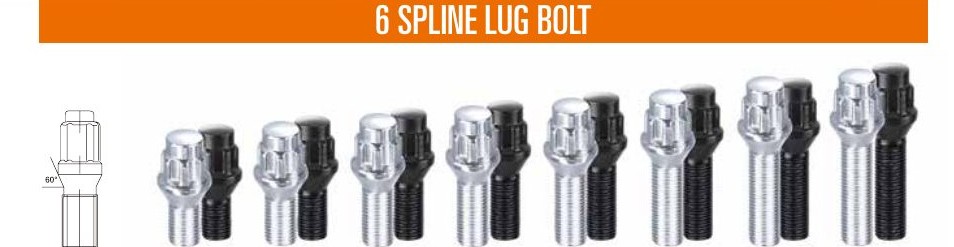
Catalog page 57. 6-spline lug bolts, shown in chrome and black.
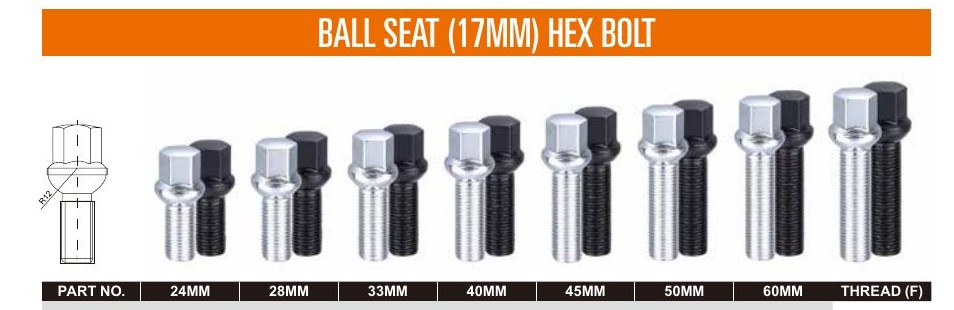
Ball-seat 17 mm hex bolts. The seat drawing is marked R12.
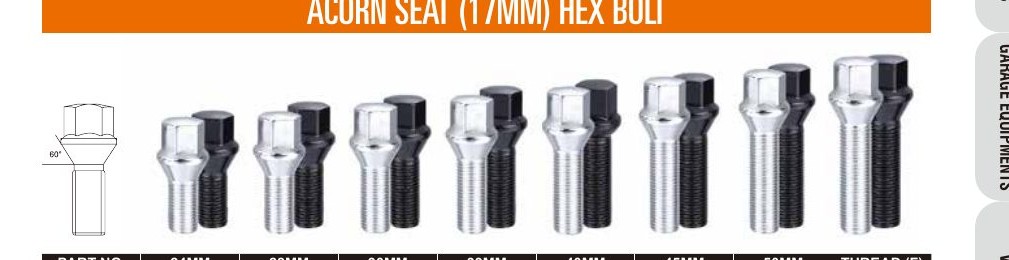
Acorn-seat 17 mm hex bolts. The seat drawing is marked 60 degrees.
Page 57 covers three bolt families. Each is offered in chrome and black, and each length column is a different part number. The length figures are the catalog's length steps for that seat. They are not a statement that every length fits every wheel thickness.
6-spline lug bolts. Lengths are 24, 28, 30, 33, 40, and 45 mm. Threads are M12x1.25, M12x1.5, M14x1.5, and M14x1.25.
| Length | Chrome | Black |
|---|---|---|
| 24 mm | FS6S24-F | FS6S24BK-F |
| 28 mm | FS6S28-F | FS6S28BK-F |
| 30 mm | FS6S30-F | FS6S30BK-F |
| 33 mm | FS6S33-F | FS6S33BK-F |
| 40 mm | FS6S40-F | FS6S40BK-F |
| 45 mm | FS6S45-F | FS6S45BK-F |
Ball-seat hex bolts, 17 mm. Lengths are 24, 28, 33, 40, 45, 50, and 60 mm. Threads are M12x1.5 and M14x1.5. The seat drawing is marked R12.
| Length | Chrome | Black |
|---|---|---|
| 24 mm | FSBS24-F | FSBS24BK-F |
| 28 mm | FSBS28-F | FSBS28BK-F |
| 33 mm | FSBS33-F | FSBS33BK-F |
| 40 mm | FSBS40-F | FSBS40BK-F |
| 45 mm | FSBS45-F | FSBS45BK-F |
| 50 mm | FSBS50-F | FSBS50BK-F |
| 60 mm | FSBS60-F | FSBS60BK-F |
Acorn-seat hex bolts, 17 mm. Lengths are 24, 28, 30, 33, 40, 45, and 50 mm. Threads are M12x1.25, M12x1.5, M14x1.5, and M14x1.25. The seat drawing is marked 60 degrees.
| Length | Chrome | Black |
|---|---|---|
| 24 mm | FSAS24-F | FSAS24BK-F |
| 28 mm | FSAS28-F | FSAS28BK-F |
| 30 mm | FSAS30-F | FSAS30BK-F |
| 33 mm | FSAS33-F | FSAS33BK-F |
| 40 mm | FSAS40-F | FSAS40BK-F |
| 45 mm | FSAS45-F | FSAS45BK-F |
| 50 mm | FSAS50-F | FSAS50BK-F |
Chrome and black bolts of the same length share that family's thread list. The BK suffix marks the black version. Seat still comes first: a 40 mm ball-seat bolt does not replace a 40 mm acorn-seat bolt.
Wheel Locks
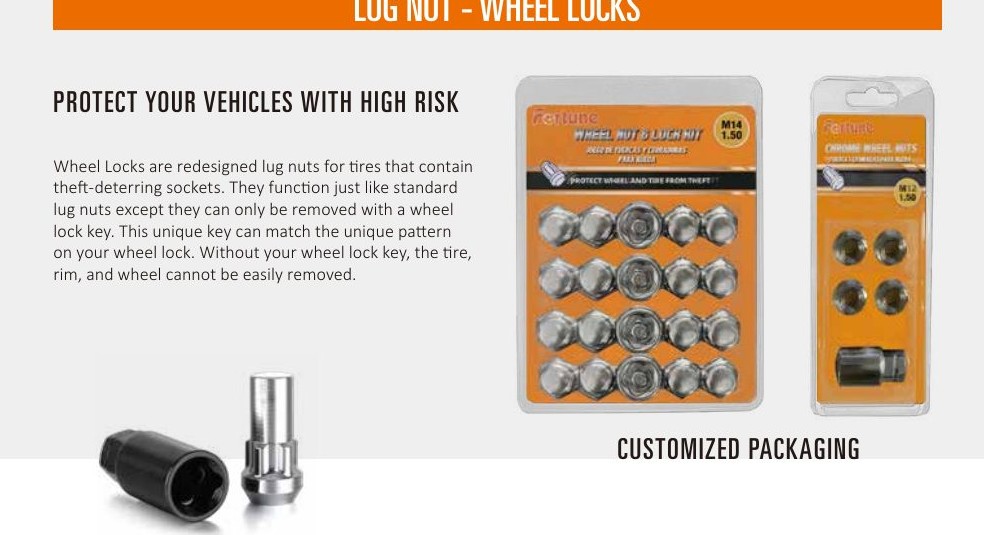
Catalog page 58. Wheel-lock nuts use a matching key and are offered in customized packaging.
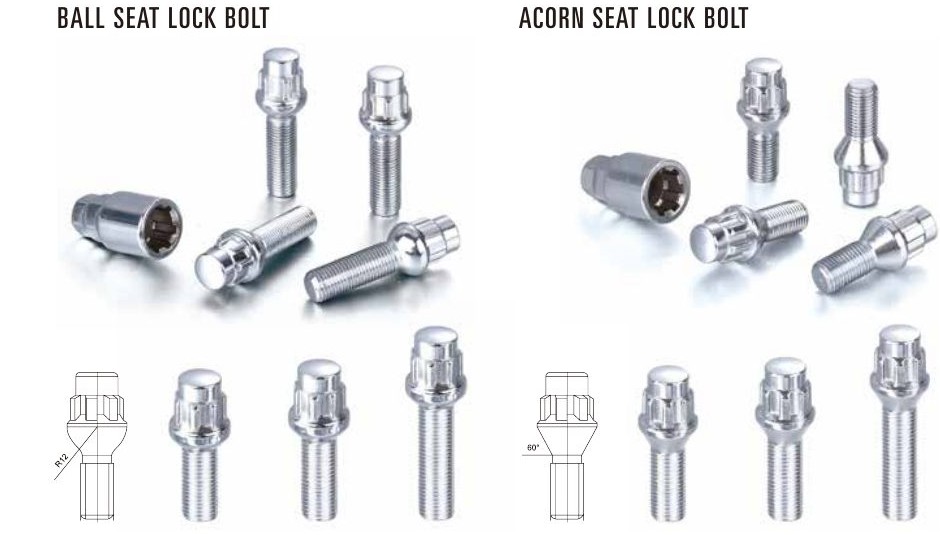
Catalog page 59. Ball-seat lock bolts are FLBS and acorn-seat lock bolts are FLAS.
Wheel locks clamp like the matching nut or bolt, but the catalog says they can be removed only with the matching key. Without that key, the tire, rim, and wheel cannot be easily removed. That is deterrence, not a certified security claim. Sell the key with the set.
Lock nuts, page 58. Hex sizes shown are 13/16 and 3/4 inch, with one OE car block headed 13/16 and 3/4 but listing 7/16 and 1/2 among its threads. Read each block separately.
| Style | Part numbers | Threads listed |
|---|---|---|
| Bulge acorn, truck | FLN03-F, FLN03B-F | 1/2, M12x1.25, M12x1.5, M14x1.5, 9/16, M14x2 |
| OE bulge acorn, car | FLN02-F | 7/16, 1/2, M12x1.25, M12x1.5 |
| Bulge acorn, car | FLN01-F, FLN01B-F | 7/16, 1/2, M12x1.25, M12x1.5, M14x1.5, M14x2 |
| Factory style | FLN04-F, FLN04A-F, FLN04B-F | M12x1.25, M12x1.5, M14x1.5 |
The truck bulge drawing is marked 47.40 mm and 60 degrees, the car bulge drawing 32 mm and 60 degrees, and the OE car drawing 21 mm and 60 degrees. Factory-style drawings for FLN04A-F and FLN04B-F show different bodies, about 37.5 mm and 46.2 mm. Those callouts belong to the illustrated style only.
Lock bolts, page 59. Both families use a 17 mm and 3/4 inch hex description. Ball-seat locks are FLBS. Acorn-seat locks are FLAS. The ball-seat drawing carries the R12 mark, and the acorn-seat drawing carries 60 degrees.
| Part No. | Seat | Overall length | Effective length | Threads |
|---|---|---|---|---|
| FLBS24-F | Ball | 56 mm | 24 mm | M12x1.5, M14x1.5 |
| FLBS28-F | Ball | 60 mm | 28 mm | M12x1.5, M14x1.5 |
| FLBS40-F | Ball | 72 mm | 40 mm | M12x1.5, M14x1.5 |
| FLAS24-F | Acorn | 56 mm | 24 mm | M12x1.5, M14x1.5, M14x1.25 |
| FLAS28-F | Acorn | 60 mm | 28 mm | M12x1.25, M12x1.5, M14x1.25, M14x1.5 |
| FLAS40-F | Acorn | 72 mm | 40 mm | M12x1.5, M14x1.25, M14x1.5 |
FLBS40-F and FLAS40-F are listed here as 72 mm overall and 40 mm effective. Catalog page 59 prints those two cells the other way around. The corrected pair matches the 32 mm difference on the 24 mm and 28 mm rows, and it matches the "40" in the part number as the effective length.
Length and Thread Engagement
Effective length is the length that can work in the thread. Overall length includes the head and seat. If it bottoms in the hub before the seat bears on the wheel, a torque wrench can click while the wheel is still loose. Do not install a wheel in that condition.
The NHTSA-filed installation poster gives a minimum check: engagement at least equal to the stud or bolt diameter. A 1/2-inch thread needs at least 1/2 inch of engagement. Less than that can lose torque. This is a minimum, not a Fortune design rating, and it does not replace the vehicle or wheel manufacturer's fastener. Check every position. Studs on one hub are not always the same length.
A Selection Sequence
Use the same order for a counter sale and for a shop work order.
| 1 | Identify whether the vehicle uses studs and nuts or hub threads and bolts. Do not mix the two systems. |
| 2 | Match an acorn seat to an acorn fastener and a ball seat to a ball-seat fastener. A flat or mag seat is outside the families confirmed here. |
| 3 | Gauge the stud or hub thread. Record diameter and pitch, not just "M12" or "half inch." |
| 4 | Select the hex or spline drive the installer can turn, including the adapter part number for spline nuts. |
| 5 | Check length against wheel thickness and engagement. Confirm that the fastener cannot bottom out. |
| 6 | For locks, include the key and confirm the driver has a place to keep it. If the spare uses a different seat, keep compatible original fasteners with the spare, as installation guidance recommends. |
Installation and Inspection
The catalog publishes no installation torque. Do not invent one. The wheel-installation poster in NHTSA file RCONL-18E065 says to use a calibrated torque device and the vehicle manufacturer's specification, then the wheel manufacturer if the vehicle maker is silent. A stud-diameter guideline in that poster is a last resort for passenger cars and light trucks. It is not a Fortune specification.
The same poster supports these shop practices:
- Clean studs, hub faces, and wheel seats. Do not lubricate the threads. Replace fasteners or studs that are corroded, stripped, cracked, or damaged.
- Use fasteners intended for that wheel. When a new wheel is installed, new fasteners are recommended by that guidance.
- Finger-start every fastener. If one does not start by hand, stop and recheck the thread.
- Keep the wheel centered and supported. Do not let it hang on the top stud while the first fasteners are tightened.
- Tighten in a star or crisscross pattern, in more than one pass, until the specified torque is reached.
- Use the full number of fasteners the vehicle was designed for.
- Re-check at the interval specified for that vehicle and wheel.
Spline nuts and wheel locks need the adapter or key at installation and at the next removal. A missing FNA003-6, FNA004-6, or FNA004-7 is the removal tool for that nut, not an optional accessory.
Common Mistakes
Matching the hex and ignoring the seat. One socket can fit several families and still be the wrong seat.
Treating M12 as one thread. M12x1.25 and M12x1.5 are both in this catalog because both are real wheel threads.
Choosing a ball-seat bolt because the length matches. Several lengths exist in both seats. Length does not convert the seat.
Swapping spline keys. Car 6-spline, truck 6-spline, and truck 7-spline nuts call out different adapters and drive sizes.
Reading color as a specification. Black, chrome, blue, and red are finishes. They do not add a strength or approval claim the page does not make.
Using overall length as the threaded length. On the lock bolts, effective length is the working thread length. For FLBS40-F and FLAS40-F that is 40 mm, not the 72 mm overall length.
Borrowing a torque number. A last-resort guideline in an industry poster is not the vehicle specification, and it is not a Fortune rating.
FAQ
Are acorn nuts and ball-seat bolts interchangeable? No. Acorn is a conical seat. Ball seat is a radius, marked R12 on Fortune's ball-seat drawings. The wheel decides.
Does a thread list mean one nut has every thread? No. Each line is an ordering option. The part supplied has one thread, and the order has to name it.
Why are some drawings 60 degrees and others 90? The styles are not identical. Most acorn and bulge drawings in this chapter are marked 60 degrees. FN00106-F and FN00904-F are marked 90 degrees. Use the drawing for the part being ordered.
How do 6-spline bolts differ from 17 mm hex bolts? A 6-spline bolt needs a spline key. Ball-seat and acorn-seat bolts on the same page use a 17 mm hex. Ball-seat bolts in this table do not list M12x1.25 or M14x1.25.
Do wheel locks replace every lug nut? They are special-socket fasteners sold with a key. Follow the vehicle and wheel instructions for how many lock positions to use, and do not reduce the total fastener count.
Are blue and red spike nuts a different thread? No. FNSK01BL-F and FNSK01R-F are coating part numbers in the same thread block as chrome and black. Still confirm the thread on the order.
What are the lengths for FLBS40-F and FLAS40-F? Overall length is 72 mm and effective length is 40 mm. Page 59 prints those two figures in reverse. This article uses the corrected pair.
Conclusion
This chapter is a selection catalog, not a vehicle fitment guide. It specifies drive, seat, thread, coating, and, for the lock bolts, overall and effective length. A correct fastener matches the wheel seat, starts by hand, develops real engagement, and is tightened to the torque specified for that vehicle and wheel. A near match on hex or diameter is not close enough.
Safety Note
Wheel fasteners are safety-related. Follow the vehicle and wheel manufacturer's instructions. Do not lubricate threads unless that manufacturer allows it. Do not install a wheel when engagement is below one thread diameter, when a fastener bottoms out, or when the seats do not match. This catalog chapter has no torque, strength grade, or approved vehicle list. Industry installation practice yields to the instructions for the actual vehicle and wheel.
Sources
- Fortune product catalog, electronic file "电子版福易春25-3.5生产前数据更新3.5.pdf," catalog pages 54-59. Visually checked against the page images. Part numbers, threads, hex sizes, coatings, and seat callouts are taken from those pages. For FLBS40-F and FLAS40-F, the printed overall and effective lengths were transposed and are corrected here to 72 mm overall and 40 mm effective.
- Wheel installation poster, file title 09WTC_WHEEL_POSTER, included in NHTSA campaign file RCONL-18E065: https://static.nhtsa.gov/odi/rcl/2018/RCONL-18E065-6286.pdf. Used for seat compatibility, thread engagement, torque responsibility, and general installation practice. Not a Fortune specification.
Post time: Oct-16-2026