



Choose zinc wheel weights when lead-free compliance and corrosion-conscious positioning matter; choose steel wheel weights when you need a durable, lead-free option for suitable wheel designs; and choose lead wheel weights when compact size, malleability, and established service procedures are the priority. The correct decision also depends on wheel material, rim-edge geometry, attachment style, coating, tape, segment size, and local regulations.
- Zinc wheel weights provide a practical lead-free route for markets with environmental or regulatory sensitivity.
- Steel wheel weights are durable and lead-free, but their fit must be checked against the wheel profile and required correction position.
- Lead wheel weights remain compact and malleable, while coating, handling, and compliance requirements demand careful review.
- Clip-on weights generally depend on the rim flange; adhesive weights are commonly placed on the inner surface of alloy wheels.
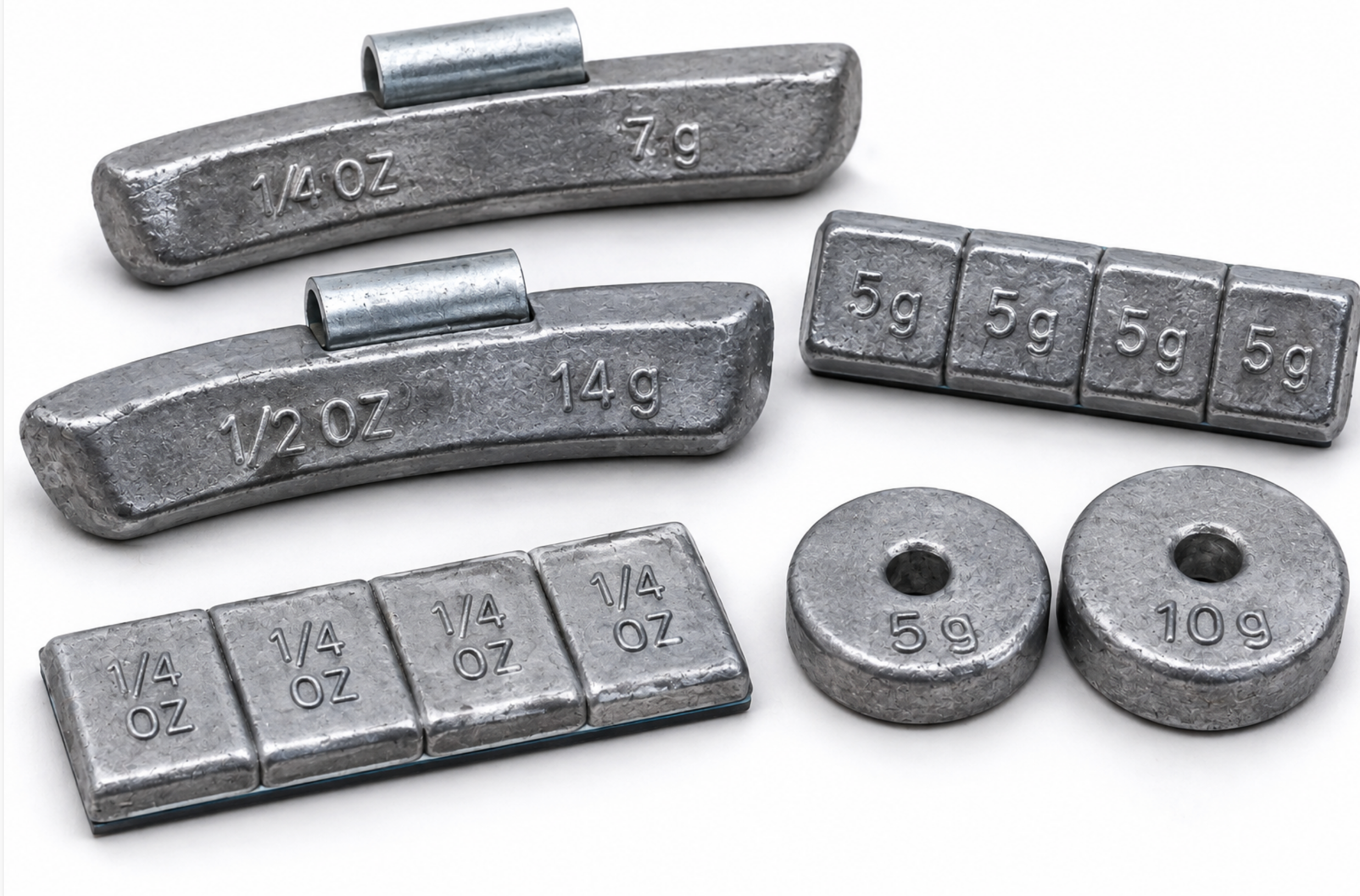
Wheel weights correct uneven mass distribution in a wheel and tire assembly, helping reduce vibration, steering shake, irregular wear, and handling complaints. This guide compares zinc wheel weights, steel wheel weights, and lead wheel weights using material behavior, installation, compliance, purchasing, and service considerations. The supplied product reference identifies Fortune as an auto-parts manufacturer operating since 1996, while the company catalog includes zinc products in weight segments from 5 g to 60 g and lead adhesive examples in 50 g, 200 g, and 2 kg packaging formats.
What wheel weight material actually changes
The material affects how much volume is needed, how easily a technician can position or adjust the weight, how the part interacts with the rim, and how buyers manage compliance and inventory. Material alone does not determine balancing accuracy: the balancer reading, correct placement, secure attachment, and appropriate segment size are equally important.
Lead is denser and more malleable than zinc and steel, according to Tire Review’s material overview. That combination helps technicians use a compact correction and, where the design permits, conform a clip-on weight to the rim. Zinc and steel are commonly selected as non-lead alternatives, but each requires a product design that matches the wheel and service method.
| Material | Numeric catalog example | Primary buying question | Typical consideration |
|---|---|---|---|
| Zinc | 5 g to 60 g segments | Is a lead-free solution required? | Check profile, coating, and corrosion expectations. |
| Steel | Confirm the supplier’s available gram range | Does the wheel accept the selected clip or adhesive format? | Check flange geometry, finish protection, and holding force. |
| Lead | 50 g, 200 g, and 2 kg packaging examples | Is lead permitted and properly managed in the target market? | Review handling, coating, disposal, and customer requirements. |
The numeric examples above describe catalog formats rather than a universal fitment rule. Buyers should not substitute one material’s segment range for another without checking the application guide and the balancer’s correction value.
Zinc wheel weights: best for lead-free positioning
Zinc is often the first material considered when a buyer needs a lead-free wheel balance weight without changing the basic balancing workflow. It is suitable for distributors, tire shops, and vehicle-service programs that want a clearly positioned alternative for environmentally sensitive markets.
The main advantage of zinc is compliance positioning, not an automatic improvement in balancing performance. A zinc weight must still match the rim, attachment method, correction location, and finish requirements. A poorly matched clip or an inadequately bonded adhesive weight can move or detach regardless of whether the metal is zinc, steel, or lead.
- Use zinc when the customer specification excludes lead.
- Confirm whether the part is intended for an alloy wheel, steel wheel, or a specified rim profile.
- Review the coating and edge design where contact with the wheel finish is important.
- Stock multiple segment sizes so technicians can make the required correction without excessive part stacking.
Zinc is not automatically interchangeable with lead. Because different materials have different density and forming behavior, the physical dimensions, clip tension, and available correction range may change. A buyer should request drawings, application guidance, and test samples before approving a broad replacement program.
Steel wheel weights: a durable lead-free route
Steel is generally chosen when a buyer wants a lead-free material with a robust metal construction and a familiar clip-on or adhesive service concept. Its suitability depends strongly on the specific product design and the wheel profile rather than on the word “steel” alone.
Steel clip-on weights require accurate engagement with the rim flange. The flange must provide the correct shape and retention condition; forcing an incompatible weight onto the edge can damage the wheel finish or create unreliable retention. For adhesive steel weights, surface preparation, tape selection, temperature, contamination control, and pressure during installation become central quality factors.
Steel may require more physical volume than a denser material for the same correction mass. That does not make it unsuitable, but it can influence clearance behind spokes, calipers, and other wheel components. Buyers should verify the maximum available correction, profile height, and clearance before standardizing a steel range.
Lead wheel weights: compact and workable, but compliance-sensitive
Lead remains useful in established service systems because it combines high density with malleability. Tire Review describes lead weights as denser and more malleable than zinc and steel, characteristics that help keep the correction compact and support controlled shaping in compatible clip-on applications.
The principal limitation is regulatory and operational, not simply technical performance. Requirements for lead wheel weights vary by jurisdiction and customer program. The California Department of Toxic Substances Control maintains information on lead wheel weights and related regulatory concerns at its lead wheel-weight reference page. Buyers should obtain current legal advice or regulatory confirmation for the destination market instead of assuming that a product accepted in one region is acceptable everywhere.
Lead is also sensitive to handling and end-of-life controls. A professional purchasing specification should identify whether the product is coated, how it is packaged, how technicians are instructed to handle it, and how removed weights are collected. A coated option may help protect the part and reduce direct contact, but the coating does not remove the need to check applicable rules.
Clip-on or adhesive: select the attachment before the metal
The attachment method is often more decisive than the material because the rim structure determines whether the weight can be retained safely and positioned accurately.
| Selection stage | Numeric check | Decision | Failure risk if ignored |
|---|---|---|---|
| Wheel identification | 1 wheel material | Identify steel or alloy construction | Wrong contact method or finish damage |
| Rim inspection | 1 flange profile | Confirm clip compatibility | Loose or distorted clip-on weight |
| Balancing reading | 1 inner and 1 outer correction position | Choose suitable segments | Overcorrection or repeated balancing |
| Adhesive preparation | 1 clean, dry bonding surface | Select tape and installation procedure | Detachment or contamination-related failure |
Clip-on weights are commonly associated with steel wheels or rims with a suitable edge structure. Adhesive weights are commonly placed on the inside of alloy wheels where an exposed clip would be unsuitable or visually undesirable. These are general service patterns, not universal rules; the vehicle, rim design, and application guide control the final choice.
- Read the balancer correction and identify the intended placement plane.
- Inspect the wheel for flange shape, coating condition, clearance, and contamination.
- Select a weight profile and segment size approved for that wheel design.
- For adhesive products, clean and dry the bonding area and follow the tape supplier’s application instructions.
- Rotate and recheck the assembly after installation according to the shop’s balancing procedure.
How buyers should compare supplier offers
A reliable procurement comparison evaluates the complete service system rather than comparing raw metal price alone. A lower unit price can be offset by incorrect fitment, poor tape performance, inconsistent segment tolerances, damaged coatings, or excessive SKU complexity.
| Purchasing criterion | Numeric evidence to request | Why it matters |
|---|---|---|
| Weight range | Minimum and maximum gram segment | Determines correction flexibility |
| Pack configuration | Pieces per strip, box, and case | Supports inventory and cost planning |
| Fitment coverage | Number of approved profiles or applications | Reduces unsuitable substitutions |
| Quality control | Inspection frequency or tolerance specification | Supports repeatable balancing work |
Ask for a drawing, material declaration, coating description, tape specification, packaging details, application guide, and sample approval process. For a lead-free program, request written confirmation of the material and any available compliance documentation. For lead products, request handling and market restrictions before placing a large order.
Common buyer scenarios
A tire shop serving alloy-wheel customers will often prioritize adhesive placement, finish protection, and tape reliability. In this scenario, the best material is the one that provides the required correction in the available inner-wheel space and remains secure after proper surface preparation.
A distributor serving several markets may maintain both lead-free zinc or steel options and compliant lead options. This approach can reduce forced substitutions, provided the packaging, part numbering, and application instructions clearly separate the ranges.
A fleet or repair network should prioritize repeatability. Standardized part numbers, predictable segment sizes, secure attachment, and technician training may matter more than selecting one material for every wheel. Fleet purchasing should also document local restrictions and end-of-life collection procedures.
Seven frequently asked questions
1. Are zinc wheel weights better than lead?
Neither is universally better. Zinc is often preferable where lead-free positioning or market restrictions apply, while lead offers greater density and malleability. Fit, attachment, compliance, and service results determine the better choice.
2. Are steel wheel weights suitable for alloy wheels?
They can be suitable when the product is designed for the wheel and installed in the correct location. Confirm profile, clearance, finish protection, and adhesive or clip compatibility before use.
3. Can I replace lead weights with zinc without changing the part number?
No. A material change can alter dimensions, clip behavior, available correction, and clearance. Treat the replacement as a new fitment decision and validate it on representative wheels.
4. When should I use clip-on weights?
Use them when the rim has a compatible flange and the application guide approves that profile. Do not force a clip onto an unsuitable edge.
5. When are adhesive weights preferred?
They are commonly preferred on alloy wheels or where the weight must be placed on the inner surface. Surface preparation and tape selection are essential to retention.
6. Does a heavier material always need fewer pieces?
Not necessarily. The required correction comes from the wheel and tire assembly, while the number and size of pieces depend on the product’s segment design and placement options.
7. What documents should a B2B buyer request?
Request material information, drawings, application guidance, packaging details, coating and tape specifications, quality documentation, and market-specific compliance information.
About the supplier and next step
Fortune is presented in the supplied company materials as an auto-parts manufacturer established in 1996, with product coverage spanning wheel weights, tire valves, TPMS-related parts, repair materials, and workshop equipment. For a sourcing project, begin with the wheel type, attachment method, target market, required segment range, packaging plan, and documentation checklist. Request samples and application guidance before approving a replacement or private-label program.
For a practical buying decision, compare zinc, steel, and lead samples on the actual wheel profiles your customers service, then confirm retention, clearance, finish protection, balancing repeatability, and regulatory suitability.
External references: material characteristics explained by Tire Review, lead wheel-weight information from California DTSC, and technical service coverage from Tomorrow’s Technician.

Post time: Nov-16-2026