



A practical compatibility guide for distributors, tire shops, and vehicle enthusiasts sourcing aftermarket lug nuts and lug bolts. Covers the three parameters that determine fit, the difference between a lug nut and a lug bolt, and a cross-reference table by vehicle category.
- An aftermarket lug nut must match the wheel on three independent parameters: thread size (diameter), thread pitch (threads per unit), and seat type (conical, ball, or flat) — getting any one wrong can crack the wheel, strip the stud, or cause the wheel to detach.
- The most common metric thread is M12x1.5 for compact cars and M14x1.5 for SUVs and light trucks; the most common imperial thread is 1/2-20 UNF for many American passenger vehicles.
- Seat type is the most-forgotten parameter: a conical (60-degree tapered) lug nut will not seat properly on a ball-seat or flat-seat wheel even when the thread is identical, because the load-bearing surface is the seat, not the thread.
- Lug nuts and lug bolts are different products: lug nuts thread onto a stud that is pressed into the hub, while lug bolts thread directly into the hub (common on European and many Japanese vehicles) — the two are not interchangeable.
- ISO 44783 specifies the dimensions, thread engagement, and test loads for wheel attachment hardware; reputable aftermarket lug nuts comply with the ISO 44783 geometry even when they are not marketed as ‘OEM’.
In our 30 years of manufacturing wheel balance weights, tire valves, and lug hardware at Fortune, the single most expensive support call we get from aftermarket distributors is a wheel that will not center properly because the lug nut seat geometry is wrong. The thread fits, the nut tightens down, and the car drives out of the shop — but the wheel is off-center by 0.5 mm to 1.5 mm, the lug nuts never reach proper torque, and within a few hundred kilometers the customer is back complaining about vibration or, in the worst case, about a wheel that has shifted on the hub.
Compatibility is not just the thread fitting onto the stud. It is the thread, the pitch, and the seat all matching the wheel the nut is being installed on. Get any one of those three wrong, and the lug nut is not the right part for the job, even if it physically threads on and tightens down. This guide walks through each parameter, the difference between a lug nut and a lug bolt, and the cross-reference you can use to match the right aftermarket part to a vehicle.
What Makes a Lug Nut “Compatible” With a Wheel?
An aftermarket lug nut is compatible with a wheel when three independent parameters match simultaneously:
Parameter 1: Thread diameter (size). The diameter of the stud the lug nut threads onto, measured in millimeters (metric) or inches (imperial). The most common sizes are M12, M14, 1/2 inch, and 7/16 inch. If the diameter is wrong, the lug nut will not start on the stud at all, or it will start but strip the threads within a turn or two.
Parameter 2: Thread pitch. The distance between adjacent thread crests, measured in millimeters (metric) or threads per inch (imperial). M12x1.5 means a 12 mm diameter stud with 1.5 mm between crests. 1/2-20 UNF means a 1/2 inch stud with 20 threads per inch. The pitch is easy to get wrong because two very similar specifications exist for the same diameter — for example, M12x1.5 and M12x1.25 are both common on Japanese vehicles, and a M12x1.5 nut will thread onto a M12x1.25 stud for two or three turns before binding and stripping the threads.
Parameter 3: Seat type. The shape of the surface that contacts the wheel when the lug nut is torqued down. The three common seat types are conical (60-degree tapered, also called acorn or tapered), ball (rounded), and flat (with an integrated washer, also called mag seat). The seat is the load-bearing surface that centers the wheel and transfers the clamping force; the thread only holds the nut in place while the seat does the actual work of securing the wheel.
All three parameters must match. A lug nut with the right thread and pitch but the wrong seat will physically install but will not perform correctly. A lug nut with the right seat and pitch but the wrong thread will not even go on the stud. The compatibility decision is a three-way match, and the seat type is the parameter that is most often overlooked when buyers focus on thread specifications.
Thread Size and Pitch: The Two Numbers You Cannot Guess
The thread size and pitch are normally expressed as a pair: M12x1.5, M14x1.5, 1/2-20 UNF, 7/16-20 UNF, and so on. The first number is the diameter; the second is the pitch. The combination is unique, and you cannot determine either number from the other.
Metric threads use millimeters for both numbers. M12x1.5 is a 12 mm stud with 1.5 mm between thread crests. M14x1.5 is a 14 mm stud with 1.5 mm between crests. The pitch varies independently of the diameter, which is why you cannot say “all M14 studs use the same pitch” — M14x1.5, M14x2.0, and M14x1.25 all exist on production vehicles.
Imperial threads use inches for the diameter and threads per inch (TPI) for the pitch. 1/2-20 UNF is a 1/2 inch stud with 20 threads per inch. 7/16-20 UNF is a 7/16 inch stud with 20 threads per inch. The UNF suffix means Unified National Fine, which is the standard thread form for automotive fastener applications in the US. UNC (Unified National Coarse) threads are also used but are less common on lug hardware.
How to measure when you do not have the original hardware. Use a thread pitch gauge to measure the distance between crests. For metric threads the result is the pitch in millimeters (1.5, 1.25, 2.0 are common). For imperial threads, count the number of crests over 1 inch (20 TPI, 16 TPI are common). If the original wheel has the studs and you can access them, compare against a known-spec stud; if not, use a thread gauge.
Two thread specifications are close enough that a casual inspection will not catch the difference. M12x1.5 and M12x1.25 differ by 0.25 mm in pitch — a 14 percent difference in spacing. A M12x1.5 nut will start on a M12x1.25 stud for two or three turns before the threads bind. By that point, the damage is done: either the stud is stripped, the nut is damaged, or both. Always measure the pitch when you are not 100 percent certain.
Seat Type: The Reason a Lug Nut That “Fits the Thread” Still Will Not Work
The seat type is the geometry of the surface where the lug nut contacts the wheel. Three types are common in the aftermarket. Fortune categorizes them across the Wheel Lug Nuts & Boltsproduct family as ACORN, BULGE ACORN, DUALIE ACORN, MG-ATTACHED WASHER, and OPEN-END for lug nuts, plus a separate line.
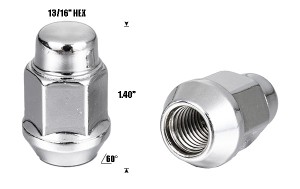
Conical (tapered, acorn) seat. A 60-degree angled chamfer on the bottom of the lug nut. This is the most common seat type on passenger vehicles worldwide. Conical seats self-center the wheel as the lug nut is torqued, which is forgiving of small variations in wheel centering. The seat must be a true 60-degree angle; a 45-degree or 50-degree taper is not compatible even if the visual difference is subtle. See the [Fortune ACORN Style](https://www.fortunewheelparts.com/acorn-style/) catalog for the standard 60-degree profile.
Ball seat (rounded, bulge acorn). A spherical or rounded surface on the bottom of the lug nut, typically with a radius of about 9.5 mm to 12 mm. Ball seats are common on European vehicles (some VW, Audi, BMW applications) and on certain alloy wheels designed for them. The ball seat requires a matching spherical recess in the wheel; using a ball-seat lug nut on a wheel with a conical recess (or vice versa) does not provide proper wheel centering. Fortune’sDUALIE ACORN Style lines cover variants that work with rounded and dual-radius wheel pockets.
Flat seat (mag seat, washer seat). A flat washer integrated into the bottom of the lug nut, often with a pressed-in steel or plastic washer. Flat seats are common on aftermarket alloy wheels, Japanese vehicles, and applications where the wheel has a flat-bottomed lug hole rather than a conical or spherical recess. The washer distributes the clamping load over a larger area. See the [MG-ATTACHED WASHER Style] catalog for this geometry.
Open-end (race / motorsport). A nut that is open at the bottom end rather than closed, designed for long-wheelbase stud applications where the stud protrudes past the nut for safety-wire or wheel-chock clearance. The OPEN-END Style catalog covers this geometry.
Visually, a conical seat, a ball seat, and a flat seat are easy to tell apart if you look at the bottom of the nut. A conical seat has a sloped chamfer, a ball seat has a curved profile, and a flat seat has a washer. The compatibility mistake happens when buyers focus on the thread and pitch and forget to verify the seat — they install a conical lug nut on a ball-seat wheel, the wheel centers on the wrong surface, and the result is vibration at speed, uneven torque, or a wheel that shifts under braking.
When the seat type does not match, the lug nut may still torque down to the specified value, but the wheel is not actually clamped correctly. The clamping force goes through the seat surface, not the threads. If the seat does not contact the wheel correctly, the clamping force is reduced or distributed unevenly, and the wheel can loosen over time. The visual symptom is usually a slight gap between the lug nut seat and the wheel, or a wheel that runs out of true when measured with a dial indicator.
Lug Nut vs Lug Bolt: Different Products for Different Wheels
One of the most common ordering mistakes is confusing a lug nut with a lug bolt. They look similar in product photos, but they are mechanically different fasteners designed for different wheel mounting systems. The [Wheel Lug Nuts & Bolts](https://www.fortunewheelparts.com/wheel-lug-nuts-bolts/) catalog is structured as two separate product lines for this reason.
A lug nut threads onto a stud that is pressed into (or bolted to) the wheel hub. The stud is the male thread; the lug nut is the female thread. Lug nuts have a closed end (acorn shape) or an open end depending on the application. Most American, Korean, and Chinese passenger vehicles use lug nuts on studs, as do many light trucks and SUVs globally.
A lug bolt is a bolt that threads directly into a threaded hole in the wheel hub. There is no stud; the bolt itself is the male thread. Lug bolts have a head with a hex or Torx drive, and a shaft that threads into the hub. Most European vehicles (BMW, Mercedes-Benz, VW, Audi, Porsche, and many others) and many Japanese vehicles (Subaru on certain models, some Mazda applications) use lug bolts. See the [Fortune Lug Bolts](https://www.fortunewheelparts.com/lug-bolts/) catalog for the full range of thread pitches, head styles, and lengths.
The two are not interchangeable. A lug nut has a closed female thread and will not thread into a hub. A lug bolt is a male thread and will not fit over a stud. When ordering aftermarket hardware, confirm whether the vehicle uses lug nuts or lug bolts before you select a part number.
Torque values also differ. Lug nuts are typically torqued to 80-160 ft-lbs (110-220 Nm) depending on vehicle class. Lug bolts are typically torqued to 90-130 ft-lbs (120-175 Nm) but require a different torque procedure because the bolt is threading into a softer hub material rather than clamping against a stud. Always consult the vehicle-specific service data for the correct torque value and procedure.
Reading Aftermarket Lug Nut Part Numbers
Aftermarket lug nut part numbers vary by manufacturer, but most follow a similar convention. The part number typically encodes the thread size, the pitch, the seat type, the overall length, and the finish.
Example: LN-M12-1.5-C-30-CH reads as a lug nut, M12 thread, 1.5 mm pitch, conical seat, 30 mm overall length, chrome finish. Different manufacturers use different separators and abbreviations, but the structure is usually the same: thread size, pitch, seat type, dimensions, finish.
When reading a competitor’s part number, focus on the thread size and pitch first (these are non-negotiable), then the seat type (also non-negotiable), and only then the dimensions and finish (these have more flexibility because the overall length and the hex size can usually be matched to the original within a few millimeters).
Reputable aftermarket suppliers publish the full specification in the product data sheet, not just in the part number. If a supplier’s catalog only lists the part number without a specification table, ask for the data sheet before you order. A missing specification is a red flag that the supplier is not engineering the product to a specific standard.
Common Thread Specifications by Vehicle Category
The table below shows the most common thread specifications by vehicle category, with the typical seat type. This is a starting point for cross-referencing; always verify against the specific vehicle before ordering.
| Vehicle Category | Thread Spec | Hardware Type | Typical Seat | Example Models |
|---|---|---|---|---|
| Japanese compact (2000+) | M12x1.5 | Lug nut | Conical (acorn) | Toyota Corolla, Honda Civic, Mazda 3 |
| Japanese mid-size (2000+) | M12x1.5 | Lug nut | Conical (acorn) | Toyota Camry, Honda Accord, Nissan Altima |
| Japanese older (pre-2000) | M12x1.25 | Lug nut | Conical (acorn) | Older Toyota, Honda, Nissan |
| Japanese SUV | M12x1.5 | Lug nut | Conical (acorn) | Toyota RAV4, Honda CR-V, Subaru Forester |
| Korean compact/mid-size | M12x1.5 | Lug nut | Conical (acorn) | Hyundai Elantra, Kia Optima |
| Korean SUV | M12x1.5 or M14x1.5 | Lug nut | Conical (acorn) | Hyundai Tucson, Kia Sportage |
| American compact/mid-size | 1/2-20 UNF or M12x1.5 | Lug nut | Conical (acorn) | Ford Focus, Chevy Malibu, Dodge Dart |
| American full-size / SUV / light truck | 1/2-20 UNF or M14x1.5 | Lug nut | Conical (acorn) | Ford F-150, Chevy Silverado, Ram 1500 |
| American heavy-duty truck | 9/16-18 UNF or M14x1.5 | Lug nut | Conical (acorn) | Ford F-250/F-350, Chevy 2500HD |
| European compact (VW, Audi) | M14x1.5 | Lug bolt | Ball | VW Golf, Audi A3, Skoda Octavia |
| European mid-size (BMW, Mercedes) | M14x1.5 or M12x1.5 | Lug bolt | Ball or Conical | BMW 3 Series, Mercedes C-Class |
| European premium (Porsche, BMW M) | M14x1.5 | Lug bolt | Conical (acorn) | Porsche 911, BMW M3 |
| Chinese domestic | M12x1.5 or M14x1.5 | Lug nut | Conical (acorn) | Most Chinese passenger vehicles |
| Aftermarket alloy wheels (universal) | Varies (matched to vehicle) | Lug nut | Conical or Ball | Depends on vehicle stud |
| Race / motorsport (open-end) | Varies (matched to vehicle) | Lug nut | Conical (acorn) | Open-end design for long studs |
Always verify the specific vehicle, not just the category. The table above is a starting point. Specific trims, model years, and aftermarket wheel packages may use different specifications. Send us the vehicle make, model, year, and trim, and we will confirm the correct hardware specification from our cross-reference database.
What Happens When You Install the Wrong Lug Nut
Wrong lug nut installations cause four distinct failure modes, and each has different visible symptoms.
Failure 1: Wheel vibration at speed. This is the most common symptom of a seat-type mismatch. The wheel is not centered correctly on the hub because the seat is contacting the wrong surface. The vibration usually appears above 80 km/h and gets worse as speed increases. The cause is a 0.5 mm to 1.5 mm lateral runout in the wheel position. Replacing the lug nuts with the correct seat type eliminates the vibration.
Failure 2: Stripped stud or hub threads. This happens when the pitch is wrong by a small amount. The nut threads on for two or three turns before binding, and continuing to turn strips the threads on either the stud, the nut, or both. The fix requires a new stud (which can be pressed in by a tire shop with a hydraulic press) or, in the case of a stripped hub, a thread repair insert. Either repair is more expensive than buying the correct lug nut in the first place.
Failure 3: Wheel detachment. This is the catastrophic failure mode and the reason we take lug nut compatibility seriously. A wheel that is not properly clamped can work loose over time, particularly under the thermal cycling of braking. The lug nuts back off gradually, and eventually the wheel separates from the hub. This is a safety-critical failure and the reason aftermarket lug nuts should always be sourced from a manufacturer that complies with ISO 44783 and can document the material grade and proof load of the hardware.
Failure 4: Cracked wheel at the lug hole. A lug nut with the wrong seat type can crack the wheel around the lug hole, particularly on cast alloy wheels. The seat type concentrates the clamping force in a different location than the wheel was designed for, and the stress concentration causes a crack to form around the lug hole. Cracked wheels must be replaced; they cannot be repaired reliably.
All four failure modes are preventable. The cost of prevention is 5 minutes of verifying the thread, pitch, and seat before you order. The cost of a failure ranges from a vibration complaint to a wheel detachment, with the most common cost being a set of new wheels and the labor to install them.
How Fortune Wheel Parts Cross-References Your Application
Fortune has manufactured wheel balance weights, tire valves, and lug hardware since 1996, and we maintain a cross-reference database of OEM and aftermarket lug nut and lug bolt specifications covering most production vehicles sold globally over the last 30 years. The catalog is structured under [Wheel Lug Nuts & Bolts](https://www.fortunewheelparts.com/wheel-lug-nuts-bolts/) with style-specific subcategories for [ACORN](https://www.fortunewheelparts.com/acorn-style/), [BULGE ACORN](https://www.fortunewheelparts.com/bulge-acorn-style/), [DUALIE ACORN](https://www.fortunewheelparts.com/dualie-acorn-style/), [MG-ATTACHED WASHER](https://www.fortunewheelparts.com/mg-attached-washer-style/), [OPEN-END](https://www.fortunewheelparts.com/open-end-style/), and [Lug Bolts](https://www.fortunewheelparts.com/lug-bolts/).
Send us the vehicle make, model, year, and trim. We will return the correct thread size, thread pitch, seat type, overall length, and finish for the lug nut or lug bolt your application requires. If your customer is sourcing replacement hardware for a vehicle they no longer have documentation for, send us a photo of the existing lug nut and we will identify it from the part geometry.
If you are sourcing for an aftermarket wheel package, send us the wheel manufacturer’s specifications and the vehicle’s stud or hub thread specification. We will match the lug nut or lug bolt to both. Aftermarket wheels sometimes require a different seat type than the OEM wheel, and we will flag that if it applies to your application.
Volume orders for distributors and tire shop chains can be configured with custom packaging, part-number labeling, and mixed-SKU pallets. We ship lug nuts and lug bolts globally with documentation that includes the ISO 44783 compliance statement, material grade certification, and dimensional inspection report. Contact our sales team to discuss volume pricing and lead times.
Request a Lug Nut Cross-Reference
Send us your vehicle make, model, year, and trim (or a photo of the existing lug nut) and we will return the correct thread size, pitch, and seat type within one business day.
Frequently Asked Questions
About the Author
Bobby is the manager at Ningbo Fortune Auto Parts, a manufacturer founded in 1996 and one of the leading professional producers of wheel balance weights, tire valves, lug nuts, lug bolts, and tool accessories. Fortune supplies aftermarket distributors, tire shop chains, and vehicle manufacturers in more than 60 countries.
Bobby works directly with Fortune’s engineering and quality teams to ensure that the lug nut and lug bolt product line meets ISO 44783 dimensions and the proof-load requirements of OEM specifications, while remaining cost-competitive for the global aftermarket.
Post time: Sep-04-2026