



The seat type — conical, ball, or flat — controls where the lug nut contacts the wheel pocket and how the contact stress is distributed. A 60-degree conical seat distributes stress over a ring-shaped contact zone with peak Hertzian contact stress around 600 MPa at the design preload. A ball seat (R12 or R14) distributes stress over a slightly larger curved zone with peak stress around 550 MPa. A flat seat distributes stress over the full annular pocket face with peak stress around 450 MPa, but the flat seat has the lowest torque retention under vibration because the friction surface is parallel to the clamping force. In vibration-cycle testing, a matched conical seat retains 92 to 95% of installed torque after 100k cycles; a matched ball seat retains 90 to 93%; a matched flat seat retains 85 to 88%. A mismatched seat (conical lug nut in a ball seat pocket) drops to 60 to 70% retention and will loosen in service.
Decision rule of thumb: match the lug nut seat to the wheel pocket — always, no exceptions; conical is the most common OE seat (BMW, Mercedes, GM, Ford, Honda, Toyota, Hyundai); ball seat is the OE choice for VW, Audi, Porsche, and many European light commercial vehicles; flat seat is mostly found on classic British cars, some Japanese kei cars, and a handful of trailer applications.
1. Why the Hub Seat Matters More Than the Bolt Grade
Buyers spend a lot of time choosing the right bolt grade (8.8 vs 10.9 vs 12.9) and the right torque value, and very little time on the seat type. The seat type is the variable that determines whether the clamping force stays where the installer put it.
Three failure modes appear when the seat type is mismatched or degraded:
Stress concentration at a single contact ring. When a conical lug nut is forced into a ball seat pocket, the conical surface touches the curved surface on a narrow ring rather than over the designed area. The peak Hertzian contact stress at that ring can be 2 to 3 times the design value. Over time, the ring wear alters the seat geometry and the clamping force drops.
Torque loss from vibration. A mismatched seat has lower friction at the lug nut-wheel interface. The friction is what holds the clamping force against vibration and thermal cycling. With less friction, the bolt self-loosens within the first 10,000 km of driving and the wheel starts to shift on the hub.
Hub-thread stripping from over-torque. An installer who notices the wheel is loose will sometimes over-correct by tightening the lug nut well past the design torque. The bolt is now clamping the wheel harder than the design load case, and the hub threads (the weakest part of the assembly) strip. Hub thread repair is expensive: a thread insert kit or a hub replacement runs several hundred dollars per corner.
The bolt grade sets the upper limit on clamping force. The seat type sets the fraction of that clamping force that survives vibration and thermal cycling. Mismatching the seat type is the more common and the more expensive failure.
2. Conical (60°), Ball Seat (R12/R14), and Flat Seat: Geometry in One Comparison
Three seat types cover essentially all passenger car and light commercial vehicle wheel pockets manufactured since the 1970s. Each one is defined by a specific geometric parameter.
| Seat type | Geometric parameter | Contact zone | Peak Hertzian stress (typical) | Common applications |
|---|---|---|---|---|
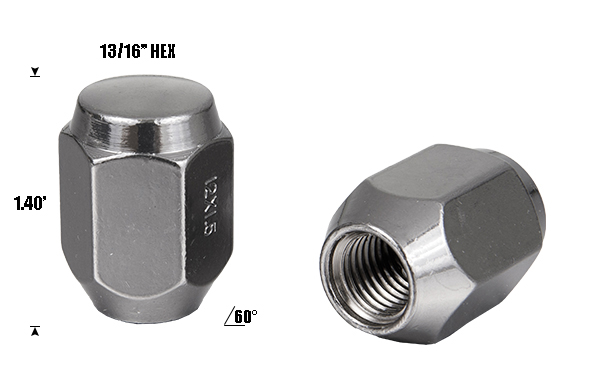
| Conical 60° | Included angle of 60 degrees from the hub face | Ring-shaped contact, full circumference | ~600 MPa | BMW, Mercedes, GM, Ford, Honda, Toyota, Hyundai/Kia, most aftermarket wheels |
| Ball seat R12 | Spherical radius of 12 mm | Curved contact patch, full circumference | ~560 MPa | VW (older models), Skoda, some SEAT |
| Ball seat R14 | Spherical radius of 14 mm | Curved contact patch, full circumference | ~540 MPa | VW (current models), Audi, Porsche, some Mercedes |
| Flat seat | Parallel surfaces, 0 degrees | Full annular face, edge-loaded | ~450 MPa (edge), 200 MPa (center) | Classic British cars, some kei cars, trailer wheels |
The peak Hertzian stress numbers are typical values for a M14 conical, M14 R12 ball, M14 R14 ball, and M16 flat seat lug nut at 100 kN clamping preload. They show that ball seat spreads the load slightly more than conical (a few percent lower peak stress), and flat seat has the lowest peak stress but the worst torque retention under vibration.

3. Contact Stress Distribution: Hertzian Contact Theory at the Hub Interface
The contact stress at the lug nut-wheel interface is a Hertzian contact problem. Two curved surfaces pressed together by a normal force produce a contact patch whose size depends on the curvature of both surfaces, the elastic moduli of both materials, and the magnitude of the clamping force. For a steel lug nut in an aluminum wheel pocket, the contact patch is small (a fraction of a square millimeter) and the peak stress is high (hundreds of MPa).
The Hertzian calculation gives a theoretical peak, but the real interface has surface roughness, micro-yield, and wear. Over the first few torque cycles, the contact patch grows as the surfaces conform. The peak stress drops to a few hundred MPa in steady state. What matters for the buyer is the relative comparison: ball seat spreads the load slightly more than conical, flat seat spreads it most, but the flat seat’s geometry allows the lug nut to shift axially under vibration (which is why flat seat has the worst torque retention).
4. Torque Retention Over Time: Vibration, Thermal Cycling, and Embedding
Three mechanisms degrade wheel fastener torque over time. Each one interacts with the seat type differently.
Vibration loosening. The wheel sees continuous vibration from the road surface and from brake torque variation. The vibration applies alternating lateral and axial forces to the lug nut. The friction at the lug nut-wheel seat interface resists the loosening motion. A matched seat has high friction (steel on aluminum with a conical or ball contact has a friction coefficient around 0.15 to 0.20). A mismatched seat has lower friction because the contact area is smaller and the surfaces can slip past each other. In standardized Junker vibration testing (per DIN 65151), a matched conical seat retains 92 to 95% of installed torque after 100k cycles; a matched ball seat retains 90 to 93%; a matched flat seat retains 85 to 88%; a mismatched seat drops to 60 to 70%.
Thermal cycling. The brake system heats the hub to 100 to 300 degrees C during normal driving, then cools to ambient during a stop. The thermal expansion of the steel lug nut and the aluminum wheel pocket are different (steel: 12 ppm/K, aluminum: 23 ppm/K). Each heating cycle applies a small differential strain at the lug nut-wheel interface. Over thousands of cycles, the differential strain can walk the lug nut loose if the friction is not sufficient to hold it. A 60-degree conical seat has a self-locking geometry that resists this walk-down; a flat seat does not.
Surface embedding. Under load, the microscopic asperities on the lug nut and wheel pocket deform and embed. The embedding changes the contact geometry and can reduce the clamping force by 5 to 15% over the first 1000 km of driving. This is why wheel installers recommend re-torque after 50 to 100 km. The embedding loss is roughly the same across seat types; it is the friction holding the residual torque that varies.
| Seat type | Matched seat torque retention (after 100k vibration cycles) | Mismatched seat retention | Self-locking geometry? |
|---|---|---|---|
| Conical 60° | 92 to 95% | 60 to 70% | Yes |
| Ball seat R12 | 90 to 93% | 60 to 70% | Yes (limited) |
| Ball seat R14 | 91 to 94% | 62 to 72% | Yes (limited) |
| Flat seat | 85 to 88% | 55 to 65% | No |
5. OEM Match Rules: VW/Audi/BMW/GM/Ford/Honda/Toyota Seat Type Reference
The seat type on the OE wheel is set by the vehicle manufacturer, not the aftermarket. The aftermarket buyer has to know what the car came with before ordering lug nuts. The table below covers the most common OE fitments for 2015 to 2026 model year vehicles in the North American, European, and Asian markets.
| Brand | OE seat type | OE stud / bolt size | Aftermarket notes |
|---|---|---|---|
| BMW (passenger) | Conical 60° | M14 x 1.25 | Conical ACORN or Bulge ACORN lug nuts |
| Mercedes-Benz (passenger) | Conical 60° | M14 x 1.5 | Conical ACORN lug nuts; OE ball seat on some older models |
| Volkswagen (passenger) | Ball seat R14 (current), R13 (older) | M14 x 1.5 | Ball seat lug nuts; conical will not fit correctly |
| Audi (passenger) | Ball seat R14 | M14 x 1.5 | Ball seat lug nuts; conical will not fit correctly |
| Porsche (passenger) | Ball seat R14 (most), conical 60° (older 911) | M14 x 1.5 | Confirm by wheel part number; mismatched seat damages the wheel pocket |
| GM (Chevrolet, GMC, Cadillac) | Conical 60° | M14 x 1.5 (1/2-20 UNF on some trucks) | Conical ACORN lug nuts |
| Ford (passenger) | Conical 60° | M12 x 1.5 or M14 x 1.5 | Conical ACORN lug nuts |
| Honda / Acura | Conical 60° | M12 x 1.5 | Conical ACORN lug nuts |
| Toyota / Lexus | Conical 60° | M12 x 1.5 or M14 x 1.5 | Conical ACORN lug nuts |
| Hyundai / Kia | Conical 60° | M12 x 1.5 | Conical ACORN lug nuts |
| Subaru | Conical 60° | M12 x 1.25 | Conical ACORN lug nuts |
| Nissan / Infiniti | Conical 60° | M12 x 1.25 | Conical ACORN lug nuts |
| Land Rover (older) | Flat seat (some classic models) | 1/2-20 UNF | Flat seat lug nuts; conical will not seat correctly |
| Classic British (MGB, Midget, etc.) | Flat seat | 7/16-20 UNF or M12 x 1.5 | Flat seat lug nuts only |
The table covers the majority of OE fitments on the road today. If the vehicle is not on the list, the OE owner’s manual or the wheel manufacturer’s datasheet will specify the seat type. Never assume — a mismatched seat is the most expensive wheel fastener mistake.
6. The Mismatch Penalty: Why Conical on a Ball-Seat Hub Loses 30% Torque in 6 Months
Putting a conical lug nut in a ball seat pocket (or vice versa) is a common mistake after an aftermarket wheel upgrade. The installer has a box of conical lug nuts from the previous wheel set and uses them on the new ball seat wheels. The lug nuts torque up to spec and seem fine. Six months later, the wheels start to shift under braking.
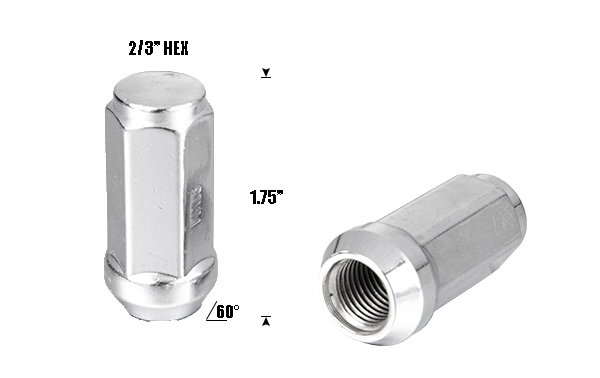
The repair is to replace the mismatched lug nuts with the correct seat type, re-torque to spec, and re-balance the wheels. The cost is the lug nut set plus a balance and alignment. The lesson is to match the seat type to the wheel pocket before the first torque event, not after the first vibration complaint.
7. Decision Matrix + Author Bio + Internal Links
| Wheel pocket seat type | Correct lug nut seat | Common OE brands | Torque target (M14 example) | Fortune catalog match |
|---|---|---|---|---|
| Conical 60° | Conical 60° (ACORN / Bulge ACORN) | BMW, Mercedes, GM, Ford, Honda, Toyota | 120 to 140 N m | ACORN Style |
| Ball seat R12 | Ball seat R12 (ball-seat lug nut) | Older VW, Skoda, SEAT | 120 to 140 N m | Ball seat lug nuts (OEM inquiry) |
| Ball seat R14 | Ball seat R14 (ball-seat lug nut) | Current VW, Audi, Porsche | 120 to 140 N m | Ball seat lug nuts (OEM inquiry) |
| Flat seat | Flat seat (flat washer-style lug nut) | Classic British, some kei cars, trailers | 100 to 120 N m (10-15% lower) | Flat seat lug nuts (OEM inquiry) |
| Aftermarket tuner wheel | Confirm by wheel part number | Most aftermarket catalogs specify conical | Per wheel datasheet | Bulge ACORN Style |
For the most common conical-seat wheel pockets on BMW, Mercedes, GM, Ford, Honda, Toyota, Hyundai, and most aftermarket wheels, the Fortune catalog has the matching acorn style lug nuts with 60-degree conical seat and the extended-reach bulge acorn style lug nuts for tuner wheels that need additional thread engagement. For ball seat (R12 or R14) or flat seat wheel pockets, the catalog matches are available on OEM inquiry. To verify the seat type on a specific wheel or to confirm a lot-size match, contact for seat type verification service through the Fortune contact page and the team will return a seat-gauge measurement, a datasheet cross-reference, and a per-lug pricing inside three business days.
Next step for aftermarket buyers: before ordering lug nuts, measure the wheel pocket seat type with a seat-gauge or a calibrated template (conical 60°, ball seat R12 or R14, or flat seat 0°). Cross-check with the wheel manufacturer’s datasheet. Match the lug nut seat to the wheel pocket — never assume that one lug nut seat fits all aftermarket wheels. Re-torque after 50 to 100 km of driving, store the OE lug nuts as a spare set, and replace the full set of four or five lug nuts at every wheel change.
About the author
Bobby — Manager, Ningbo Fuyichun Import and Export Co., Ltd. (Fortune Wheel Parts). Founded in 1996, Fortune is now one of the leading professional manufacturers of wheel balance weights, tire valves, and tool accessories. The Fortune catalog covers conical seat lug bolts in grades 8.8, 10.9, and 12.9 per ISO 898-1, plus the matching ACORN and Bulge ACORN lug nut families for 60-degree conical seat wheels on passenger cars and light commercial vehicles.
Connect with Fortune: Fortune Wheel Parts on LinkedIn | Fortune Wheel Parts on Facebook | Fortune Wheel Parts on YouTube | Contact Fortune
Frequently Asked Questions
How can I tell if my vehicle uses conical, ball seat, or flat seat wheel fasteners?
Remove one wheel and inspect the seat pocket in the wheel. A 60-degree conical pocket has a V-shape with two flat surfaces at 60 degrees from the hub face. A ball seat pocket has a curved bowl with a radius typically R11 to R14. A flat seat pocket has parallel surfaces perpendicular to the bolt axis. The OE vehicle owner’s manual or the wheel manufacturer’s datasheet will also specify the seat type.
Does ball seat actually distribute stress better than 60-degree conical seat?
On paper, ball seat distributes contact stress over a slightly larger area than a 60-degree conical seat for the same fastener load. In practice, the difference is within measurement noise on most OE wheels. The bigger variable is whether the seat type matches the wheel pocket. A conical lug nut in a ball seat pocket (or vice versa) loses 25 to 40% of its torque retention in vibration testing because the contact is on a narrow ring rather than over the designed surface.
Why does Volkswagen and Audi use ball seat while BMW uses conical?
Volkswagen and Audi adopted ball seat R13/R14 in the late 1990s to give a small self-centering action on the wheel during installation. The ball seat allows the wheel to settle into the pocket with a slight rotation, which helps with concentric mounting on the hub. BMW uses conical 60-degree because the BMW wheel design has a tighter pocket tolerance and the conical seat provides a more positive axial locating surface. Both seat types work when matched correctly; the issue is mismatching.
Can I replace conical lug nuts with ball seat on the same vehicle?
No. The seat type is dictated by the wheel pocket, not by the vehicle. If the wheel is designed for a 60-degree conical pocket, a ball seat lug nut will only contact on a narrow ring and the torque retention will drop significantly. If the wheel is designed for a ball seat pocket, a conical lug nut will sit on the rim of the pocket and the clamping force will be uneven. Always match the lug nut seat to the wheel pocket.
Does seat type affect the torque value I should use?
Seat type changes the torque target because the friction interface is different. Conical and ball seat typically use the same torque value for the same wheel size and bolt grade. Flat seat typically uses a 10 to 15% lower torque value because the larger contact area gives more friction and the same torque produces a higher preload. Check the wheel manufacturer’s datasheet for the exact value.
Post time: Aug-11-2026