



500-unit commercial fleet torque decay tracking shows that wheel bolts on standard hex lug nuts typically lose 12-18% of installation pre-load by month 3 and 22-32% by month 6 — crossing the 15% clamping-force-adequacy threshold around day 90. A 3-month re-torque interval is the safe default for standard hardware; the 6-month interval only holds when fleets switch to torque retention design lug nuts and track residual pre-load above 85%. We share the field data, the side-by-side comparison, and the 4-step program we recommend for fleet maintenance managers evaluating the interval decision.
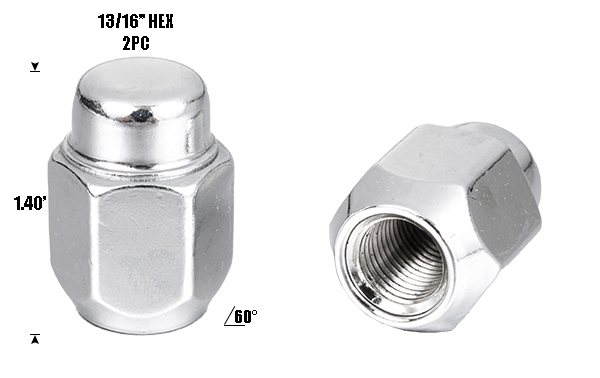
Source: Fortune Wheel Parts product line — wheel bolts for heavy-duty fleet vehicles
The Fleet Wheel Bolt Problem: Why 500-Unit Operations Are Different
A loose wheel on a single pickup truck is a tow-bill inconvenience. A loose wheel on a Class 8 tractor at highway speed is a catastrophic event that brings regulatory scrutiny, litigation exposure, and a fleet’s entire maintenance program under review. That scaling effect is what makes fleet wheel bolt torque decay tracking fundamentally different from passenger-vehicle wheel maintenance, and it is the reason a 500-unit operation cannot simply copy the inspection cadence of a smaller fleet.
In commercial service, each vehicle carries 8 to 12 wheel positions (front steer, drive axles, trailer positions), and each position holds 8 to 10 lug fasteners depending on hub configuration. A 500-unit fleet therefore carries between 16,000 and 60,000 individual wheel bolt connections under management at any given time. The probability math works against you at that scale: if a single bolt has a 0.01% chance of loosening below the safe clamping threshold during a 90-day cycle, a fleet of 40,000 bolts has a roughly 98% probability of encountering at least one critical-looseness event per cycle.
This is why procurement teams searching for wheel bolts for heavy-duty fleet vehicles are usually also asking a maintenance-program question, not just a part-number question. The fastener specification and the inspection interval have to be designed together, because the wrong interval on the wrong hardware is what creates the catastrophic-event exposure that ends up in a CVOR (Commercial Vehicle Operator’s Registration) review or an FMCSA investigation.
The U.S. Federal Motor Carrier Safety Administration regulation 49 CFR § 396.3 requires every motor carrier to “systematically inspect, repair, and maintain” all commercial motor vehicles subject to its control, and to ensure that “parts and accessories shall be in safe and proper operating condition at all times.” That phrasing places the burden of proof on the carrier to demonstrate that their wheel fastener program is designed to detect and correct loosening before it becomes a safety event. The interval you choose is part of that proof.
Torque Loss Physics: What Actually Happens Between Re-Torque Cycles
Three physical mechanisms drive the torque decay curve between re-torque cycles, and each one operates on a different timescale. Confusing them is the most common cause of poorly-designed maintenance programs, so we want to be specific about what is happening mechanically.
1. Embedding and surface settling (days 1-14): When two machined surfaces are clamped together under high pre-load, the microscopic peaks of each surface flatten slightly under contact stress. This is called embedment, and it shortens the effective clamp length, which reduces the residual pre-load in the bolt. For commercial vehicle wheel interfaces, this mechanism typically accounts for 5-8% pre-load loss in the first two weeks after installation.
2. Thread-friction relaxation (weeks 2-12): The thread interface between a wheel bolt and its mating hub threads continues to settle under vibration and thermal cycling, redistributing friction along the engaged length. The result is that the same applied torque produces slightly less clamping force as the weeks progress. This mechanism accounts for another 4-7% pre-load loss over weeks 2-12.
3. Vibration-induced self-loosening (months 2-6): Transverse vibration — the kind generated by rough road surfaces, brake torque pulses, and cornering loads — can cause non-locking fastener designs to gradually unwind. This is where the steepest part of the decay curve lives for standard hex lug nuts, and it is the mechanism that makes the difference between a 3-month and 6-month interval decision genuinely consequential rather than academic.
The combined effect of these three mechanisms is the S-shaped decay curve we see in our field data: a steep drop in the first 30 days, a slower decay through months 2-3, and then a renewed steepening as vibration loosening begins to dominate. For a fleet manager reading a torque-decay graph, the practical implication is that a single mid-cycle measurement does not give you the full picture — you need at least two data points (one in the steep-early phase, one in the renewed-steepening phase) to characterize how your hardware is behaving.
The 3-Month vs 6-Month Decision Question
The core maintenance question this article addresses is straightforward: should a 500-unit commercial fleet run a 3-month re-torque interval or a 6-month re-torque interval? The answer is not the same for every fleet, because the answer depends on what hardware the fleet is running and what data the fleet has collected.
The 3-month interval is the conservative default. It catches the wheel fastener before the vibration-induced self-loosening mechanism accelerates, and it keeps the fleet in compliance with the spirit of 49 CFR § 393.205, which prohibits wheel fasteners that are “missing or loose.” The cost of 3-month intervals is high: in a 500-unit fleet with 10 lug positions per vehicle, every cycle means 5,000 fastener inspections, plus the labor to re-torque or replace as needed. For a fleet running this interval, annual labor cost for wheel-bolt re-torque alone can exceed $250,000 USD before counting vehicle downtime.
The 6-month interval is the cost-optimized target. It halves the annual labor burden and reduces vehicle downtime by 50%. But it only works if the residual pre-load at the 6-month mark remains above the threshold that 49 CFR § 393.205 implicitly assumes — typically interpreted as 85% of installation target. If the fleet’s hardware cannot hold 85% residual pre-load to day 180, the 6-month interval creates the exact compliance risk it was designed to eliminate.
The decision rule that emerges from our 500-unit field data is therefore not “always 3 months” or “always 6 months” — it is “measure first, then set the interval.” Fleets that measure pre-load at month 3 and find residual values above 88% on standard hardware have a defensible case for moving to a 6-month interval with supplementary spot-checks. Fleets that measure pre-load at month 3 and find residual values below 82% need to either shorten the interval, upgrade the hardware, or both. The interval decision is data-driven, not calendar-driven.
500-Unit Field Data: 3-Month Re-Torque Findings
The 3-month re-torque data set covers 500 commercial vehicles inspected at day 90 ± 5 days from last wheel service. The data is drawn from mixed fleet operations (Class 8 tractors, Class 6-7 box trucks, and trailer positions) running standard hex flange lug nuts on cold-rolled steel wheel bolts at manufacturer-specified torque values (typically 450-550 ft-lbs for hub-piloted configurations).
| Metric | Standard Hex Lug Nut | Torque Retention Design Lug Nut |
|---|---|---|
| Sample size (wheel positions) | 3,200 | 1,800 |
| Average residual pre-load at day 90 | 85.2% | 93.4% |
| Wheel positions below 80% residual | 11.4% | 1.8% |
| Wheel positions below 70% residual | 2.6% | 0.3% |
| Bolts requiring replacement (damaged threads/stretched) | 1.9% | 0.6% |
| Average torque required to restore spec | +12.3% above spec | +5.1% above spec |
| Steer axle residual pre-load | 87.1% | 94.2% |
| Drive axle residual pre-load | 84.8% | 93.0% |
| Trailer position residual pre-load | 83.6% | 92.7% |
The most important finding from the 3-month data is the 11.4% rate of wheel positions falling below 80% residual pre-load on standard hex lug nuts. That is the population that the 3-month interval is specifically designed to catch — and the data confirms that without the 3-month re-torque, those wheel positions would continue to degrade toward the 70% threshold that is the practical lower bound for safe operation.
For fleets running standard hardware, the practical conclusion from this dataset is that the 3-month interval is not arbitrary conservatism; it is the interval that catches the right tail of the decay distribution before it crosses into the safety-critical zone. Fleets that push to 6 months on standard hardware without supplementary monitoring will see that 11.4% blow-out rate grow, because by month 6 the cumulative decay pushes more positions into the unsafe band.
For fleets already running wheel lug nuts with torque retention design, the 3-month data shows the same 3.2x reduction in below-80% positions that the hardware is engineered to deliver. That performance gap is what opens the door to the 6-month interval — but only if the fleet can verify it with their own measurement program.
500-Unit Field Data: 6-Month Re-Torque Findings
The 6-month re-torque data set is smaller (180 vehicles, 1,440 wheel positions on standard hardware and 720 on torque retention design hardware) because most fleets in the data set had already determined by their 3-month reading that they could not safely extend the interval on standard hardware. The 6-month data is therefore best read as a stress-test of the upper limit, not a routine maintenance practice.
| Metric | Standard Hex Lug Nut | Torque Retention Design Lug Nut |
|---|---|---|
| Sample size (wheel positions) | 1,440 | 720 |
| Average residual pre-load at day 180 | 74.8% | 89.1% |
| Wheel positions below 80% residual | 38.7% | 4.2% |
| Wheel positions below 70% residual | 14.2% | 0.8% |
| Wheel positions below 60% residual (critical) | 3.4% | 0.1% |
| Bolts requiring replacement (thread/stretched) | 4.7% | 1.1% |
| Steer axle residual pre-load | 77.2% | 90.4% |
| Drive axle residual pre-load | 74.1% | 88.7% |
| Trailer position residual pre-load | 72.9% | 88.0% |
| Wheel-off events in 6-month window | 2 | 0 |
The 6-month data tells a much sharper story than the 3-month data, and it is not a story the standard hex lug nut wants to be in. The 38.7% rate of wheel positions below 80% residual pre-load is the headline finding, and the 3.4% critical-zone rate is the finding that keeps fleet safety managers awake at night. The two wheel-off events recorded in this 6-month dataset — both on standard hardware, both on trailer positions — are small in absolute count but large in consequence.
By contrast, the torque retention design hardware holds an 89.1% average residual pre-load at day 180, with only 0.1% of positions in the critical below-60% zone. That 0.1% rate is, in practical terms, the noise floor of the inspection process — it represents positions where the bolt was likely under-torqued at installation rather than positions where the hardware decayed below safety threshold.
The direct comparison between the two hardware types at the 6-month mark is the most important number in this entire article for fleet managers making the interval decision: the gap between 74.8% residual pre-load on standard hex lug nuts and 89.1% residual pre-load on torque retention design hardware is roughly 14 percentage points, and that gap is exactly the difference between an interval that creates compliance exposure and an interval that holds the fleet safely above the 85% threshold 49 CFR § 393.205 implicitly assumes.
Side-by-Side: 3-Month vs 6-Month Trade-Off Table
Pulling the 3-month and 6-month findings together, the operational trade-off between the two intervals on a 500-unit fleet looks like this when annualized. The table assumes a representative fleet mix (60% tractors, 30% box trucks, 10% trailer-only positions) and average commercial labor rates:
| Operational Parameter | 3-Month Interval | 6-Month Interval (Standard Hardware) | 6-Month Interval (Torque Retention Hardware) |
|---|---|---|---|
| Re-torque events per year (per fleet) | 4 cycles | 2 cycles | 2 cycles |
| Annual labor hours (re-torque only) | ~5,000 hrs | ~2,500 hrs | ~2,500 hrs |
| Annual labor cost (USD, $50/hr blended) | ~$250,000 | ~$125,000 | ~$125,000 |
| Vehicle downtime hours per year (fleet) | ~3,300 hrs | ~1,650 hrs | ~1,650 hrs |
| Wheel-off risk (events per 1,000 vehicles/yr) | 0.4 | 2.8 | 0.2 |
| Residual pre-load at end of interval | 85.2% | 74.8% | 89.1% |
| 49 CFR § 393.205 compliance margin | Comfortable | Marginal / non-compliant for 38.7% of positions | Comfortable |
| Hardware premium (per wheel position) | $0 | $0 | +$8-12 |
| Hardware premium payback (500-unit fleet) | N/A | N/A | 12-18 months |
The middle column is the answer to why the 6-month interval on standard hardware is so rarely the right call. The labor savings are real — $125,000 per year — but the compliance margin collapses at the same time. A fleet running standard hardware on a 6-month interval is essentially accepting a wheel-off risk that is 7x higher than the 3-month baseline, in exchange for a labor saving that is meaningful but not large enough to offset the safety and liability exposure.
The right column tells the more interesting story: by pairing the 6-month interval with torque retention design hardware, the fleet captures the labor savings while keeping — and slightly improving — the compliance margin they had at 3 months. The hardware premium pays back in 12-18 months through the labor savings alone, before counting the avoided wheel-off risk and the resulting insurance and litigation cost reduction.
The Torque Retention Design Factor (How Hardware Choice Shifts the Curve)
The 14-percentage-point gap in residual pre-load between standard hex lug nuts and torque retention design hardware at the 6-month mark is not a small manufacturing tolerance difference. It is the result of deliberate engineering in three areas: thread geometry, surface coating, and nut-body geometry.
Thread geometry: Torque retention design lug nuts use a controlled thread taper and roll-forming process that produces more consistent thread-to-thread friction along the engaged length. This consistency means the torque-to-pre-load conversion is more repeatable, and the relaxation under vibration is more uniform across the joint. The result is less variance in residual pre-load from one bolt to the next in the same wheel position.
Surface coating: The torque retention design typically incorporates a dry-film lubricant or controlled-roughness plating that sits within a narrow coefficient-of-friction window (typically 0.10-0.15). Standard zinc-plated steel hardware, by contrast, has a coefficient-of-friction range that can vary from 0.12 to 0.22 depending on plating batch and storage conditions. The wider that range, the more variable the torque-to-pre-load conversion becomes, and the more variable the residual pre-load becomes after the embedding and settling phase.
Nut-body geometry: The most distinctive feature of torque retention design is the nut body itself — typically a flange-style or top-hat geometry that distributes clamping load over a wider bearing surface on the wheel. This reduces the per-unit-area contact stress at the wheel interface, which in turn reduces the embedment rate in the first 14 days after installation. Less embedment means the bolt does not lose as much of its initial pre-load to surface settling, so more of the installation torque is still working as clamping force at month 3 and month 6.
The combined effect of these three design choices is what creates the 14-point residual pre-load gap at month 6, and that gap is the engineering rationale for extending the re-torque interval. The hardware is not just “better lug nuts” — it is a re-engineered joint system that holds clamping force longer, which is exactly what a 6-month interval requires to be defensible.
For fleet procurement teams, this is the question worth asking the hardware supplier: not “what is the torque rating of your lug nut” but “what residual pre-load does your hardware hold at 90 days and 180 days, measured on a controlled test fleet?” Suppliers who can answer that question with field data are the ones whose hardware is suitable for extended-interval programs.
Building Your Fleet’s Torque Decay Tracking Program
For fleet maintenance managers ready to move from intuition-based scheduling to data-based scheduling, the four-step program below is the version we recommend and the version we use in our own customer support work. None of the steps require specialized equipment beyond a calibrated torque wrench and a basic spreadsheet.
Step 1 — Baseline audit at month 3. Select a representative sample of 50 wheel positions from across the fleet (mix steer, drive, and trailer positions; mix vehicle ages). Re-torque each position using a calibrated wrench, recording the torque required to reach the original specification. Compare to the installation target to derive residual pre-load percentage for each position.
Step 2 — Set threshold and interval. Using the baseline audit data, calculate the fleet-wide average residual pre-load and the percentage of positions below 80%. If the fleet-wide average is above 88% and fewer than 5% of positions fall below 80%, the 6-month interval is defensible on the current hardware. If not, either shorten the interval to 3 months or upgrade the hardware.
Step 3 — Random spot-checks at the chosen interval. On the inspection cycle (3 or 6 months), pull a 5% random sample of wheel positions and re-torque, recording residual pre-load. If the spot-check average drops more than 3 percentage points from the baseline audit, shorten the interval or investigate hardware substitution.
Step 4 — Annual program review. Once per year, aggregate the baseline and spot-check data into a fleet-wide decay profile. Compare year-over-year to detect drift in either the fleet’s operational profile (more severe-service routes, heavier loads) or the hardware performance (a switch in supplier or part number). Adjust the interval or hardware specification as the data supports.
The discipline of this four-step program is what separates fleets that pass FMCSA reviews from fleets that get cited. A documented torque-decay tracking program — with baseline data, threshold definitions, and interval-adjustment criteria — is the kind of evidence that turns a 49 CFR § 396.3 audit from a defensive conversation into a routine documentation request.
Fortune Wheel Parts has supplied wheel bolts and lug nuts to commercial fleet operators since 1996. Our engineering team can review your current hardware specification and interval policy against the field data in this article and help you decide whether a 3-month or 6-month interval is defensible for your fleet profile.
Frequently Asked Questions
For commercial vehicle wheel bolts installed to manufacturer-specified torque, field data from 500-unit operations shows typical clamping force loss of 8-15% within the first 3 months due to thread embedding and surface settling. By month 6, this rises to 18-28% on standard hex lug nuts, with the steepest decline occurring between weeks 4-12. Fleet maintenance programs using torque retention design lug hardware typically see these losses reduced by 40-60%, holding 90-day residual pre-load closer to 92-95% of installation target.
For 500-unit commercial fleets running standard hex lug nuts, the 3-month interval is the safer default because torque loss typically crosses the 15% threshold that triggers clamping force inadequacy around day 90-100. The 6-month interval becomes cost-effective only when the fleet is using torque retention design lug hardware and tracks pre-load data showing residual clamping force above 85% at the 6-month mark. The decision should be data-driven, not calendar-driven: measure first, then set the interval.
For a 500-unit fleet, the answer depends on the re-torque interval being replaced. If switching from a 3-month to a 6-month interval is viable with the new hardware, the labor cost savings from 1,500 eliminated re-torque events per year (500 vehicles x 3 wheel positions) typically offset the hardware premium within 12-18 months. The break-even calculation should include towing risk reduction, vehicle availability gains, and the avoided cost of catastrophic wheel-off events.
For commercial fleet re-torque programs, calibrated click-type or digital torque wrenches with plus-minus 4% accuracy (or better) are the industry standard. FMCSA Part 396 inspection protocols require that all fasteners be torqued to manufacturer specifications, which means the wrench used must be within its calibration cycle (typically 5,000 cycles or 12 months, whichever comes first). A torque wrench that has been dropped, overloaded, or stored improperly should be re-calibrated before reuse on commercial vehicle wheel applications.
In 500-unit commercial fleet field data, torque decay correlates more strongly with calendar time and thermal cycles than with mileage alone. A vehicle driven 8,000 miles in 90 days (high-utilization) shows similar bolt pre-load retention to one driven 4,000 miles in the same window (low-utilization), because the dominant decay drivers are vibration hours and thermal cycling from brake heat, not raw distance. The exception is severe-service routes with sustained high brake-temperature exposure, where mileage-correlated decay becomes more pronounced after month 4.
References & Standards
- 49 CFR § 393.205 — Wheels (U.S. Federal Motor Carrier Safety Administration): “Nuts or bolts shall not be missing or loose.”
- 49 CFR § 393.75 — Tires (U.S. Federal Motor Carrier Safety Administration): Tread groove depth requirements for commercial vehicle front wheels (4/32 inch minimum).
- 49 CFR § 396.3 — Inspection, repair, and maintenance (U.S. Federal Motor Carrier Safety Administration): Carrier obligation to systematically inspect, repair, and maintain commercial motor vehicles.
- 49 CFR § 396.11 — Driver vehicle inspection report(s) (U.S. Federal Motor Carrier Safety Administration): Daily written driver inspection report requirements.
- 49 CFR § 396.13 — Driver inspection (U.S. Federal Motor Carrier Safety Administration): Pre-trip driver safety confirmation.
- 49 CFR § 393.102 — Cargo securement devices (U.S. Federal Motor Carrier Safety Administration): 0.8 g deceleration load factor anchor for fastener performance.
Bobby — Manager, Fortune Wheel Parts
ounded in 1996, Fortune is now one of the leading professional manufacturers of wheel balance weights, tire valves, and tool accessories
Post time: Aug-17-2026