



- Brake heat loosens lug bolts on commercial vehicles through three mechanisms acting together: differential thermal expansion, coating degradation, and conical seat creep.
- Specify forged 10.9 grade lug bolts as the procurement baseline for class 6-8 commercial vehicles, with a double-coated finish for winter road-salt service.
- Mandate a re-torque after the first 50-100 miles following every wheel install, then at every tire rotation interval, and document every event in a digital log.
- Use a calibrated five-stud star pattern in two passes (50% then 100% of final torque) to prevent the off-center seating that causes conical seat wear.
- Tie the wheel torque log to the FMCSA DVIR workflow so the regulator’s record and the operator’s evidence are aligned from day one.
Fleet wheel safety is one of those topics that lives quietly in the maintenance shop until the day it does not. A wheel-off incident on a commercial vehicle is not just a maintenance failure. It is a single point of failure that ends in roadside injury, a regulatory out-of-service order, a CSL (Compliance, Safety, Accountability) score impact, and a liability file that the fleet operator will be unpacking for the next three to five years. The fastener that failed was almost always a lug bolt that started the day in spec and ended the day loose, and the path from in spec to loose is one that every fleet safety manager can close with the right specification, the right tool, and the right documentation.
I have spent more than a decade inside the wheel parts industry and watched the same failure pattern repeat across fleets that buy on price and fleets that buy on specification. The price-buying fleets tend to run zinc-plated 8.8 grade bolts with a paper torque ticket, and they are the fleets that show up in the post-incident docket. The specification-buying fleets run forged 10.9 grade conical seat lug bolts double coated, a calibrated digital torque tool, a star-pattern procedure, and a digital re-torque log, and they are the fleets that close the file without an admission of fault. This article is a walk-through of the specification, the procedure, and the documentation that close the gap.
Why Brake Heat Loosens Lug Bolts on Commercial Vehicles
Most fleet managers who contact us about wheel safety already understand the headline that brake heat is the leading cause of lug bolt loosening on commercial vehicles. What they do not always understand is that brake heat is the trigger, not the cause. The actual loosening is driven by three mechanisms acting on the bolt, the wheel, and the seat interface at the same time, and all three have to be managed for a fleet safety program to actually prevent the failure mode rather than just delay it.
The first mechanism is differential thermal expansion. A steel lug bolt and an aluminum wheel hub do not expand at the same rate under brake heat, and the difference in expansion coefficient is enough to produce a measurable change in clamp load across a single downhill braking event. The bolt tries to stay the same length, the hub tries to grow, and the preload that was set at install drops by a few percent every time the brakes run hot.
The second mechanism is coating degradation. A single-layer zinc or chrome coating starts to lose its thickness at temperatures that are routine for a commercial truck running a loaded grade. Once the coating thins, the underlying steel bolt begins to interact with the wheel material directly, and the friction coefficient at the thread interface drops. Lower friction at the thread means less of the applied torque is converted into clamp load, and the bolt appears to “loosen” even though the applied torque is unchanged.
The third mechanism is conical seat creep. The conical seat at the wheel end of the bolt is the centering surface, and a small amount of micro-creep at this interface is normal on a new install. Under repeated brake heating, the micro-creep accumulates, and after a few hundred thermal cycles the wheel sits a fraction of a millimeter off-center. That off-center position is enough to change the load distribution across the bolt circle, and the bolts that pick up the extra load run hotter than the bolts that pick up less. From that point the failure mode accelerates.
What Lug Bolt Grade a Commercial Fleet Should Specify
The grade question is the easiest one to answer, and it is also the one that is most often answered wrong. For class 6-8 commercial vehicles (the gross vehicle weight rating bracket that covers most over-the-road tractors, day cabs, straight trucks, and refuse vehicles), the minimum spec is forged 10.9 grade. There is no defensible technical reason to run 8.8 grade on a steer or drive axle of a class 7 or 8 truck, and the small per-bolt savings are not worth the line on the post-incident docket.
10.9 grade is a metric property class identified by the radial markings on the bolt head. The mechanical properties are: nominal tensile strength of 1040 MPa, yield strength of 940 MPa, and elongation at break of 9 percent minimum. The corresponding imperial grade in the SAE J429 system is grade 8, and the two systems are not interchangeable on a one-to-one basis, so a fleet that buys both metric and imperial bolts needs to be careful about which spec they are sourcing. Per the ISO 898-1 standard that defines the metric property class, the head marking on a 10.9 bolt is a 10.9 stamp or equivalent marking, and that marking is what the receiving inspector should be checking on every shipment.
| Property Class | Tensile Strength | Yield Strength | Typical Use |
|---|---|---|---|
| 8.8 | 800 MPa | 640 MPa | Light commercial, trailer non-steer axles |
| 10.9 | 1040 MPa | 940 MPa | Class 6-8 commercial steer and drive axles (minimum) |
| 12.9 | 1220 MPa | 1100 MPa | Severe service, racing, vocational specialty |
Beyond the grade, the finish matters. A conical seat lug bolt forged 10.9 grade double coated gives the fleet two layers of protection in winter road-salt conditions. The first zinc-rich base coat is a sacrificial layer that protects the underlying steel even if the top coat is damaged. The top coat provides chemical and abrasion resistance and slows the white-corrosion creep that single-coated bolts show after one or two winters. For fleets operating in the snow belt, the double-coated spec is the right call, and the cost difference per bolt is small relative to the labor cost of a wheel-off response.
Re-Torque Procedures That Actually Prevent Wheel-Offs
The re-torque procedure is the single most important line item in a fleet wheel safety program, and it is the one that is most often skipped because it adds an hour to the workflow that the dispatcher does not want to absorb. The reason the re-torque matters is simple: the install torque is a snapshot of the clamp load at the moment of install, and the re-torque is the only data point that proves the wheel was still in spec at the start of the duty cycle. Without a re-torque record, the fleet has no defensible position if a wheel comes loose later in the cycle.
Per the recommended practices from the Tire Maintenance Council, the re-torque should be performed after the first 50-100 miles of service following a wheel install. The 50-100 mile window is when most of the brake-heat-driven and seating-driven preload loss has already happened, and a re-torque at this point is the equivalent of a mid-cycle reset. After the first re-torque, the next event is at the tire rotation interval, typically 6,000-10,000 miles for a commercial steer tire, and the rotation event is also a natural place to re-torque because the wheel is already off the hub.
For severe-service fleets (refuse, transit bus, vocational, off-road), the re-torque interval should be halved. These fleets see two to three times the brake-event cycle count of an over-the-road tractor, and the seat-creep and coating-degradation mechanisms that drive lug bolt loosening accumulate proportionally faster.
Star-Pattern Torque Procedure for Five-Stud and Ten-Stud Wheels
The star-pattern procedure is the standard across the commercial wheel industry, and the reason is that a sequential pattern (tightening bolts 1-2-3-4-5 in order) will pull the wheel off-center. A star pattern tightens opposing bolts in sequence, which keeps the wheel centered on the hub as the clamp load builds. For a five-stud wheel, the star pattern is 1-3-5-2-4. For a ten-stud wheel, the pattern is 1-6-3-8-5-10-2-7-4-9.
The two-pass procedure is what actually seats the wheel. The first pass is at 50% of the final torque value, which is enough to seat the wheel against the hub face without the off-center pull that a high-torque first pass would create. The second pass is at the published final torque value, and the second pass is also where the star pattern matters most because the wheel is now in contact with the hub face and any off-center pull will translate directly into conical seat wear.
| Step | Action | Torque | Pattern |
|---|---|---|---|
| 1 | Hand-thread all bolts | Snug | Sequential |
| 2 | First pass | 50% of final | Star (1-3-5-2-4) |
| 3 | Second pass | 100% of final | Star (1-3-5-2-4) |
| 4 | Mark torque tool reading | Final | Sequential verification |
| 5 | Record in digital log | Final | Timestamp + tech ID |
The single most common procedure error in commercial shops is skipping the first 50% pass and going straight to the published torque. The 50% pass exists because the wheel needs to be centered before the full clamp load is applied, and skipping it is the mechanical equivalent of seating a cylinder head without the torque sequence. The shop will get a torque value, but the wheel will be off-center, and the off-center condition will drive seat wear across the next 1,000-2,000 miles of service.
Documentation: The Single Most Valuable Liability Defense
After a wheel-off incident, the first thing the regulatory and insurance review asks for is documentation. The fleet that has a digital, queryable torque log wins the file. The fleet that has a paper shop ticket loses the file. The reason is not that paper is illegal; the reason is that paper is not auditable at the resolution that a wheel-off review needs.
A complete wheel safety documentation file should include: the install date and time, the technician ID, the torque tool serial number and the most recent calibration date, the torque value applied to each wheel position, the lug bolt batch and grade, the re-torque readings at the first service interval and at every tire rotation since install, the most recent brake and wheel-seal inspection record, and the FMCSA Driver Vehicle Inspection Report (DVIR) covering the affected axle. Per the FMCSA Part 396 inspection recordkeeping requirements, the DVIR is the regulator’s primary record, and a fleet that can produce a matching torque log for the same axle is in a materially stronger position than a fleet that cannot.
The practical implementation is a digital log that ties the torque readings to the VIN, the wheel position, the timestamp, and the technician. The log should be queryable by axle, by date range, and by technician, and it should be backed up off-site. A paper shop ticket does not satisfy any of these requirements, and the cost of building the digital log is small relative to the cost of a single wheel-off incident.
Common Failure Modes and What They Tell You
When a wheel does come loose, the failure mode carries information that the fleet safety manager should capture. The four most common failure modes, in order of frequency, each point at a different root cause and each calls for a different corrective action.
- Multiple loose bolts on the same wheel, no thread damage. The install torque was below spec, or the re-torque was skipped. The corrective action is a procedure review and a torque tool calibration check.
- One or two loose bolts, conical seat wear visible. The wheel was running off-center, and the worn seat allowed the bolt to lose preload under thermal cycling. The corrective action is to replace the wheel, replace all five bolts, and review the install procedure for a missing 50% first pass.
- Snapped bolt head, threads intact in the hub. The bolt grade was below spec, the torque was over-applied, or both. The corrective action is a procurement review and a torque tool audit, because this failure mode is the one that almost always lands in court.
- Stripped threads in the hub. The hub was over-torqued, the bolt threads were damaged at install, or the hub was previously repaired with a thread insert that has now failed. The corrective action is a hub inspection and replacement, plus a review of the install crew training.
Each of these failure modes is preventable with the right combination of specification, procedure, and documentation. The fleet that gets all three right is the fleet that does not show up in the post-incident docket.
Choosing the Right Lug Bolt for the Application
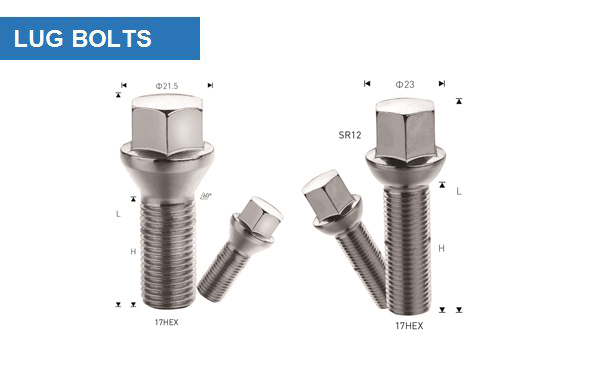
The Fortune wheel lug nuts and bolts product catalog covers the six most common commercial wheel configurations. The conical seat lug bolt is the right pick for aluminum and steel wheels with a conical mounting seat (the most common configuration for class 6-8 trucks). The acorn style nut is the right pick for passenger car and light truck applications. The bulge acorn and dualie acorn are for higher-torque and dual-wheel rear axle applications. The mg-attached washer style is for steel wheels with a flat mounting face. The open-end style is for applications where the stud extends through the nut and a closed-end nut is impractical.
For a commercial fleet operating class 6-8 vehicles in mixed climate, the right spec is a forged 10.9 grade conical seat lug bolt with a double-coated finish, sourced from a manufacturer that publishes the head-marking compliance per ISO 898-1 and that documents the lot traceability for every shipment. The Fortune product line meets all three requirements, and the lot traceability is what gives the fleet a defensible record in the post-incident review.
FAQ: Fleet Wheel Safety and Lug Bolt Loosening
- Why does brake heat cause lug bolts to loosen on commercial vehicles?
- Brake heat causes lug bolts to loosen through three mechanisms acting together: differential thermal expansion between the steel bolt and the aluminum or steel wheel hub, loss of preload from thread-locking compound or coating degradation at elevated temperature, and gasket creep at the conical seat interface. On a heavy commercial vehicle running repeated brake-event cycles, the cumulative effect is measurable bolt elongation and a steady drop in clamp load, which is why every reputable fleet safety program mandates a re-torque interval after the first 50-100 miles of service.
- What lug bolt grade should a commercial fleet use?
- For class 6-8 commercial vehicles, forged 10.9 grade lug bolts are the industry-standard minimum. 10.9 grade is a metric property class with a nominal tensile strength of 1040 MPa and a yield strength of 940 MPa, identified by the radial markings on the bolt head per ISO 898-1 and SAE J429. Lower-grade 8.8 bolts (800 MPa tensile, 640 MPa yield) are acceptable for light commercial vehicles but should not be used on a steer or drive axle of a class 7 or 8 truck.
- How often should fleet lug bolts be re-torqued?
- The TMC (Tire Maintenance Council) recommended practice for commercial fleets is to re-torque lug bolts after the first 50-100 miles of service following a wheel install, then at every tire rotation interval (typically 6,000-10,000 miles). For severe-service fleets, including refuse, transit bus, and vocational fleets with high brake-event cycles, the re-torque interval should be halved. A documented re-torque record is also the single most important piece of evidence in a post-incident liability review.
- Does the conical seat finish on a lug bolt matter?
- Yes. The conical seat finish on a forged lug bolt is the primary centering surface between the bolt and the wheel, and a damaged or worn conical seat will cause the wheel to sit off-center even when the torque is correct. Fortune’s conical seat lug bolts are forged first and then double-coated for corrosion resistance, which preserves the seat geometry better than a coated-only or case-hardened-only alternative. On a fleet operation, replacing a lug bolt because of a worn seat is far cheaper than replacing a wheel that has been running off-center.
- What documentation does a fleet need after a wheel-off incident?
- After a wheel-off incident, the regulatory record that a commercial fleet is expected to produce includes: the wheel install date and technician ID, the torque value and tool calibration record, the re-torque log for the affected wheel position, the lug bolt batch and grade, the most recent brake and wheel-seal inspection, and the FMCSA driver vehicle inspection report (DVIR) covering the affected axle. Fleets that maintain this record digitally with timestamped torque readings are in a materially stronger liability position than fleets that rely on a paper shop ticket.
- Are double-coated lug bolts worth the cost over zinc-plated bolts?
- For most commercial fleets, yes. A double-coated lug bolt combines a zinc-rich base coat for sacrificial corrosion protection with a top coat for chemical and abrasion resistance, which is meaningfully more durable than single zinc plating in winter road-salt conditions. The cost difference per bolt is small relative to the labor cost of a wheel-off incident response, and a fleet that runs a multi-year truck lifecycle will replace the bolts several times anyway. The right comparison is per-bolt installed cost over the lifecycle, not per-bolt purchase price.
Final Word on Fleet Wheel Safety
Fleet wheel safety is not a single decision. It is a system: the right specification (forged 10.9 grade, double coated, conical seat), the right procedure (calibrated star pattern, two-pass torque, re-torque at 50-100 miles), the right tool (calibrated digital torque wrench with traceable serial number), and the right documentation (digital torque log tied to the FMCSA DVIR). Fleets that run all four components see wheel-off incidents fall to a number that the safety manager can defend, and fleets that run only one or two components see the same incidents that have been showing up in the post-incident docket for the last twenty years.
If you are evaluating a conical seat lug bolt for a commercial fleet, the Fortune conical seat lug bolt in forged 10.9 grade double coated is the right shortlist candidate, and the full wheel lug nuts and bolts product catalog covers the rest of the commercial configurations. Fortune has been in the wheel parts industry since 1996, and the parts documentation that backs the catalog is the same documentation a fleet safety manager needs in a post-incident review.
Founded in 1996, Fortune is now one of the leading professional manufacturers of wheel balance weights, tire valves, and tool accessories.
Post time: Oct-16-2026