



For a global tire service chain, choosing a wheel weight supplier is not a simple price comparison. Wheel weights are a core consumable in tire balancing, and they directly affect ride comfort, vibration control, tread wear, and the consistency of every service bay. When a chain prepares for annual wheel weight procurement, the evaluation usually covers product performance, packaging standardization, regional compliance, supply stability, and the supplier’s ability to support high-volume operations across multiple store formats.
In North America and other mature aftermarket regions, tire service chains, tire shops, repair franchises, distributors, and fleet maintenance operators all demand reliable wheel weight products that fit standard workflows. A supplier who understands SKU clarity, OE-style quality expectations, and fast-moving inventory needs is far more likely to win long-term business.
Why Wheel Weights Matter in Tire Service Operations
Wheel weights are used for tire dynamic balancing. Their main function is to correct uneven mass distribution in the wheel and tire assembly, reducing vibration, steering shake, and premature wear. In a high-throughput tire service chain, this consumable is used every day, which means even small quality issues can turn into large-scale operational problems.
For service chains, the stakes are practical:
- Balancing accuracy affects customer satisfaction.
- Consistent adhesion or clip retention reduces comeback rates.
- Standardized product ranges simplify technician training.
- Reliable inventory helps prevent bay delays during peak season.
What Global Tire Service Chains Look for in a Wheel Weight Supplier
1. Product fit for different wheel types
Wheel weight selection depends on the wheel rim material, lip shape, and balancing requirement. Global chains need a supplier that can cover common applications across multiple vehicle types and wheel designs.
- Clip-on wheel weights are typically used on steel wheels and rely on the rim edge structure for installation.
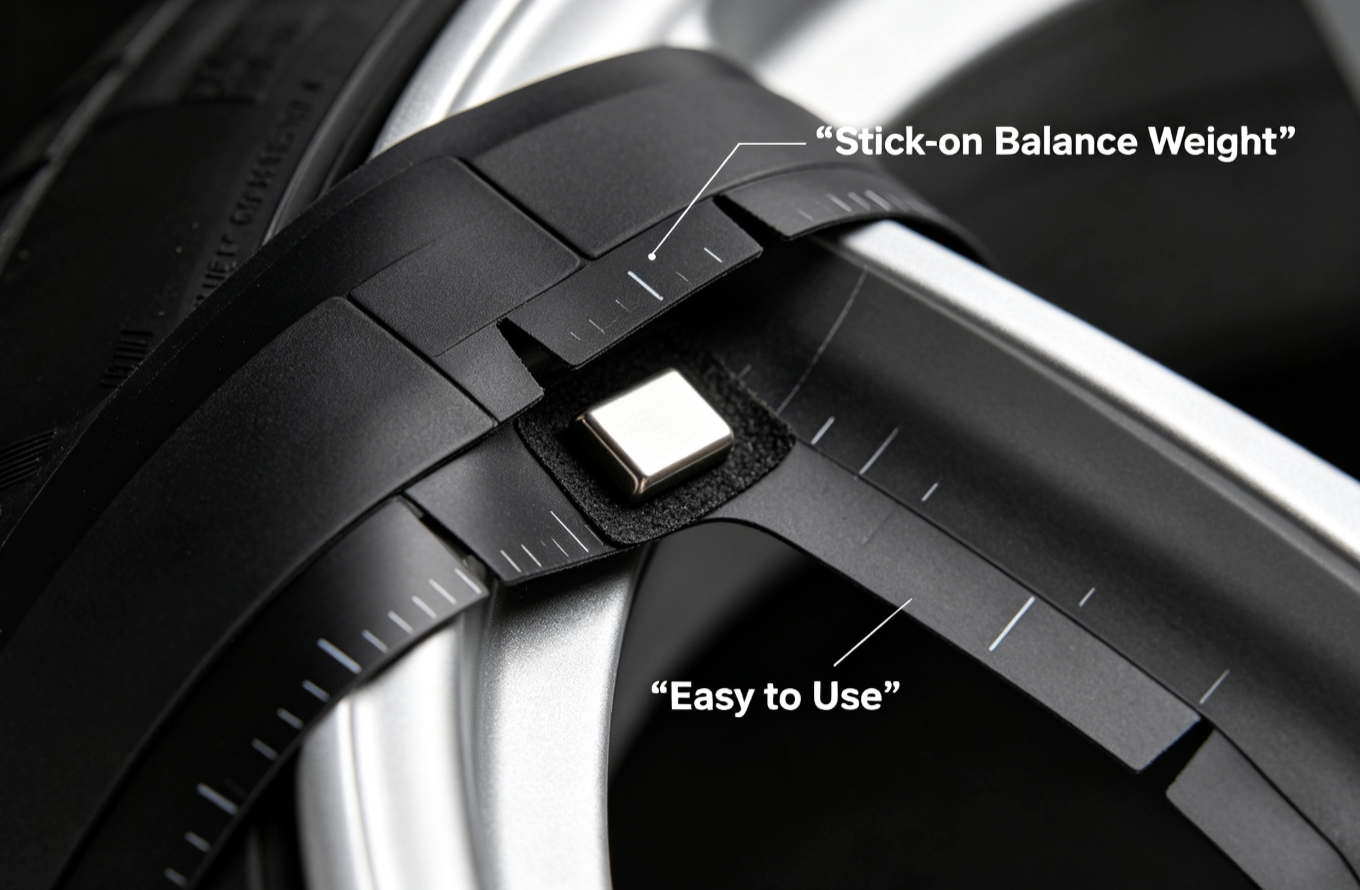
- Adhesive wheel weights are more commonly used on the inner barrel of aluminum wheels.
- Segmented weight design improves balancing precision and gives technicians more flexibility during installation.
A strong supplier should provide clear product naming, weight segmentation options, and application guidance so technicians can select the right part quickly.
2. Material options for regional compliance
Different markets have different environmental and regulatory expectations. That is why material choice is a major supplier evaluation point.
- Lead wheel weights are still widely used in traditional repair systems, especially where specifications, adhesive tape, and coating stability are trusted.
- Zinc alloy wheel weights are often viewed as a lead-free alternative and are preferred in environmentally sensitive markets.
A tire service chain operating across regions needs a supplier who can support different compliance requirements without changing service quality or SKU logic.
3. Coating, tape, and retention stability
In wheel weights, the visible product is only part of the story. The quality of the coating, adhesive tape, and mounting stability determines whether the product performs consistently in daily service. Global chains often test whether a supplier’s product can withstand storage, handling, temperature changes, and repeated installation conditions.
For adhesive wheel weights, tape adhesion is especially important. For clip-on versions, the fit on the rim edge and the metal resilience matter most. A supplier with poor dimensional control can create installation problems and increase labor time.
4. Packaging and SKU standardization
Automotive aftermarket channels place high importance on SKU standardization, packaging format, and inventory turnover. For a tire service chain, it is not enough for a product to perform well; it must also integrate smoothly into warehouse and store operations.
Suppliers are often evaluated on whether they provide:
- Clear part numbers and weight specifications
- Uniform carton and inner packaging sizes
- Barcode-friendly labeling
- Stable carton quantities for replenishment
- Regional packaging options for distribution centers
This is especially important for large chains that manage multiple stores and centralized purchasing.
5. Delivery reliability and annual supply capacity
Annual contracts require more than a good sample. Buyers want proof that the supplier can handle seasonal spikes, especially during winter tire changeover periods when wheel weights are used heavily alongside tire service work. The supplier must be able to maintain output, fill orders on time, and respond to demand fluctuations without disrupting store operations.
Chains often ask:
- Can the supplier support recurring monthly volumes?
- Is there enough capacity for peak season?
- How stable is the lead time?
- Can inventory be replenished quickly across regions?
How Tire Service Chains Test Wheel Weight Quality
Before signing a contract, many chains run internal or pilot-store evaluations. These tests focus on real shop conditions rather than lab-only claims.
Installation performance
Technicians check whether the wheel weight installs easily, stays in place, and matches the rim profile. For clip-on products, they assess fit on steel wheel lips. For adhesive products, they test initial tack, long-term adhesion, and removal behavior.
Balancing consistency
Because wheel weights are used to correct mass imbalance, accurate weight segmentation matters. If the actual weight varies too much from the nominal specification, balancing precision suffers. Chain buyers often inspect sample lots to confirm consistency across batches.
Coating durability and appearance
Wheel weights may be exposed to moisture, road grime, and temperature cycling. Poor coatings can corrode, discolor, or fail prematurely. Buyers want products that look professional and support the chain’s service reputation.
Adhesive and retention tests
For adhesive wheel weights, chains may check performance on different wheel surfaces and under different ambient temperatures. For clip-on styles, they may evaluate vibration resistance and whether repeated installation damages the wheel lip.
Why Annual Contracts Depend on More Than Product Price
Many buyers initially compare price, but global chains rarely sign based on price alone. A low-cost wheel weight supplier may create hidden expenses if the product causes rework, returns, or service delays. Annual contract decisions usually balance total value across procurement, operations, and customer experience.
- Lower comeback rates reduce labor costs.
- Standardized SKUs simplify purchasing and training.
- Stable supply protects seasonal revenue.
- Regulatory compatibility reduces market risk.
Seasonality and the Role of Wheel Weights in Winter Service
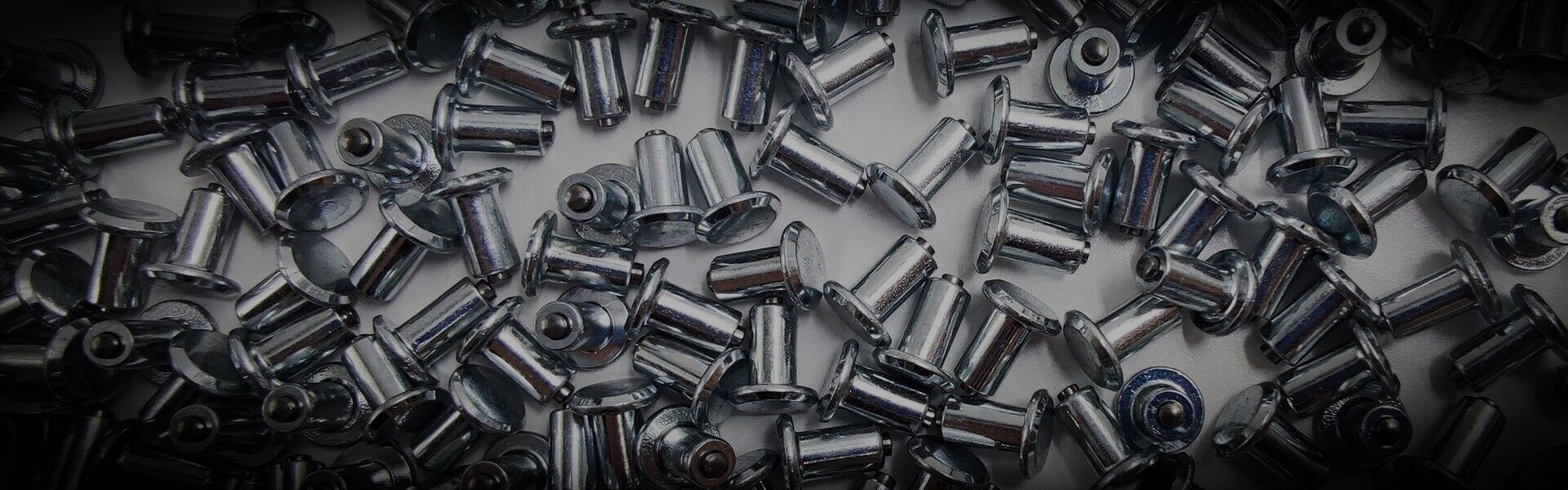
Winter tire service often peaks alongside snow and ice preparation. In these periods, wheel weights and tire studs may both experience seasonal procurement pressure. Service chains that operate in cold-weather markets need suppliers who understand this cycle and can support advance stocking.
Because wheel weights are used during tire changeovers and balancing work, chains often forecast consumption by region, store traffic, and vehicle mix. A supplier that can help with demand planning becomes more valuable than one that only ships product.
How Buyers Compare Suppliers in B2B Procurement
For B2B purchasing, product pages and catalogs should provide the information buyers need to move quickly from evaluation to approval. The best supplier content usually includes:
- Product name and use case
- Applicable vehicle or wheel type
- Material specification
- Weight segmentation or size options
- Packaging quantity
- Installation guidance
This aligns with how aftermarket buyers search and compare products: product name + usage + fitment + material + scenario. For example, search-friendly phrases such as “adhesive zinc wheel weight for aluminum rims” or “clip-on lead wheel weight for steel wheel balancing” are far easier for procurement teams to evaluate.
What Makes a Strong Long-Term Wheel Weight Partner
The best wheel weight suppliers do more than manufacture parts. They support the chain’s operational consistency. That means understanding the service environment, offering reliable quality control, and maintaining a product range that fits different markets.
Strong supplier characteristics include:
- Stable raw material sourcing
- Consistent product dimensions and coating quality
- Regional compliance support
- Clear packaging and labeling systems
- Responsive account management
- Ability to support OEM-style quality expectations where needed
How Fortune Wheel Parts Fits the Buyer’s Checklist
At Fortune Wheel Parts, product presentation and application clarity matter for B2B buyers. For global tire service chains and distributors, the ideal supplier should help simplify annual purchasing by offering clearly organized wheel weight solutions, fitment guidance, and packaging consistency that supports store-level efficiency.
When buyers compare suppliers, they are not just asking, “Is the product available?” They are asking:
- Will this part work across our store network?
- Can we standardize it in our annual procurement plan?
- Does it meet regional and operational requirements?
- Will it reduce installation problems and customer complaints?
That is why the supplier evaluation process for wheel weights is so rigorous.
Conclusion
Global tire service chains evaluate wheel weight suppliers with a mix of technical, operational, and commercial criteria. They want products that are accurate, easy to install, regionally compliant, and available in standardized packaging for fast-moving aftermarket operations. Whether the chain prefers clip-on, adhesive, lead, or zinc alloy products, the winning supplier is the one that can deliver consistent quality at scale.
For buyers managing annual wheel weight procurement, the smartest strategy is to choose a partner that understands both balancing performance and the realities of multi-location tire service business.
FAQ
What do tire service chains check first in a wheel weight supplier?
They usually check product fit, material options, installation stability, packaging standardization, and the supplier’s delivery reliability before reviewing price in detail.
Why are adhesive wheel weights important for aluminum wheels?
Adhesive wheel weights are commonly used on the inner side of aluminum wheels because they avoid rim-edge clamping and provide a clean balancing solution.
Are zinc wheel weights replacing lead wheel weights?
In many environmentally sensitive markets, zinc alloy wheel weights are used as a lead-free alternative, but lead wheel weights are still common in traditional repair systems where regulations allow them.
What does segmented wheel weight design improve?
Segmented design improves balancing precision and gives technicians more flexibility when matching the required weight amount.
Why is packaging important in annual wheel weight procurement?
Packaging affects warehouse handling, SKU standardization, barcode scanning, store replenishment, and inventory turnover across large service networks.
What is the biggest risk of choosing the wrong supplier?
The biggest risks are installation inconsistency, poor retention, higher comeback rates, and supply disruption during peak tire service seasons.
Post time: Sep-26-2026