



UNIVERSAL ABSORBENT SELECTION GUIDE
How to Choose Universal Absorbents for Automotive Workshops
A practical guide to selecting pads, rolls, socks, pillows drum toppers, and floor mats for workshop spill control.
 Oil is not the only liquid that reaches the floor of an automotive workshop. A normal service day may involve engine oil, coolant, water, washer fluid, diluted cleaning products, transmission fluid, and other maintenance liquids. A single-purpose oil-only absorbent may be useful for certain jobs, but it may not cover the mixed-liquid conditions found around service bays, workbenches, drums, and maintenance equipment.
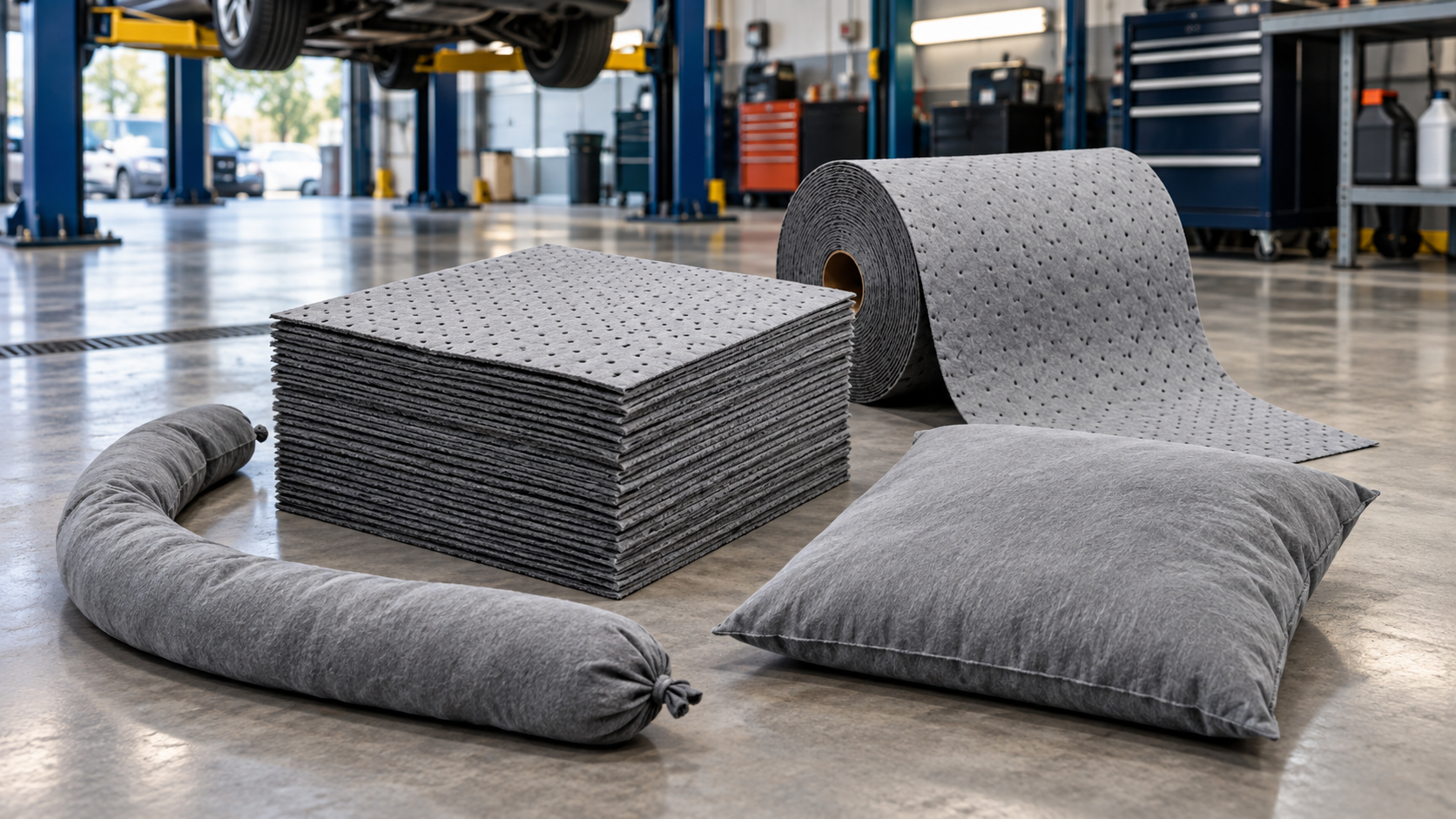
Universal absorbents are designed as a practical general-purpose option for many common workshop liquids. They are available as pads, rolls, socks, pillows, drum-top covers, and adhesive-backed floor mats. Choosing among these formats requires more than finding the lowest price per case. Buyers should consider the type and quantity of liquid, the way the leak moves, the work surface, the cleanup procedure, and the information available for the exact absorbent product.
This guide explains how automotive workshops and distributors can match universal absorbent formats to everyday spill-control tasks. It also identifies the product data that should be checked before purchase. It does not replace a site-specific spill-response plan, a safety data sheet, or the instructions for the liquid involved.
What Is a Universal Absorbent?
In industrial use, a universal absorbent is generally intended to pick up a broad range of water-based and hydrocarbon-based liquids. Typical examples may include water, coolant, oils, and certain non-aggressive industrial fluids. The word “universal,” however, should not be interpreted as “compatible with every chemical.”
Chemical concentration, temperature, viscosity, exposure time, and the absorbent’s construction can all affect performance. Strong acids, caustics, oxidizers, reactive chemicals, and unidentified liquids require a compatibility review before cleanup. OSHA spill-cleanup guidance recommends reviewing the safety data sheet and considering the substance’s chemical and physical properties, quantity, location, exposure risks, and compatibility with cleanup materials.
Universal absorbents also differ from oil-only absorbents. Oil-only products are normally selected when the objective is to pick up hydrocarbons while repelling water, including oil floating on water. Universal products are the more relevant general-purpose category when both water-based and oily workshop liquids may be encountered. A dedicated chemical or hazmat absorbent may be needed for corrosive or unknown substances.
Absorption and Adsorption
The market commonly uses terms such as “absorbent pad,” “sorbent pad,” and “absorbent mat.” Technically, absorption means that a liquid penetrates into a material, while adsorption means that it is attracted to and held on the material’s surface. Some spill-control products can involve both mechanisms. For purchasing and catalog communication, the familiar term “universal absorbent” is usually the clearest, provided that the product’s actual test data and compatibility information remain available.
Why Format Matters as Much as Absorbency
An absorbency figure does not explain how effectively a product can control a real leak. A flat pad works differently from a flexible sock. A roll can cover a walkway or workbench, while a pillow is better suited to a concentrated pool or confined space. Selecting the correct shape can reduce unnecessary material use and make the response easier for technicians.
| Format | Primary Function | Typical Workshop Use | Main Selection Question |
|---|---|---|---|
| Pads | Catch drips and wipe small amounts | Under components, tools, hoses, or service points | Is the pad weight and surface construction suitable for the task? |
| Rolls | Cover a larger or repeated-use area | Along benches, under equipment, or across a service zone | What width, length, and cutting or perforation arrangement are needed? |
| Socks | Surround or redirect a moving spill | Around machines, drums, drains, or the edge of a leak | Is the sock long and flexible enough to create the required barrier? |
| Pillows | Absorb concentrated liquid in a small area | Sumps, corners, drip pans, and pooled leaks | Will the pillow fit the space and remain in contact with the liquid? |
| Drum Toppers | Keep the top of a drum cleaner | Around pumps, funnels, and dispensing points | Does the diameter and opening arrangement match the drum? |
| Adhesive Floor Mats | Protect high-traffic floor areas | Entrances, service lanes, and leak-prone walkways | Is the backing suitable for the floor and removal procedure? |
No single format is automatically superior. Many workshops benefit from keeping several forms in the same spill station: socks to contain a leak, pads or a roll to absorb the remaining liquid, and a disposal container for the used material.
Universal Absorbent Pads: Fast Response to Drips and Small Spills
Pads are among the simplest absorbent products to deploy. A technician can place one under a leaking component, use several around a work area, or apply a fresh pad during final cleanup. Their individual size makes them convenient for controlled use and inventory counting.
The supplied Fortune product information shows universal pads in extra-heavyweight, heavyweight, mediumweight, and lightweight categories. It also lists single-lamination and two-sided-lamination constructions in parts of the range, with 15 × 18 inch pads appearing as a common format.
Weight category should be matched to the job rather than treated as a quality ranking. A lightweight pad may be economical for minor drips or frequent replacement. A mediumweight pad can provide a balance between handling and liquid capacity for routine maintenance. A heavyweight or extra-heavyweight pad may be more appropriate where a pad must manage a larger amount of liquid or remain in place longer. These are functional categories; buyers should still request the actual basis weight, construction, and tested absorbency of the selected item.
Lamination can influence strength, lint control, abrasion resistance, and the way a pad handles when wet, depending on the product design. A one-sided laminated pad may place the reinforced surface toward the user or work area, while a two-sided design may provide more consistent surface protection on both faces. The exact benefit should be confirmed from product-specific construction data rather than inferred from the word “laminated” alone.
Universal Absorbent Rolls: Flexible Coverage for Larger Areas
Rolls allow a workshop to cut material according to the length of a bench, machine, aisle, or service area. They are useful where leakage is spread over a wider surface or where the same location requires continuing protection.
The supplied product sheet includes 30 inch × 150 foot industrial universal rolls and a 36 inch × 150 foot universal needle-punch matting roll. These dimensions give buyers options for wider coverage, but width and length are only the starting point.
Before choosing a roll, consider:
- Whether it will be placed temporarily or left in position during ongoing work
- Whether technicians need perforations for quick, consistent tearing
- Whether the surface must tolerate foot traffic, carts, or tools
- Whether the product tends to shift, bunch, or curl in the intended area
- Whether liquid could pass through and reach the floor beneath it
- How contaminated sections will be removed without spreading the liquid
A roll used beside a stationary machine has different requirements from material placed across a busy service lane. For traffic areas, slip resistance, edge condition, backing, and floor compatibility deserve specific attention.
Socks: Contain the Spill Before It Spreads
An absorbent sock is a flexible tubular product used to surround, channel, or slow a liquid. Its main value is containment. Placing pads directly on a moving spill may absorb some liquid, but the uncovered portion can continue to migrate toward walkways, storage areas, or drains. A sock can help establish a boundary before the remaining liquid is collected.
Common automotive and maintenance applications include:
- Encircling the base of a leaking machine or drum
- Protecting a floor drain while the appropriate response is organized
- Creating a barrier between a leak and a pedestrian route
- Following the irregular edge of a workbench or equipment base
- Diverting a slow leak toward a safer collection area
The Fortune sheet includes universal socks in case-packed configurations. Before ordering, buyers should also confirm each sock’s length, diameter, fill material, outer fabric, absorbency, and chemical compatibility. Case quantity alone does not show how much perimeter can be protected.
Socks should not be treated as permanent dams, drain seals, or substitutes for stopping the source of a leak. The first priority is to identify and stop the release when this can be done safely.
Pillows: Concentrated Absorption for Pools and Confined Spaces
Absorbent pillows contain absorbent material inside a permeable outer cover. Their three-dimensional shape allows them to contact a deeper pool of liquid than a thin pad. They can be useful in drip pans, sumps, corners, or spaces where a leaking line repeatedly releases liquid into one location.
The supplied Fortune information lists two universal pillow sizes: approximately 5.51 × 5.51 inches at 0.29 lb and 15.75 × 15.75 inches at 1.10 lb. The smaller format may suit restricted spaces or localized drips, while the larger format may be considered for a broader pool. These dimensions and weights describe the products, but they do not establish liquid capacity. A tested absorbency figure and the corresponding test method are still required for capacity comparisons.
A pillow should be placed where liquid can reach it without creating a trip hazard or interfering with equipment. It should also be inspected before it becomes saturated. Leaving a heavily loaded pillow in an active work area can allow liquid to spread again when the product is compressed or moved.
Drum Toppers: Managing Repeated Drips at the Source
Drum-top absorbents are cut to sit on top of a drum, typically around pumps, funnels, or dispensing equipment. They help manage the small, repeated drips that can accumulate during fluid transfer. This format supports housekeeping by placing the absorbent close to the source instead of waiting for liquid to reach the floor.
The Fortune product sheet identifies a gray universal cold-formed drum topper designed to fit a 55-gallon drum. Buyers should verify the actual diameter, opening pattern, pump arrangement, and compatibility with the liquid being transferred. A drum topper is not a substitute for a closed container, a correctly installed pump, or secondary containment where those controls are required.
Adhesive-Backed Floor Mats: Protection for Traffic Areas
The supplied range also includes gray adhesive-backed commercial floor-protection matting in 34 inch × 50 foot and 34 inch × 100 foot rolls. The product information describes it as a solution for areas where slippery floors may affect employees, customers, or visitors, with a backing intended to hold the mat in place while allowing removal.
This type of product may be considered for entrances, service lanes, walkways, or locations exposed to recurring tracked-in moisture and workshop fluids. Before use, the facility should check that the floor is clean and compatible with the adhesive, follow the installation instructions, inspect the edges, and establish a replacement schedule. Performance may change with floor coating, contamination, temperature, traffic, and installation quality. Claims about residue-free removal or suitability for every floor should not be made without product-specific evidence.
A Practical Selection Process
1. Identify the Liquid
Start with the liquid’s label and safety data sheet. Determine whether it is a known oil, coolant, water-based product, solvent, acid, alkali, oxidizer, mixture, or unidentified substance. Do not use a general-purpose absorbent on a hazardous or reactive liquid merely because the product is called universal.
2. Stop and Contain the Release
If it can be done safely, stop the source. Protect personnel and restrict access. Use a compatible sock or other appropriate barrier to prevent the spill from spreading. EPA guidance for used-oil spills similarly emphasizes stopping the source, containing the released oil, and then cleaning and managing the recovered material correctly.
3. Estimate Volume and Spill Pattern
A few drops beneath a component may require only a pad. A continuous leak may need a roll section or drip collection system. A moving spill may require socks first. A deep pool in a confined area may be better addressed with a pillow. Facilities should keep enough material for a credible spill scenario, not only for routine wiping.
4. Match Product Construction to the Work Area
Review weight category, dimensions, lamination, surface durability, backing, perforations, and packaging. For high-traffic areas, examine movement and trip risks. For delicate components or finishing areas, check lint characteristics. For hot surfaces or flammable-liquid environments, obtain specific temperature, ignition, and static-control guidance from the manufacturer and the site safety team.
5. Compare Absorbency on a Consistent Basis
Absorbency can be reported per pad, per roll, per case, or relative to the dry weight of the product. These figures are not directly comparable unless the test liquid and test method are also consistent. Manufacturer reference data notes that absorption behavior can vary with viscosity, temperature, polarity, and surface tension. Ask suppliers to identify the test method, test liquid, units, and whether the result represents saturation capacity or a more practical working capacity.
6. Plan Handling and Disposal Before Use
Used absorbents take on the characteristics of the liquids they collect. Workers need suitable gloves and other protective equipment, a compatible labeled container, and a defined route for storage, recycling, or disposal. EPA notes that sorbent material containing free-flowing used oil is managed under applicable used-oil requirements in the United States. Requirements vary by liquid and jurisdiction, so the facility’s environmental procedure and local regulations take priority.
Common Purchasing Mistakes
Treating “Universal” as Unlimited Chemical Compatibility
Universal absorbents are versatile, not chemically indestructible. Obtain compatibility information for aggressive, concentrated, hot, reactive, or unfamiliar liquids. When the spill is unknown, isolate the area and follow the site’s hazardous-material procedure.
Comparing Only the Number of Pieces per Case
A case with more pads is not necessarily more economical. Compare pad dimensions, weight, construction, tested capacity, expected consumption, storage space, and disposal volume. The useful comparison is cost per completed task or cost per unit of documented absorption under comparable conditions.
Using Pads Without First Containing a Moving Spill
Pads placed in the center of a spreading leak may leave the leading edge uncontrolled. When appropriate, establish a boundary with socks or another compatible containment method before absorbing the pooled liquid.
Ignoring Traffic and Floor Conditions
Loose absorbent material can itself become a slip or trip concern. Choose an appropriate floor format, keep edges flat, replace saturated material, and inspect adhesive-backed products regularly.
Waiting Until a Spill Happens to Read the Instructions
Product information, safety data sheets, PPE, disposal containers, and emergency contacts should be prepared before an incident. Staff should know which absorbents are intended for routine workshop fluids and which situations require escalation.
Buyer Checklist for Universal Absorbents
Before approving a product or requesting a quotation, ask for:
- Product format and intended applications
- Material composition and construction
- Dimensions, basis weight, and thickness where relevant
- Lamination or backing details
- Absorbency per item and per package
- Test method and test liquid used for the absorbency figure
- Chemical compatibility guidance and limitations
- Temperature, flammability, and static-control information where relevant
- Pack quantity, case dimensions, and storage conditions
- Instructions for use and removal
- Available technical documents, test reports, and market-specific compliance information
For distributors, consistent terminology is also important. “Pad,” “roll,” “sock,” “pillow,” “drum topper,” and “adhesive floor mat” describe different functions and should not be combined into a single undifferentiated product description.
Frequently Asked Questions
Can a universal absorbent be used for engine oil and coolant?
Universal absorbents are generally considered for both oil-based and water-based workshop liquids, which can include engine oil and many coolants. The compatibility of the exact product with the exact fluid should still be confirmed, especially when additives, high temperatures, or mixtures are involved.
What is the difference between universal and oil-only absorbents?
Universal absorbents are intended for a broad mix of water-based and oil-based liquids. Oil-only absorbents are designed to target hydrocarbons while repelling water and are often selected for outdoor or water-surface oil recovery. Neither category should be assumed suitable for every chemical.
Should a workshop choose pads or rolls?
Pads are convenient for individual drip points, small spills, and controlled consumption. Rolls are more adaptable for long benches, machine areas, and wider zones because the user can cut the required length. Many workshops stock both.
When is an absorbent sock useful?
A sock is useful when liquid must be surrounded, redirected, or kept away from a drain or walkway. It primarily supports containment; pads, rolls, pillows, or recovery equipment may then be used to remove the liquid.
Does a heavyweight pad always absorb more?
It may contain more absorbent material than a lighter product of similar size and construction, but the category name alone is not proof of capacity. Compare documented basis weight and absorbency results obtained under stated test conditions.
Can used absorbents go into ordinary waste?
That depends on the liquid collected and the applicable local rules. Used absorbents may inherit hazardous, flammable, or regulated properties from the liquid. Follow the safety data sheet, facility procedure, and waste-management requirements in the relevant jurisdiction.
Conclusion
Universal absorbents can simplify workshop preparedness because the same product family can address many routine water-based and oily liquids. Effective selection still depends on matching the format to the spill: pads for localized drips, rolls for broad coverage, socks for containment, pillows for concentrated pools, drum toppers for fluid-transfer points, and adhesive mats for selected traffic areas.
Fortune’s supplied universal absorbent range includes multiple pad weights, industrial rolls, universal pillows, drum toppers, socks, needle-punch matting, and adhesive-backed floor-protection rolls. Final purchasing decisions should be based on product-specific construction, tested absorbency, compatibility, handling requirements, and the facility’s spill-response procedure.
Safety Note: This article provides general product-selection information. Always consult the liquid’s safety data sheet, the absorbent manufacturer’s instructions, the facility spill-response plan, and applicable environmental and occupational-safety requirements. Trained personnel should handle hazardous, reactive, unidentified, or large-volume spills.
Sources
- U.S. EPA — Managing Used Oil: Answers to Frequent Questions for Businesses
- U.S. EPA Archive — Sorbents
- OSHA — Housekeeping Safety: Spill Cleanup Guidance
- 3M — Petroleum Sorbents Reference Guide
- New Pig — How to Choose a Mat
- Fortune universal absorbent product sheet supplied by the user, reviewed September 2026.
Post time: Sep-19-2026