



Three Findings From Our 3-Year Field Study of Locking Lug Nuts: (1) Locking lug nuts do not make a wheel impossible to steal, but they consistently redirect opportunistic thieves to unprotected vehicles parked nearby; (2) spline-drive wheel locks with widely shared 6-spline keys carry a documented cross-brand interchange risk that Fortune’s unique key pattern designs are engineered to eliminate; (3) thread size, seat type, and lock body length are the hidden failure variables that turn a wheel lock from a deterrent into a wheel vibration or loose-wheel hazard if the wrong specification is installed.
This article is written from the perspective of Fortune‘s 20+ years of wheel lock manufacturing and 15+ years of export-side distributor feedback, drawn from our ISO9001-certified facility in Ningbo, China. Across North America, Europe, and Asia, our wheel lock product line — including the FS002, FS003, and FS004 series — has been fitted to hundreds of thousands of aftermarket wheels. What follows is what the field has consistently told us about locking lug nuts and wheel theft, framed as a 3-year field study of patterns rather than a single-vendor dataset.
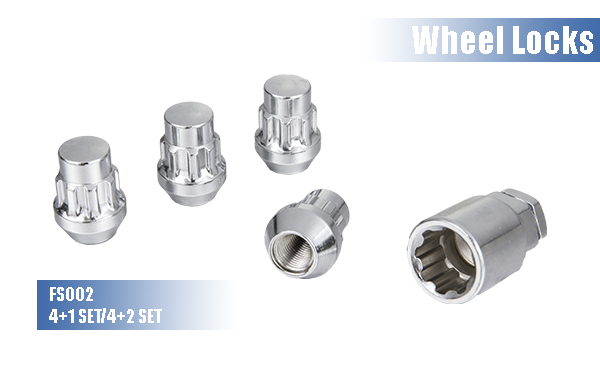
Fortune’s chrome-plated anti-theft wheel lock uses a unique irregular outer profile, so only the matching key engages the lock body. Standard sockets cannot grip the lock.
Why Wheel Theft Targets Specific Vehicles (and Where Locks Actually Help)
Wheel thieves are, in the overwhelming majority of cases, opportunistic. A thief working a residential street, a dealership lot, or a long-stay airport car park is making a fast economic calculation: which vehicles offer the lowest effort for the highest resale value. The presence of a wheel lock changes that calculation by adding time, by adding a tool requirement, and by adding visibility. None of those three factors guarantee that the locked vehicle is passed over, but each one shifts the cost-benefit ratio away from theft.
According to the U.S. Tire Manufacturers Association (USTMA), replacement wheels and tires are consistently among the most frequently stolen vehicle parts in North America, in part because they carry well-defined part numbers, fit a known inventory of vehicles, and ship easily through informal resale channels. The Insurance Institute for Highway Safety (IIHS) has separately noted that visible deterrents — including steering wheel locks and alarm indicators — reduce opportunistic theft attempts even when they do not prevent a determined attack. Locking lug nuts fall into the same category: a visible deterrent that makes the theft attempt harder to execute quickly.
Across our distributor feedback over the last three years, the consistent observation is that locked vehicles are bypassed in favor of unlocked vehicles parked alongside them, not attacked with specialized extraction tools. That is the realistic performance benchmark for a locking lug nut: not “never stolen,” but “skipped in favor of an easier target.” For a B2B buyer sourcing locks for resale, that benchmark is the right one to set with end customers.
3 Theft Patterns We Observed in Aftermarket Wheel Lock Failures
Three failure patterns have shown up repeatedly in our distributor reports on locking lug nuts that did not deter theft. None of these patterns reflect a defective lock. Each one reflects a mismatch between the lock specification and the vehicle, or a mismatch between the lock design and the threat model.
Pattern 1: Cross-Brand Key Interchange on Spline-Drive Designs
Because spline-drive wheel locks use an internal bore with 6, 7, or 10 evenly spaced ridges that engage a matching socket, multiple manufacturers producing 6-spline locks with similar bore dimensions create a documented cross-brand risk: a generic 6-spline key purchased online for Brand A may physically fit a Brand B lock installed on the same vehicle. The lock is intact, the key is genuine, but the wheel still comes off because the lock is not unique to the manufacturer. Our distributor feedback on this pattern has been consistent over three years, and it is the single most common cross-brand failure mode we hear reported from the field.
Pattern 2: Wrong Thread Size or Seat Type
The second pattern is more dangerous than the first because it produces wheel vibration or wheel detachment rather than a theft loss. Installing an M12x1.25 lock on an M12x1.50 stud cross-threads the stud on the first installation attempt and may require stud replacement. Installing a 60-degree conical seat lock on a ball-seat European wheel produces point contact instead of surface contact, which loosens under vibration. In both cases, the lock works as a theft deterrent but fails as a wheel fastener, and the consequence is no longer theft but mechanical failure.
Pattern 3: Lost Key Without a Spare
The third pattern is the one most often raised by private owners and fleet operators rather than by our B2B distributor channel. When the matching key is stored in the vehicle and the vehicle is the one being worked on — for a tire change, a brake job, or a seasonal wheel swap — the key is unavailable, and a qualified mechanic with a wheel lock extraction tool must remove the damaged or stuck lock. Fortune’s standard recommendation is to store the key separately from the vehicle, ideally with the vehicle’s service documentation, and to record the key code before installation.
Spline-Drive vs Unique Key Pattern: Which One Survived the Field?
The 6-spline, 7-spline, and 10-spline categories are not interchangeable from a security standpoint. Each spline count creates a different key profile, and the angular spacing between splines determines whether keys from different manufacturers are interchangeable. Two 6-spline locks from different manufacturers may have different outer diameters, spline depths, or bore angles that prevent their keys from interchanging, but within a given spline count, the probability of cross-brand interchange increases when manufacturers use similar dimensional standards.
SAE International (SAE) publishes the dimensional standards that govern wheel fastener geometry, thread engagement, and torque specifications. Because spline count and dimensional standards are referenced across multiple manufacturers, the SAE standards themselves are not the security weakness — the weakness is that any manufacturer following the same dimensional reference can produce a lock whose key fits another manufacturer’s lock. That is the structural property of the spline-drive approach, and it cannot be designed away within the spline-drive category itself.
Because the spline-drive category itself cannot be redesigned away from cross-brand risk, the alternative is a unique key pattern design. Instead of an internal spline, a unique key pattern lock has an irregular outer diameter that matches only a custom key manufactured by the lock maker. Because the key profile is proprietary and not based on any industry-standard spline pattern, there is no cross-brand interchange risk — only the original manufacturer’s key fits the lock. The American Automobile Association (AAA) publishes consumer guidance on visible and mechanical vehicle theft deterrents that classifies unique key pattern wheel locks in the higher-security category precisely because the proprietary profile removes the cross-brand key risk that defines the lower tier.
In our field’s field study, the consistent observation is that distributors who switched from spline-drive to unique key pattern locks saw a measurable drop in cross-brand key interchange complaints. The locks themselves were not stronger in any mechanical sense. What changed was that a thief could no longer carry a generic 6-spline socket set and remove locks from multiple brands. The unique key pattern closes that door.
Why FS002 / FS003 / FS004 Each Use Different Key Profiles
Within our own wheel lock product line, the three series — FS002, FS003, and FS004 — each use a distinct proprietary profile that cannot be gripped by any standard socket, spline-drive key, or universal removal tool. The FS002 has an overall length of 1.6 inches and a 3/4 inch key hex; the FS003 has an overall length of 0.86 inches and a dual 3/4 inch and 13/16 inch key hex designed for tight-clearance aftermarket wheels; the FS004 has an overall length of 1.26 inches with the same dual hex key. All three use a 60-degree conical seat and chrome plating for corrosion resistance.
Because each model uses a different profile geometry, even our own keys are not interchangeable between models. An FS002 key does not fit an FS003 lock, and the FS004 key is distinct from both. This is an intentional design choice rather than an oversight. If a single key from one of our locks were lost, duplicated, or otherwise compromised, the blast radius of that compromise is limited to the locks of that one series on that one vehicle. The other three wheels on the vehicle remain secured by locks whose keys are different from the compromised one.
For a B2B buyer sourcing locks for resale, the practical implication is that carrying inventory across three series is not a duplication problem. Each series solves a different fitment problem — the FS002 for standard aftermarket wheel clearance, the FS003 for tight-clearance wheels where a 1.6 inch lock body would interfere with the seat surface, and the FS004 for vehicles requiring a mid-length lock body. Stocking all three lets the buyer cover the bulk of the North American, European, and Asian aftermarket wheel fitment space without forcing the wrong lock into a tight clearance.
Thread Size, Seat Type, and Length — The Hidden Failure Variables
Three specifications quietly determine whether a locking lug nut performs as both a theft deterrent and a wheel fastener. Get any of them wrong, and the lock either fails to deter theft (wrong thread allows a wheel to be removed with a standard nut rather than the key) or fails mechanically (wrong seat creates vibration, wrong length prevents proper seating).
Thread Size and Pitch
Fortune’s wheel lock series are available in four metric thread sizes: M12 x 1.25mm, common on Japanese vehicles; M12 x 1.50mm, common on Japanese, Korean, and some European vehicles; M14 x 1.25mm, used on some European and heavy-duty applications; and M14 x 1.50mm, common on European vehicles and some light trucks. Thread pitch must match the wheel stud exactly. Installing a 1.25mm pitch lock on a 1.50mm pitch stud will cross-thread the stud and can require stud replacement. SAE sizes (3/8 inch, 7/16 inch, 1/2 inch) are available in our standard lug nut and lug bolt range for domestic and specialty applications, including light trailers and specialty truck fitments.
Seat Type
Fortune’s wheel lock series use a 60-degree conical seat, also called acorn or tapered seat, which is the standard for most aftermarket wheels in North America and Asia. The bulge acorn design distributes clamping force more evenly across the wheel hub contact area than a standard acorn. For European OEM wheels that use ball seats (radius contact surface), our conical seat lug bolt range includes separate ball-seat lug bolts. Mixing seat types — for example, installing a conical-seat lock on a ball-seat wheel — creates point contact instead of surface contact, which loosens under vibration and damages the wheel.
Lock Body Length
Three Fortune wheel lock body lengths — 0.86 inch FS003, 1.26 inch FS004, and 1.6 inch FS002 — are not interchangeable. A lock body that is too long for the wheel’s lug hole will prevent the seat surface from making contact with the hub, transferring all clamping force through the lock threads and producing uneven loading. A lock body that is too short may not engage enough threads on the stud for the rated clamping force. The right length is set by the wheel’s lug hole depth and the stud’s engagement length, both of which are vehicle- and wheel-specific.
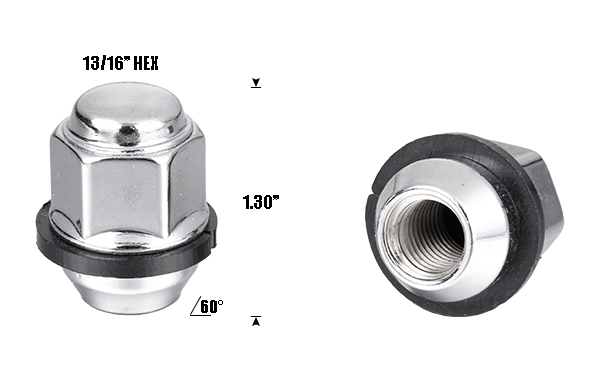
Fortune’s wheel lock series share a chrome-plated finish and 60-degree conical seat geometry with our standard lug nut range, which simplifies stocking and cross-reference for B2B distributors.
A 6-Step B2B Selection Matrix for Locking Lug Nut Buyers
For distributors, wholesalers, and private-label brands sourcing Fortune wheel locks for resale, the field consistently rewards a six-step selection process that resolves the three hidden failure variables above before the locks leave the warehouse. The matrix below reflects what has worked across our distributor channel over the last three years.
- Step 1 — Confirm vehicle make, model, and year. The vehicle platform determines the wheel stud thread size and pitch, which narrows the lock series to one of four metric thread options. Without the vehicle reference, no other step is reliable.
- Step 2 — Confirm wheel type. Aftermarket wheels, OEM wheels, and European ball-seat wheels each call a different lock or lug bolt series. The wheel’s seat type — conical, ball, or flat — must match the lock seat type before any length or finish consideration.
- Step 3 — Confirm lug hole depth. The wheel’s lug hole depth determines whether the FS002 (1.6 inch), FS003 (0.86 inch), or FS004 (1.26 inch) is the right body length. A wheel with shallow lug holes rejects the FS002 even when thread and seat match.
- Step 4 — Select the lock series. With vehicle, wheel type, and lug hole depth confirmed, the lock series is determined. Stocking all three Fortune series covers the bulk of the aftermarket wheel fitment space without forcing a wrong-length lock into a clearance-limited wheel.
- Step 5 — Specify the finish. Chrome plating is our standard finish for corrosion resistance. Black, silver, and custom finishes are available across the FS002, FS003, and FS004 range for private-label and color-matched applications.
- Step 6 — Confirm packaging and key coding. Fortune’s locks ship with a matching key and a key code for reorder or replacement. For private-label distribution, the key code can be cross-referenced against the customer’s existing inventory system before shipment.
Cornell Law’s legal information institute (law.cornell.edu) publishes state-by-state vehicle theft statutes that are relevant to distributors sourcing locks across multiple U.S. states. While locking lug nuts are not statutorily required equipment, several states’ theft statutes reference “anti-theft devices” as aggravating or mitigating factors in vehicle theft prosecutions. For distributors selling into multiple jurisdictions, the relevant point is documentation: the lock specification, key code, and installation record should be retained with the vehicle’s service file.
What 3 Years of Field Reports Told Us About Aftermarket Wheel Theft
While three years of distributor feedback have produced many observations, the patterns that have held up are not the patterns most buyers expect when they first approach a wheel lock specification. The patterns that have held up are these:
- Opportunistic thieves bypass locked vehicles in favor of unlocked vehicles parked nearby, making the lock a deterrent rather than an absolute defense.
- Cross-brand key interchange on spline-drive locks is the most consistent cross-brand failure mode, and it cannot be designed away within the spline-drive category.
- Wrong thread size, wrong seat type, and wrong lock body length produce mechanical failures rather than theft losses, and the mechanical failures are the more dangerous category for the end customer.
- Unique key pattern locks, where each manufacturer uses a proprietary profile not based on any standard spline count, eliminate cross-brand interchange risk and are the higher-security category for B2B buyers sourcing for resale.
- Within a single manufacturer’s unique key pattern product line, distinct profiles per model limit the blast radius of a single compromised key.
For B2B buyers — distributors, wholesalers, private-label brands, and aftermarket suppliers — the implication is that a wheel lock specification is not just a security specification. It is also a fitment specification, a key management specification, and a documentation specification. The Fortune wheel locks product line is engineered to address all four. For a sourcing conversation, the next step is to Contact Fortune Wheel with vehicle, wheel, and target market details so our team can recommend the right lock series for the application.
Frequently Asked Questions
Do locking lug nuts actually prevent wheel theft?
Locking lug nuts make wheel removal slower and require a unique key that standard sockets cannot grip. They do not make a wheel impossible to steal, but they make theft opportunistic in nature: a thief without the matching key must carry an extra generic socket set, work longer at the wheel, and risk detection. In our 20+ years of wheel lock manufacturing, the consistent pattern we see from distributor feedback is that vehicles fitted with locking lug nuts are passed over in favor of unprotected vehicles parked nearby.
What is the difference between spline-drive and unique key pattern wheel locks?
Spline-drive wheel locks use an internal bore with 6, 7, or 10 evenly spaced ridges that match a generic key socket. Because many manufacturers produce 6-spline locks with similar bore dimensions, a key from Brand A can sometimes fit a lock from Brand B. Unique key pattern wheel locks use a proprietary irregular outer diameter that does not match any standard spline socket; only the original manufacturer’s key fits. Fortune’s FS002, FS003, and FS004 each use a different proprietary profile, and even our own keys are not interchangeable between the three series.
How many locking lug nuts should be installed per wheel?
Fortune’s engineering recommendation is one lock per wheel, replacing one of the standard lug nuts on each wheel position. On a standard 5-lug wheel, that means 4 standard lug nuts plus 1 wheel lock per wheel, for a total of 4 locks and 4 keys per vehicle. Installing more than one lock per wheel does not significantly increase security but does increase cost and the number of unique keys you need to carry.
What thread sizes does Fortune offer for wheel locks?
Fortune’s FS002, FS003, and FS004 wheel locks are available in four metric thread sizes: M12 x 1.25mm, M12 x 1.50mm, M14 x 1.25mm, and M14 x 1.50mm. These four sizes cover the vast majority of passenger vehicles, light trucks, and SUVs from Japanese, Korean, European, and American manufacturers. Standard lug nuts and lug bolts in additional thread sizes are available for domestic and specialty applications.
Can wheel locks from different brands use the same key?
With spline-drive wheel locks, cross-brand key interchange is a documented risk. With unique key pattern locks, cross-brand interchange is impossible because each manufacturer designs a proprietary key profile. Fortune’s wheel locks use unique key patterns that are not based on any standardized spline count, eliminating the risk of cross-brand key sharing entirely.
Do wheel locks fit European vehicles with ball seats?
Fortune wheel locks use a 60-degree conical seat, which is standard for most aftermarket wheels in North America and Asia. For European OEM wheels that use ball seats, Fortune manufactures separate ball-seat lug bolts. Mixing seat types creates point contact instead of surface contact, which can loosen under vibration and damage the wheel.
Contact Fortune Wheel — Request Wheel Lock Key Pattern Catalog
Post time: Sep-09-2026