



Wheel weights are one of the most important consumables in tire service. Their job is simple but essential: correct uneven mass distribution in the wheel-and-tire assembly so drivers experience less vibration, less steering shake, and less uneven tire wear. For tire shops, distributors, and aftermarket buyers, OEM wheel weights are not just a commodity item—they are a precision product that must balance fitment, performance, durability, and compliance.
At Fortune Wheel Parts, OEM wheel weight manufacturing combines product engineering, material selection, tooling accuracy, and strict quality control to support B2B buyers who need stable supply and consistent performance. In this article, we’ll walk through the full process of custom wheel weights manufacturing, from CAD design to mass production, and explain how to evaluate quality for different vehicle and wheel applications.
What Are OEM Wheel Weights and Why Do They Matter?
OEM wheel weights are designed to meet the fit, performance, and packaging requirements of professional tire service channels. They are used to restore wheel balance after tire installation, rotation, or repair. Because wheel balance directly affects ride comfort, tire lifespan, and handling stability, the quality of the wheel weight itself matters as much as the balancing procedure.
There are two core styles used across the market:
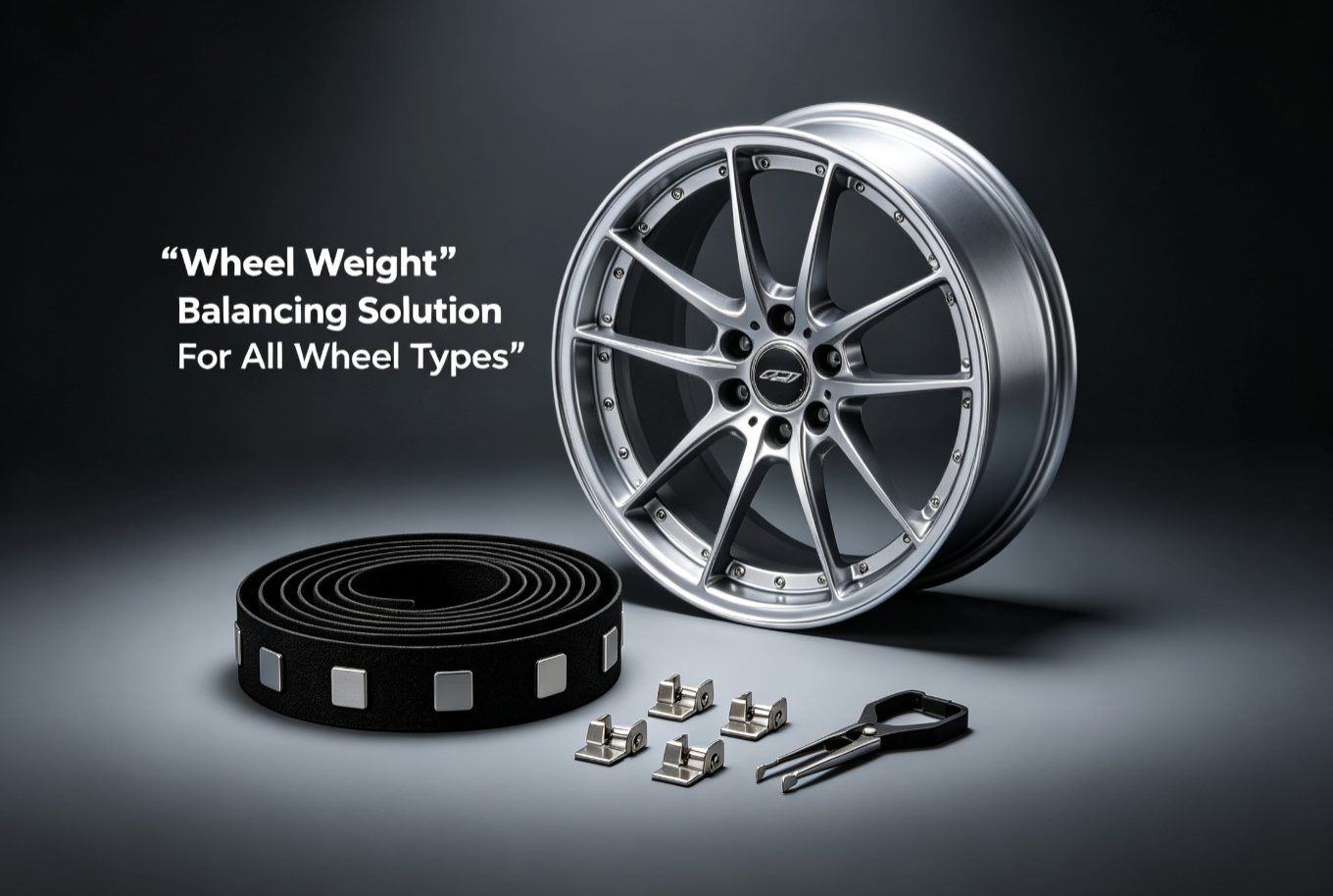
- Clip-on wheel weights, commonly used for steel wheels and installed by gripping the wheel rim edge.
- Adhesive wheel weights, more commonly used on the inner barrel of aluminum wheels.
Wheel weight selection depends on wheel material, rim profile, and the required balancing amount. That is why OEM wheel weights are often specified by shape, segment size, coating, and installation method.
Step 1: Product Planning and Market Specification
Before CAD modeling begins, the manufacturing team defines the product requirements based on the target market. This step is critical for OEM wheel weight manufacturing because the aftermarket is highly sensitive to SKU clarity, packaging format, and inventory turnover.
Key planning factors
- Vehicle application: passenger cars, light trucks, commercial fleets, or winter tire service.
- Wheel type: steel wheel or alloy wheel.
- Installation method: clip-on or adhesive.
- Material: zinc alloy, lead, or other approved alternatives.
- Segmented weight design: the weight increment per segment determines balancing precision and installer flexibility.
- Packaging requirement: retail box, bulk pack, OEM tray, or shop-use carton.
For B2B buyers in North America, standardized models and clear cross-reference information are especially important. Tire shops, repair chains, distributors, and fleet maintenance buyers need products that are easy to identify, store, and reorder.
Step 2: CAD Design and Engineering Development
CAD design is where custom wheel weights become a manufacturable product. Engineers define the physical shape, hook profile, adhesive backing area, coating thickness, and segment structure. The goal is to create a part that installs securely, balances accurately, and performs consistently across different wheel designs.
What CAD design must solve
- Fitment accuracy: ensuring the clip-on profile matches rim lip geometry or the adhesive strip matches the mounting surface.
- Weight segmentation: creating breakaway sections that allow fine-tuned balancing.
- Durability: preventing corrosion, deformation, and adhesive failure during use.
- Installation ease: making the part fast to place in a high-volume shop environment.
- Compliance: supporting market-specific requirements such as lead-free preferences in sensitive regions.
For adhesive products, design also includes the adhesive tape selection and backing geometry. For clip-on products, the spring tension and rim engagement angle are critical. Small design differences can affect retention force, balance precision, and the risk of detachment.
Step 3: Material Selection for OEM Wheel Weights
Material choice is one of the most important decisions in wheel weight manufacturing. Different markets and service environments require different solutions.
Zinc alloy wheel weights
Zinc alloy wheel weights are widely viewed as a lead-free alternative and are suitable for environmentally sensitive markets. They are often chosen when regulations, sustainability goals, or customer preferences require non-lead solutions.
Lead wheel weights
Lead wheel weights remain common in traditional repair systems. They are valued for their long history of use, stable density, and well-established installation habits. In this category, consistency in specifications, tape performance, and surface coating stability is essential for reliable performance.
Coating and adhesive considerations
Whether the product is zinc or lead, the coating must support corrosion resistance and shelf stability. For adhesive wheel weights, the tape must deliver strong initial tack and long-term adhesion while remaining compatible with wheel surface conditions.
Step 4: Tooling and Prototype Validation
After the design is finalized, prototype tooling is created for validation. This stage confirms whether the part can be produced consistently at scale and whether it performs correctly in the field.
Prototype testing typically checks:
- Dimensional accuracy
- Clip retention force
- Adhesive bonding strength
- Segment break-off consistency
- Surface finish and coating quality
- Balance correction performance on real wheels
At this stage, engineers may revise the CAD file to improve fit or simplify installation. A well-run prototype phase reduces downstream problems in mass production and lowers the risk of customer complaints.
Step 5: Mass Production Process
Once the design is approved, OEM wheel weight manufacturing moves into mass production. The exact process depends on material and style, but the core objective is the same: produce stable, repeatable, and install-ready parts in large quantities.
Typical production stages
- Raw material preparation: alloy or lead feedstock is prepared and inspected.
- Forming or casting: the base shape is created with the required segment structure.
- Trimming and finishing: excess material is removed and surfaces are refined.
- Coating or plating: protective layers improve corrosion resistance and appearance.
- Adhesive application: for stick-on models, high-performance tape is applied under controlled conditions.
- Marking and packaging: weight values, SKU identifiers, and batch data are added for inventory control.
Production stability is especially important for segmented wheel weights. The breakpoints must separate cleanly so technicians can achieve the required balance value without wasting time or damaging the part.
Step 6: Quality Control in Wheel Weight Manufacturing
Quality control is what separates a reliable OEM product from an inconsistent one. Because wheel weights directly affect vehicle smoothness and service efficiency, every batch should be checked for physical and functional consistency.
Core QC checkpoints
- Weight tolerance: each segment must match the stated mass.
- Dimensional accuracy: clip geometry, tape size, and overall profile must remain within spec.
- Surface integrity: no cracks, burrs, or coating defects.
- Adhesion performance: the tape must hold under standard installation and service conditions.
- Corrosion resistance: coatings must support storage and road exposure.
- Packaging accuracy: SKU labels, counts, and carton data must be correct for distribution.
For B2B buyers, batch traceability is highly valuable. If a customer reports a problem, a clear lot control system makes root-cause analysis much easier.
How Wheel Type and Rim Structure Affect Selection
Different vehicles and wheel designs require different wheel weight solutions. That is why product pages for OEM and custom wheel weights should clearly state wheel type, fitment, and installation guidance.
Steel wheels
Steel wheels usually pair with clip-on wheel weights. The installation depends on the rim edge structure, so the clip profile must match securely.
Aluminum wheels
Aluminum wheels often use adhesive wheel weights on the inner barrel. In these cases, surface cleanliness and tape quality are critical to avoid lift-off or movement.
Rim shape and balancing demand
Wheel lip shape, barrel width, and required correction weight all influence the final selection. A good OEM system should provide multiple segment sizes and clear application guidance so installers can choose the right product quickly.
OEM Wheel Weights in the Aftermarket Supply Chain
In the automotive aftermarket, OEM wheel weights are sold through tire shops, repair chains, distributors, and fleet service businesses. These buyers care about more than just material price. They also need:
- Consistent SKU structure
- Clear packaging quantities
- Fast replenishment
- Reliable quality from batch to batch
- Installation-friendly formats for technicians
For seasonal demand, especially winter tire service, wheel weights often experience purchasing spikes. Shops that also service snow-rated tires may increase stock alongside other seasonal products such as tire studs and repair consumables.
Why OEM Quality Matters in Related Tire Service Products
The same quality mindset used in wheel weight manufacturing also applies to other wheel-end service parts. For example, valve stems and TPMS service kits are safety-critical components because they directly affect air retention and sensor compatibility. Tire repair materials require the right balance of sealing strength and flexibility. Basic tools like tire pressure gauges, tire changers, balancing machines, jacks, and stands all support safe and efficient service operations.
This is why professional buyers prefer suppliers who understand the full tire service ecosystem. A manufacturer that can support wheel weights, TPMS parts, repair materials, and shop equipment usually offers better compatibility knowledge and stronger B2B service support.
How to Evaluate a Custom Wheel Weight Supplier
If you are sourcing custom wheel weights or OEM wheel weights for distribution, look for a supplier that can answer the following questions clearly:
- What is the exact material composition?
- Which wheel types are supported?
- How is the product segmented?
- What coating or tape system is used?
- What packaging options are available?
- Can the supplier provide consistent batch quality and traceability?
- Are product pages optimized with model, purpose, fitment, material, and usage scenario?
A strong supplier should also provide installation suggestions and fitment details to reduce errors in the workshop. This is especially important for high-volume channels where speed and accuracy matter.
Frequently Asked Questions
What is the main purpose of wheel weights?
Wheel weights correct uneven mass distribution in the wheel-and-tire assembly. This reduces vibration, steering shake, and uneven tire wear.
What is the difference between clip-on and adhesive wheel weights?
Clip-on wheel weights are typically used on steel wheels and attach to the rim edge. Adhesive wheel weights are commonly used on aluminum wheels and stick to the inner barrel.
Why are zinc alloy wheel weights popular?
Zinc alloy wheel weights are a common lead-free alternative and are often chosen for markets where environmental compliance and regulatory sensitivity matter.
Are lead wheel weights still used?
Yes. Lead wheel weights are still widely used in many traditional repair systems because they are familiar, effective, and well supported by existing service workflows.
What makes a wheel weight suitable for OEM or custom applications?
OEM or custom wheel weights should have accurate dimensions, stable segmentation, durable coating, reliable adhesion or clip retention, and clear packaging and SKU identification.
Why is segmented design important?
Segmented weight design determines how precisely a technician can match the required balancing value. It also improves installation flexibility across different wheel correction needs.
What should B2B buyers look for in a wheel weight supplier?
B2B buyers should look for consistent quality, clear model structure, fitment guidance, packaging options, traceability, and the ability to support repeat purchasing at scale.
Conclusion
OEM wheel weight manufacturing is much more than making a small metal part. It is a process that combines CAD engineering, material selection, tooling precision, production discipline, and strict quality control. From the first design concept to the final packaged SKU, every detail affects balancing accuracy, installation efficiency, and customer satisfaction.
For tire shops, distributors, and aftermarket brands, the best custom wheel weights are the ones that install easily, balance accurately, and stay consistent across batches. If you need a supplier that understands wheel-end products and B2B market requirements, Fortune Wheel Parts can support OEM wheel weights, custom wheel weights, and other tire service products with a professional manufacturing approach.
Post time: Sep-27-2026