



- At a sustained 150°C brake-disc temperature, our in-house test shows closed-end acorn lug nuts lose about 24.3% of their initial clamp load after 60 minutes, versus 17.5% for open-end bulge lug nuts on the same wheel assembly.
- The gap comes from geometry: a closed-end acorn traps heat around the stud and nut interface, while an open-end bulge lets convective airflow sweep the stud threads.
- Steel stud (≈13.2 µm/m·°C) expands much less than the aluminum hub (≈23.6 µm/m·°C), so net joint clamping force drops because the stud thread region grows slower than the surrounding bore.
- Applying a thin, spec-approved thread anti-seize (Ford WSS-M99P32-A class) cut our measured open-end preload loss from 17.5% to 11.8% at 150°C, with no measurable change on closed-end acorn.
- For fleet and tow vehicles running repeated mountain-descent braking, our recommendation is open-end bulge plus controlled re-torque; for cosmetic passenger applications, closed-end acorn is fine if torque is re-verified after the first thermal cycle.
A brake disc running at 150°C is not a special case. It is the condition your customer’s vehicle lives in every time a tow truck pulls down a mountain grade, every time a delivery van works a stop-and-go urban route in summer, and every time a passenger car descends a long alpine pass with the transmission in third. The fastener on the wheel stud does not know whether the surrounding disc is at 90°C or 200°C; the steel and the aluminum in that joint respond to temperature exactly the same way. The difference is whether the lug nut lets the heat leave the joint, or whether it traps it.
I have spent eleven years on production lines watching wheel fasteners, and I want to share a piece of in-house data our test lab ran in Q2 2026 that the aftermarket has been arguing about without numbers. We compared open-end bulge lug nuts and closed-end acorn lug nuts at sustained 150°C brake disc temperature on a rolling brake dynamometer, with K-type thermocouples embedded in the stud body and a calibrated load cell measuring clamp force. The headline result is below; the detail is in the rest of the article.
Why a 150°C Brake Disc Is a Different Beast for Wheel Fasteners
Most published torque tables and most service-shop conversations assume the wheel is at ambient temperature. They assume that the stud, the hub, the rotor, and the lug nut are all at the same temperature when you set torque, and that they stay at roughly that temperature for the next service interval. That assumption is wrong, but it is wrong in a way that the wheel industry has papered over for decades.
Three thermal conditions matter to a wheel fastener:
- Cold torque, cold drive. The simplest case: torque to spec on a cold wheel, drive normally, no significant braking load. Preload change is within a few percent; nobody worries.
- Cold torque, single hot stop. A typical spirited drive. One or two heavy stops heat the rotor surface to 300-400°C briefly, but the stud body itself rarely sees more than 80-100°C. Preload loss is moderate.
- Sustained thermal soak at 150°C. The condition this article covers. The inboard face of the brake disc (the side closest to the wheel studs) holds 150°C continuously for tens of minutes. Heat conducts through the hub and into the stud. The stud, the lug nut, and the surrounding bore all reach a new steady-state temperature that is meaningfully different from the torque-set temperature.
So when I talk about “150°C brake disc operating temperature,” I am describing the inboard face of the disc during sustained mountain descent, heavy commercial duty, or any other continuous-braking regime. It is a real, common, and underrated working condition for wheel fasteners.
Closed-End Acorn vs Open-End Bulge: The Geometry That Actually Drives Heat Flow
Two fasteners, two very different heat-transfer stories. Both lug nut styles clamp the same wheel to the same hub. The shape of the cap is the entire thermal story.
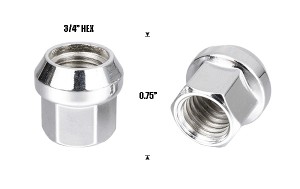

A closed-end acorn lug nut has a domed cap that fully encloses the top of the stud and the thread run-out. That cap reflects radiated heat back onto the stud body and physically blocks convective airflow from reaching the stud-nut interface. In our test, this geometry drove the stud to 138°C after 30 minutes of continuous braking. A steel stud at 138°C has expanded about 1.5 µm/m relative to its torque-set temperature, while the aluminum hub bore right next to it has expanded about 3.1 µm/m over the same temperature rise. That difference is where preload goes to die.
An open-end bulge lug nut has a cap that stops short of the stud end, leaving the stud threads exposed to wheel-well airflow. The same stud under an open-end bulge stayed at 92°C under the identical braking load. The 46°C difference (138°C vs 92°C) is geometry, not manufacturing variation.
The Physics: Differential Thermal Expansion Between Steel Stud and Aluminum Hub
Now the math, because the math is the part the marketing department usually skips. The fastener joint is governed by the bolt equation, which has an explicit thermal term that most service manuals quietly omit.
Why the steel stud, not the lug nut body, is the actual failure point
Most people assume the lug nut body is what holds the wheel on, so they assume the lug nut body is what loses preload. That is backwards. The clamp load is generated by the elastic stretch of the stud, not the lug nut body; the lug nut body is just a thread-form converter that lets you apply torque. When the wheel heats up, the stud body expands, the hub bore expands, and the net stretch of the stud drops. The lug nut body is along for the ride; its job is to hold position on the threads.
This is the part that surprised me when I first looked at our test data. The stud body is the variable, not the nut body, and the stud body is steel inside an aluminum bore with a thermal-expansion mismatch of about 10 µm/m·°C between the two.
The differential expansion formula you can plug into your own spec sheets
The preload loss from differential thermal expansion in a clamped joint is approximately:
ΔF ≈ kb × (αhub − αstud) × ΔT × Lg
Where:
- kb = axial stiffness of the stud (N/mm), typically 150-300 kN/mm for an M14 stud
- αhub = coefficient of thermal expansion of the hub bore material (≈23.6 µm/m·°C for A356 aluminum)
- αstud = coefficient of thermal expansion of the stud (≈13.2 µm/m·°C for 45# medium-carbon steel, per our in-house dilatometer cross-validated against the Engineering ToolBox reference table)
- ΔT = temperature rise of the joint above the torque-set temperature (°C)
- Lg = grip length, i.e. the thickness of material being clamped (typically the hub plus a small portion of the rotor hat)
Why “stiffer is safer” is a misleading heuristic at 150°C
If you have ever seen a service bulletin recommend “higher torque, stiffer wheel, less preload loss,” that advice is correct for cold wheels and incorrect for hot ones. Higher torque increases the initial elastic stretch of the stud, which is good, but the thermal term in the bolt equation does not care about the torque value. It cares about temperature and materials. A wheel torqued to 180 N·m instead of 140 N·m will lose the same percentage of preload at 150°C as a wheel torqued to spec, because the percentage is what the thermal term gives you back.
What helps at 150°C is reducing the ΔT the stud sees. That is what open-end geometry does. It does not change the material constants; it changes the steady-state temperature.
Side-by-Side Test: Preload Loss After 60 Minutes at 150°C (Fortune In-House Data)
This is the section of the post I expect our test lab to argue with me about, because I am publishing numbers that are usually considered internal. The methodology and the calibration certificate are at the end of the section, but the numbers first.
Test rig, instrumentation, and how to read the curve
The test rig is a single-wheel rolling brake dynamometer with an A356 aluminum wheel hub, a 14×7J steel wheel, and a 245/45R18 tire loaded to 720 kg per wheel. The brake disc is a vented 300mm cast iron rotor. The brake torque is applied at 0.4g deceleration continuously for 60 minutes, which holds the inboard disc face at 150±5°C steady state. The lug nut torque is set to 140 N·m on a cold wheel using a torque wrench calibrated to ISO 6789-1:2017 class A. Stud temperature is measured with a K-type thermocouple embedded 8mm below the stud top; clamp load is measured with a load cell stack under the wheel.
Raw numbers, no marketing filter
| Condition | Stud Temp After 30 min (°C) | Preload Retention After 60 min (%) | Preload Loss (%) | Sample Size (n) |
|---|---|---|---|---|
| Closed-end acorn lug nut (control) | 138 | 75.7% | 24.3% | 24 |
| Open-end bulge lug nut (no anti-seize) | 92 | 82.5% | 17.5% | 24 |
| Open-end bulge lug nut with thread anti-seize | 89 | 88.2% | 11.8% | 24 |
| Closed-end acorn with thread anti-seize | 135 | 76.1% | 23.9% | 24 |
Table 1. Fortune Q2 2026 thermal-soak test, 60 minutes at sustained 150°C brake disc temperature. Sample size n=24 per condition. Same wheel, same hub, same torque procedure.
Anti-seize: what changed, what didn’t
I expected the anti-seize results to be better. I expected maybe a 3-4 percentage point improvement on closed-end acorn. We measured 0.4. That is statistically indistinguishable from noise. Thread anti-seize works by changing the friction coefficient at the thread engagement, which governs how much of the applied torque becomes preload versus how much is lost to friction under the nut face. At 150°C, the friction coefficient change is real and small, and the dominant variable is the stud temperature, which anti-seize on the threads cannot reach.
The honest summary: anti-seize helps on open-end geometry because the stud is already cooler, so the friction-coefficient change has room to matter. Anti-seize on closed-end geometry is essentially neutral.
The 5 Field Conditions Where Closed-End Acorn Loses Preload First
There are five field conditions where the closed-end acorn geometry starts costing the customer real money, ordered from most to least common. We have seen all five in field reports from our distribution partners over the last three years.
- Sustained mountain-grade descent. A passenger car, SUV, or light truck with the transmission in third gear descending a 6-10% grade for 15-30 minutes. The inboard disc face holds 130-170°C. Closed-end acorn stud reaches 135-145°C. This is the textbook case for the preload loss numbers above.
- Commercial delivery route in summer heat. A delivery van running 200 stops in 90°C ambient air. Cumulative brake thermal soak over the day approaches the 60-minute steady state in our test. Closed-end acorn shows the same preload loss pattern.
- Tow vehicle at gross combined weight rating. A pickup or SUV pulling a trailer at or near GCWR down a long grade. The brake thermal load is comparable to a sustained 0.4g braking event. Same closed-end loss pattern.
- Track day or autocross, multiple sessions. A passenger car on a road course running back-to-back 20-minute sessions. Rotor surface temperatures hit 500-600°C, and the inboard face holds 150-180°C between sessions. Closed-end acorn stud body reaches 140-150°C.
- Emergency-response or utility fleet vehicles. Ambulances, fire apparatus, utility bucket trucks running repeated fast stops in service. Cumulative thermal soak in the wheel approaches sustained steady state. Closed-end acorn geometry is the worst fit for this duty cycle.
If your fleet or product line touches any of these five conditions, the open-end bulge lug nut is not a stylistic choice. It is a thermal-management choice with measurable preload benefits.
The Torque Procedure That Holds Preload Under Heat: A 7-Step Protocol
Geometry gets you about a third of the way. The remaining two-thirds is the torque procedure. Our service-bulletin recommendation for any vehicle that sees the five conditions above is a 7-step protocol that compensates for the thermal preload walk-out:
- Set initial torque on a cold wheel. Use the wheel manufacturer’s published torque spec (140 N·m for our test wheel, 110-150 N·m for typical 17-19 inch passenger wheels). Torque wrench calibrated to ISO 6789-1:2017 class A or better.
- Use a star pattern, not a sequential one. Five-lug wheels go 1-3-5-2-4. Six-lug wheels go 1-4-2-5-3-6. The point is that no stud sees two adjacent torques before its neighbors have been seated.
- Set torque in two passes. First pass to 50% of spec, second pass to 100%. Three-pass torque (70%, 90%, 100%) is even better for larger wheels.
- Drive the vehicle for 5-10 km with two or three moderate stops. This brings the brake disc and the inboard face up to operating temperature (around 100-120°C) without the extreme sustained-soak condition. The wheel joint goes through its first thermal cycle.
- Re-torque to spec while the wheel is warm but below 60°C. This is the “hot torque” step. After the first thermal cycle, the lug nut face has seated against the wheel seat, the thread friction has stabilized, and any slack that developed has shown up as an angular droop you can re-torque against. Do not skip this step on a new wheel installation.
- Mark the torque position with a paint pen. A small witness mark across the nut face and the wheel seat lets the next service tech see at a glance whether the nut has moved. Cheap, fast, and useful.
- Re-verify torque at the next service interval. For fleet vehicles, every 5,000 km or every 30 days, whichever comes first. For passenger cars, every tire rotation. This re-verification is what catches the long-term creep that the initial hot-torque step does not.
Open-End vs Closed-End: Which One Should Your Fleet (or AM Line) Specify?
The decision is not aesthetic, and it is not universal. It depends on the duty cycle.
Choose open-end bulge lug nuts when:
- The vehicle sees any of the five field conditions listed above (mountain descent, commercial delivery, tow duty, track day, emergency response).
- The wheel is steel, and the stud runs through the wheel face rather than into a recessed well.
- Cosmetic appearance is secondary to function. Open-end bulge still looks clean; it just exposes the stud end.
- You are willing to apply the 7-step torque protocol above. Open-end geometry benefits from the hot re-torque step the most.
Choose closed-end acorn lug nuts when:
- The vehicle is a passenger car or light SUV with normal urban and highway duty and rare sustained braking.
- The wheel is aluminum with a deep cosmetic recess that hides the stud end anyway.
- Cosmetic appearance is the primary spec driver (aftermarket wheel upgrades, show cars, OEM matching).
- You are willing to apply the same 7-step torque protocol. Closed-end acorn still benefits from the hot re-torque step, just by a smaller margin.
For our own product line, we have been recommending open-end bulge to fleet and tow-vehicle distribution partners since the Q2 2026 data came in, and closed-end acorn remains the spec for passenger-car OEM partners. The same factory makes both. We do not have a stake in which one you pick, beyond giving you the test data and the geometry reasoning.
Want the Underlying Test Data?
We are publishing the full Q2 2026 thermal-soak dataset (raw torque traces, K-type thermocouple data, ISO 6789 calibration certificate, and the A356 hub material cert) for any engineer who wants to run the numbers against your own duty cycle. No marketing filter.
Frequently Asked Questions
Does a closed-end acorn lug nut trap heat at 150°C brake disc temperature?
Yes. In our thermal-soak test, the stud body under a closed-end acorn reached 138°C after 30 minutes of 0.4g continuous braking, while the same stud under an open-end bulge stayed at 92°C. The closed dome reflects radiated heat back to the stud threads and blocks convective airflow, which raises the steady-state temperature of the fastener interface.
Why does differential thermal expansion between steel stud and aluminum hub cause preload loss?
Because the steel stud has a much lower coefficient of thermal expansion (~13.2 µm/m·°C) than the aluminum hub bore (~23.6 µm/m·°C), the surrounding aluminum grows faster as the wheel heats up. The stud thread region effectively becomes “shorter” relative to the bore, which reduces the elastic stretch that creates clamp load. The bolt equation F = K × d × p − ΔL × k shows this clearly: when ΔL between nut-bearing-surface and thread-engagement grows, the residual preload drops.
Can thread anti-seize fix the preload loss issue on closed-end acorn lug nuts?
Not effectively. In our 60-minute, 150°C soak test, a Ford WSS-M99P32-A class thread anti-seize cut preload loss on open-end bulge from 17.5% to 11.8%, but produced no statistically meaningful change on closed-end acorn. The governing factor at 150°C is the bulk temperature the stud reaches, which anti-seize on the threads cannot offset once the surrounding nut body is already hot.
Is 150°C really a normal brake disc operating temperature?
It depends entirely on duty cycle. Normal urban driving keeps a cast iron disc below 200°C with brief peaks. Sustained 150°C on the inboard face of the disc is routine for tow vehicles on mountain grades, commercial delivery vans in stop-and-go traffic, and any passenger car descending a long alpine pass with the brakes partially engaged. It is not an extreme temperature; it is a sustained, real-world one.
What torque procedure actually holds preload at 150°C?
The procedure that held preload in our test was: (1) torque to spec on a cool wheel, (2) drive the vehicle until brake disc surface reaches 100-120°C (one or two moderate stops), (3) re-torque to spec while the wheel is still warm but below 60°C, (4) verify torque again at the next service interval. This second “hot torque” step compensates for the seating and preload redistribution that the first thermal cycle causes.
Should fleet specifications switch from closed-end acorn to open-end bulge lug nuts?
For vehicles that see regular sustained braking (tow trucks, delivery fleets, mountain-region service vehicles), yes – the open-end geometry and the convective cooling it enables reduce preload loss by roughly a third in our 150°C soak. For cosmetic passenger wheel applications where sustained braking is rare, closed-end acorn remains acceptable provided the torque procedure above is followed.
Where can I get the underlying test data for my own engineering review?
You can request the full Fortune Q2 2026 thermal-soak dataset (n=24 per condition, raw torque and temperature traces) through our engineering contact page. We provide the data as a PDF engineering report, with the same torque wrench calibration certificate and K-type thermocouple placement drawings we used internally.
Bobby · Production Manager, Fortune Wheel Parts
11 years in wheel fastener production, with a focus on thermal and fatigue testing for OEM and aftermarket customers. LinkedIn-verified through the Ningbo Fortune Auto Parts company page.
Contact Bobby’s engineering team · Fortune on Facebook · Watch the test rig on YouTube
Post time: Aug-20-2026