




A tire valve stem catalog is a matrix, not a list. Our published snap-in table carries nine numbers, but six of them are the same 11.5 mm valve in six different lengths, and the other three sit in two different rim-hole classes entirely. Planning by part number fills a shelf with near-duplicates; planning by rim hole and length leaves fewer SKUs and better coverage.
- Nine published numbers, three rim-hole classes: 11.5 mm covers TR412 to TR423, 16 mm covers TR415 and TR425, 8.8 mm covers TR438.
- Length is the second axis, not the first: inside the 11.5 mm class, lengths run from 22 mm to 62 mm in six steps.
- One core and one cap cover all nine numbers, a 9002# core and a VC8 cap, making the accessory line the cheapest coverage in the category.
- Know the limits before you print the catalog: the published series is rated to 65 PSI, 4 mm rim thickness and minus 40 to plus 100 °C.
- Plan replacement around the tire, not a second schedule, because the published rubber life of three to four years mirrors tire life.
The data here comes from our published product specification for the TR413 series, the table a distributor should ask for before choosing a range. The full range is on our products page, and it is organised into five valve sub-families: rubber valves, metal valves, TPMS kits, caps and cores, and extensions.
The Matrix Behind the Part Numbers
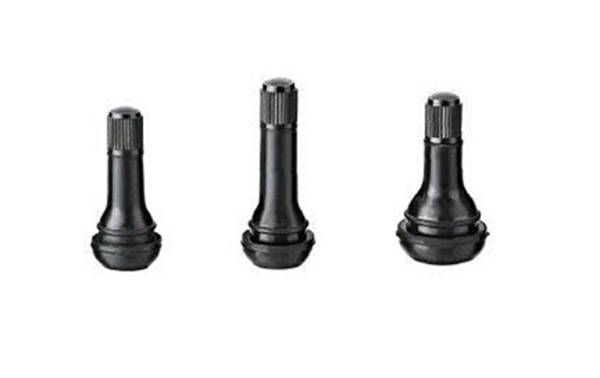
A valve stem is specified by two dimensions that a shelf label rarely shows: the rim hole diameter it snaps into, and the effective length that clears the wheel. Everything else — core, cap, rubber grade — is either shared across the family or specified by the service limits.
| TR No. | Rim hole | Eff. length | Core | Cap |
|---|---|---|---|---|
| TR412 | Ø11.5 mm / .453″ | 22 mm | 9002# | VC8 |
| TR413 | Ø11.5 mm / .453″ | 30 mm | 9002# | VC8 |
| TR414 | Ø11.5 mm / .453″ | 38 mm | 9002# | VC8 |
| TR414L | Ø11.5 mm / .453″ | 45 mm | 9002# | VC8 |
| TR418 | Ø11.5 mm / .453″ | 49 mm | 9002# | VC8 |
| TR423 | Ø11.5 mm / .453″ | 62 mm | 9002# | VC8 |
| TR415 | Ø16 mm / .625″ | 30 mm | 9002# | VC8 |
| TR425 | Ø16 mm / .626″ | 49 mm | 9002# | VC8 |
| TR438 | Ø8.8 mm / .346″ | 32 mm | 9002# | VC8 |
Because the table is a grid, not a sequence, so the first decision is which axis your customers pull on. For most distributors that is the 11.5 mm class in the middle of the length range, with the extremes and the two other hole classes held as coverage. The 11.5 mm spread is 40 mm, from the 22 mm TR412 to the 62 mm TR423, in uneven steps.
Tiering the Range: A, B and C
The workable structure is three tiers, and the split is by how often a number is asked for rather than by how it is priced. Tier A is the daily line: TR413, TR414 and TR414L, the three mid-length 11.5 mm numbers. Tier B is coverage: TR412, TR418 and TR423 at the length extremes, plus TR415, TR425 and TR438. Tier C is order-in: metal clamp-in, high-pressure series and TPMS kits.
| Tier | Numbers | Why it belongs there |
|---|---|---|
| A — daily | TR413, TR414, TR414L | The middle of the 11.5 mm length range, where most wheel and hub-cap combinations sit |
| B — coverage | TR412, TR418, TR423, TR415, TR425, TR438 | Depth at the ends of the length range plus the 16 mm and 8.8 mm hole classes |
| C — order-in | TR570, V-5, V3-20, TR540, TR416, MS525, high-pressure series, TPMS kits | Fitment-specific, lower turnover, often tied to one vehicle programme |
Because tier B exists to stop a lost sale rather than to earn margin, so it is planned by coverage and not by forecast, which usually means a shallow facing quantity and a reorder rule rather than a stock position. I would rather see six tier-B numbers at two facings each than three at ten, because the sale that walks out is the one where a length or hole class was missing.
The Accessory Spine: One Core, One Cap
All nine snap-in numbers share a 9002# core and a VC8 cap, so one accessory line covers the whole matrix. That is the most useful fact in a distributor plan: accessory demand is broader than valve demand, and a customer who does not need a stem may still need a core or a cap.
The standards behind that interchangeability matter when a customer asks why one core fits everything. Tyre valve threads are standardised in ISO 4570:2002, which specifies limit dimensions and tolerances for three series of tyre valve threads, including 5V1 and 5V2; the published standard runs to five pages and is dated March 2002. Because the thread is standardised rather than proprietary, so a core range can be planned as one or two lines instead of one line per valve number.
Two cautions. Caps are not decorative: a missing cap lets moisture and grit into the core, which is a leak waiting to be blamed on the valve. And extensions are a fitment decision, not a substitute for length, because an extension on a short valve adds a joint the design never had.
The Second Catalog: Metal Valves and TPMS
Metal clamp-in valves and TPMS service kits are a different catalog with a different planning logic, and mixing them into the snap-in line distorts both. Our published metal range lists six series: TR570 in straight or bent form, V-5 for passenger car and light truck, V3-20 with a nickel-plated O-ring seal, TR540, TR416 and MS525.
The valve line is produced under the ISO/TS 16949-certified system stated on our product page, and the current automotive quality reference is IATF 16949:2016, maintained by the International Automotive Task Force and sitting under the general framework of ISO 9001:2026, published in September 2026. A clamp-in valve is chosen for a wheel and a pressure class, not a shelf position, and TPMS kits add a vehicle-programme dimension. Because demand for a clamp-in number is tied to a vehicle programme, not a general service interval, so it is planned against known fitment. Keep them in tier C with a fitment list, and do not let them take the shelf space the tier-A line needs.
The Replacement Cycle Sets the Reorder Rule
Valve stems are replaced with tires far more often than on their own, and that behaviour drives the reorder rule. Our published specification notes that a rubber valve body ages and loses elasticity, giving a service life of three to four years, similar to tire life, and recommends replacing it with the tire.
Two consequences follow. Valve demand tracks tire-change volume, including the seasonal peaks that dominate a workshop calendar. And attach rate is the number to watch: if a workshop replaces the valve every time it mounts a tire, consumption is a direct multiple of tire volume; if it does not, the missed replacement stays invisible until the valve fails.
Five Planning Mistakes That Fill a Shelf With Duplicates
These are the errors I see most often in distributor range plans, and each one is cheaper to fix on paper than in stock.
The five mistakes and the correction
- Buying by length without checking the hole class. A 30 mm valve exists in both the 11.5 mm and 16 mm classes, and they are not interchangeable.
- Stocking every length evenly. The 11.5 mm class spans 40 mm, but demand concentrates in the middle, so even facings across six numbers is a guaranteed slow-mover.
- Treating cores and caps as an afterthought. One core and one cap cover nine numbers, so a missing accessory line costs sales the valve stock cannot recover.
- Ignoring the pressure and temperature limits when specifying. The published series is rated to 65 PSI and minus 40 to plus 100 °C, and a customer outside that window needs the metal or high-pressure family.
- Mixing clamp-in and TPMS numbers into the fast-moving line. Fitment-specific parts sit idle at the front and push tier-A numbers into the back room.
A One-Page Planning Worksheet
Four columns and one afternoon will produce a defensible range for a distributor of almost any size. Column one is the rim-hole classes you actually see, taken from the wheels your customers service. Column two is the length range inside each class, from the wheel face and hub-cap depth. Column three is the accessory line, planned once for the whole matrix. Column four is the service limit, because a number that cannot be sold into a complying application is not coverage, it is stock.
Then apply the tier rule: tier A gets depth, tier B gets coverage and a reorder trigger, tier C gets a fitment list and an order-in note. If you want a second opinion, send the wheel types and applications you sell into and we will map them against the published matrix.
Conclusion: Plan the Grid, Then Buy the Numbers
A distributor’s valve range is decided by two columns — rim hole and effective length — and by one behaviour: the valve is replaced with the tire. Planning the grid first gives a smaller catalog that covers more wheels; planning by part number gives six lengths of the same valve and a gap where the 16 mm class should be.
Our published table is the reference for that exercise, and we can map a wheel list onto it. What we cannot do is tell you which numbers your market pulls, because that is a fact about your customers, not our catalog.
Which planning route fits your business
- Plan by the grid when you serve general repair and tire shops, where the 11.5 mm class in mid lengths does most of the work.
- Plan by fitment when you serve a fleet or a dealer programme, where a small number of wheel types and clamp-in valves dominate.
- Hold the 16 mm and 8.8 mm classes as coverage, not depth, unless a customer base pulls them regularly.
- Do not stock a number just because it is in a catalogue, because a catalog is a capability list, not a demand forecast.
Building a valve stem range?
Send the wheel types, applications and service limits you sell into, and we will map them against the published matrix.
Frequently Asked Questions About Tire Valve Stem SKU Planning
How many tire valve stem SKUs does a distributor actually need?
Fewer than the catalogue implies, if you plan by fitment rather than by part number. The published table has nine numbers in three rim-hole classes, and six of the nine are different lengths in the same 11.5 mm class. A practical starting line is the three mid-length 11.5 mm numbers plus one long and one short, with the 16 mm and 8.8 mm classes held as coverage.
What is the difference between the 11.5 mm and 16 mm valve stem classes?
The rim hole diameter, and therefore which wheel the valve fits. The published table lists TR412 to TR423 on an 11.5 mm (0.453 inch) hole, TR415 and TR425 on 16 mm (0.625 inch), and TR438 on 8.8 mm (0.346 inch). Buying by length alone is the most common error, because a 30 mm valve in the wrong hole class will not seal.
Why does effective length matter if the valve snaps into the same hole?
Because it is what the technician reaches with an air chuck and what clears the wheel face or hub cap. Inside the 11.5 mm class the published lengths run from 22 mm to 62 mm, a spread of 40 mm. A short valve on a deep-dish wheel is awkward to inflate; a long one on a flush alloy can foul the cap, so depth comes from the ends of the range.
Do valve cores and caps need their own SKU planning?
Yes, but a simple one, because accessory demand is broader than the valve matrix. In the published table all nine snap-in numbers share a 9002# core and a VC8 cap, so one core line and one cap line cover nine numbers. That is the cheapest coverage in the category, and the line that sells when a customer only needs a leak fixed.
When should a valve stem be replaced?
In practice, when the tire is replaced, unless there is reason to do it earlier. The published specification notes that a rubber valve body ages, cracks and loses elasticity, giving a service life of three to four years, similar to tire life. Because the rubber ages independently of tread depth, so the decision belongs in the tire change process, not a separate interval.
What pressure does a standard snap-in valve handle?
The published TR413 series table states a maximum cold inflation pressure of 65 PSI, a maximum rim thickness of 4 mm and an operating range of minus 40 to plus 100 degrees C. Above that pressure the catalogue moves to high-pressure and metal clamp-in series, which is why the metal family belongs in a separate tier.
Bobby is a manager at Ningbo Fortune Auto Parts Manufacture Co., Ltd., the Ningbo-based manufacturer founded in 1996 that produces wheel balance weights, tire valves and tool accessories. His work sits between the factory and the distributor: range planning, specification questions and export supply for customers who buy valves and weights as a category rather than as single items.
Related reading
Last verified: 2026-11-09. Catalog numbers, rim-hole diameters, effective lengths, core and cap designations and service limits are transcribed from the published Fortune TR413 series product specification and are reproduced here as published data, not as independent test results. Category counts are taken from the published product navigation. No market size, market share or demand figure is claimed anywhere in this article, and no price or cost figure is published; commercial terms are quoted per order. ISO 4570 and IATF 16949 references are as published by AFNOR and the International Automotive Task Force.
Post time: Nov-09-2026