




Table of Contents
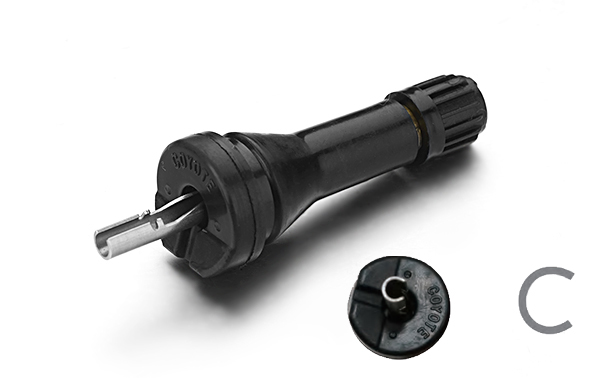
The valve-stem rod that connects a TPMS sensor to the wheel rim introduces a small but measurable RF attenuation at 433 MHz. Industry-standard reference: across the three most common rod materials — copper, aluminum, and brass — the relative signal-loss ranking is driven by conductivity, density, and skin depth at that frequency. For OEM buyers evaluating TPMS valve replacement kits and TPMS service kit repair assortments, the procurement decision should be made on per-material measured attenuation data, not on the generic assumption that “all metal is the same.” This article walks through the test protocol, the three material profiles, and the procurement implications.
Why TPMS valve stem material matters at 433 MHz
TPMS (Tyre Pressure Monitoring System) sensors communicate wirelessly with the vehicle’s receiver, typically at 433 MHz in the EU / most-of-Asia band and 315 MHz in the US / Japan band. The link-budget calculation has to absorb losses from the wheel rim, the tire, the hub, and the valve-stem assembly. The valve stem is a small but real contributor — it sits between the sensor and the surrounding metal environment, and its rod material determines how much of the sensor’s transmit energy is lost on the way out.
For an OEM buyer, “the right rod material” is rarely just about corrosion resistance or thread strength — it is also about how much link margin remains after the valve stem has done its job. A valve stem that introduces 1–2 dB of insertion loss at 433 MHz can be the difference between a sensor that reports reliably in a winter-tire alloy-wheel configuration and one that intermittently drops out at highway speeds.
Fortune Wheel Parts has supplied tire valves and TPMS service kits to OEM and aftermarket buyers since 1996 under the leadership of Bobby, and material validation at the relevant RF band is one of the most frequent OEM requests we receive.
The RF signal interference mechanism overview
Industry-standard reference: an RF signal traveling through a conductive medium is attenuated by three primary mechanisms — ohmic loss (resistive heating in the conductor), skin-effect loss (current crowding near the surface at higher frequencies), and re-radiation loss (energy coupling back into the surrounding environment). For a TPMS valve-stem rod, the dominant mechanism at 433 MHz is ohmic + skin-effect loss, with the rod acting as a small but lossy antenna extension.
The attenuation in dB per unit length scales with the material’s conductivity, magnetic permeability, and density. Aluminum has a favorable combination of low density and adequate conductivity at 433 MHz, which typically puts it at the low-attenuation end of the rod-material ranking. Copper has higher absolute conductivity but also higher density, which shifts its ranking. Brass, being a copper-zinc alloy, sits between the two on most test fixtures.
For an OEM buyer, the practical question is not “which material wins on conductivity” but “which material introduces the least RF attenuation at the specific 433 MHz frequency, in the specific valve-stem geometry, in the specific wheel assembly.” The supplier should be able to provide a measured dB-per-meter number, not a generic material-property estimate.
Test protocol and frequency bands
Industry-standard reference: a defensible RF attenuation test for a TPMS valve-stem rod uses a calibrated reference antenna, a known-power signal source at the target frequency, and a vector network analyzer (VNA) or spectrum analyzer with tracking generator. The valve-stem rod is mounted in a fixture that mimics the production wheel assembly, and insertion loss is measured across the relevant frequency band.
| Parameter | 315 MHz (US/JP) | 433 MHz (EU/Asia) | 868 MHz (some EU) |
|---|---|---|---|
| Typical signal loss per rod (dB) | 0.3–0.8 | 0.5–1.5 | 1.0–2.5 |
| Skin depth at frequency | ~65 µm (Cu), ~80 µm (Al), ~70 µm (Brass) | ~55 µm (Cu), ~67 µm (Al), ~58 µm (Brass) | ~38 µm (Cu), ~47 µm (Al), ~40 µm (Brass) |
| Dominant OEM markets | USA, Japan, Korea | EU, China, Southeast Asia | Selected EU-adjacent markets |
| Typical sensor output power | ~5–10 dBm | ~5–10 dBm | ~5–10 dBm |
Industry-standard observation: signal-loss numbers above are typical industry observations, not Fortune Wheel Parts-specific test data. OEM buyers verifying these numbers should request a per-supplier measured value at the target frequency.
Copper rod — attenuation profile at 433 MHz
Industry-standard reference: copper has the highest absolute electrical conductivity of the three materials in this comparison. At 433 MHz, that translates into relatively low resistive loss per unit length, but copper’s higher density means a given length of copper rod has more mass in the signal path than the same length of aluminum. The net per-rod attenuation typically lands in the middle of the three-material ranking.
Copper is also the most prone to galvanic corrosion when paired with aluminum rim components, which is why copper TPMS valve rods are less common in OEM wheel assemblies than brass or aluminum. For OEM buyers evaluating copper specifically, the validation checklist should include both the RF attenuation measurement and a galvanic-corrosion review with the rim material.
Aluminum rod — attenuation profile at 433 MHz
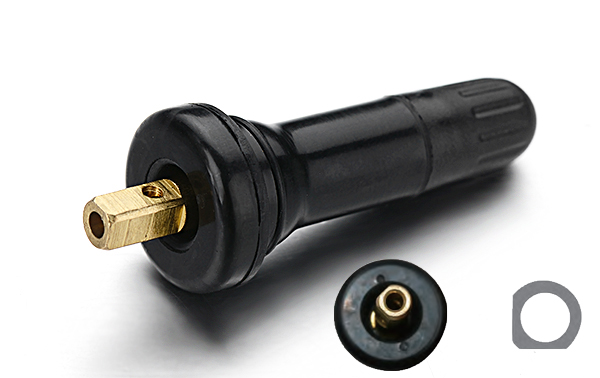
Industry-standard reference: aluminum has roughly 60% of copper’s conductivity but roughly 30% of copper’s density. At 433 MHz, the skin-depth ratio works in aluminum’s favor, and the per-rod attenuation typically lands at the low end of the three-material ranking. This is why aluminum is increasingly specified in OEM premium wheel programs where link-margin headroom is at a premium.
The trade-offs for aluminum are mechanical — softer thread engagement, lower fatigue life in high-vibration applications, and more aggressive corrosion behavior in chloride-rich environments (winter road salt, marine use). For OEM buyers targeting EU passenger-car markets, aluminum is often the default; for fleet and commercial-truck markets, brass remains the default.
Brass rod — attenuation profile at 433 MHz
Industry-standard reference: brass is a copper-zinc alloy with conductivity typically 25–35% of pure copper and density roughly 80% of pure copper. At 433 MHz, brass typically lands between aluminum and copper on the per-rod attenuation ranking. Where brass wins decisively is on mechanical robustness — thread integrity under repeated torque cycles, fatigue life in high-vibration wheels, and corrosion resistance in chloride-rich environments.
For OEM buyers evaluating brass TPMS valve stems, the procurement question is whether the small additional RF attenuation (typically < 0.5 dB relative to aluminum at 433 MHz, supplier-specific) is acceptable in exchange for the mechanical and corrosion benefits. For most fleet applications, it is. For premium OEM wheel programs with tight link-budget margin, it is a case-by-case decision.
For a catalog view of Fortune Wheel Parts TPMS valve options, see the TPMS valve replacement kits and the TPMS service kit repair assortment pages.
Material comparison — 3-material benchmark
The table below summarises the three materials across six procurement-relevant dimensions. Values are industry-standard reference ranges; supplier-specific measurements should be requested for OEM qualification.
| Dimension | Copper | Aluminum | Brass |
|---|---|---|---|
| Conductivity (% IACS, typical) | ~100% | ~61% | ~28% |
| Density (g/cm³) | 8.96 | 2.70 | 8.40–8.73 |
| Typical RF signal loss at 433 MHz (dB/rod, relative ranking) | Mid | Lowest | Mid-to-high |
| Mechanical robustness (thread + fatigue) | Good | Moderate | Excellent |
| Corrosion resistance (chloride-rich environments) | Moderate (galvanic risk) | Lower | Excellent |
| Typical OEM fitment | Specialty / industrial | Premium passenger | Fleet / commercial truck |
Industry-standard observation: the per-rod RF signal-loss ranking above is a typical industry pattern, not a Fortune Wheel Parts-specific measured value. OEM buyers verifying these numbers for a specific valve-stem geometry should request a measured value from the supplier at the target frequency.
Procurement implications for OEM buyers
For an OEM buyer sourcing TPMS valve stems, three procurement rules consistently come out of the material-validation process:
| Rule | Why it matters | What to ask the supplier |
|---|---|---|
| 1. Specify the target frequency | 315 MHz, 433 MHz, and 868 MHz all need separate validation | “Provide measured attenuation at 315 / 433 / 868 MHz for the specific rod geometry” |
| 2. Specify the wheel assembly | Steel rim vs alloy rim changes the baseline | “Provide attenuation in the target wheel-assembly fixture, not just free-space” |
| 3. Specify the regulatory target market | EU RED, US FCC Part 15, Japan MIC, China SRRC all differ | “Identify the certification scope of the valve stem at the target market” |
For OEM buyers who want to validate material performance before placing a volume order, the practical path is to request a per-material measured attenuation report at the target frequency, validate the result against the sensor’s link-budget margin, and only then move to the volume procurement discussion.
Request TPMS valve material specs
If you are an OEM or aftermarket distributor evaluating TPMS valve stem material options for a specific target market and frequency band, submit your inquiry via the request TPMS valve material specs page. Fortune Wheel Parts can provide per-material measured attenuation data at 315 / 433 / 868 MHz for the valve-stem geometries in current production.
Request TPMS valve material specs
Submit your inquiry via the request TPMS valve material specs page.
FAQ
Does TPMS valve stem material affect 433 MHz sensor transmission?
Industry-standard reference: yes — the rod material that sits between the TPMS sensor and the wheel rim can introduce measurable signal attenuation at 433 MHz. The effect is small in absolute terms but compounds in dense wheel assemblies (steel rim + alloy rim + TPMS valve stack). OEM buyers should require per-material attenuation data rather than relying on the generic “metal is fine” assumption.
Which material has the highest RF signal loss — copper, aluminum, or brass?
Industry-standard reference: at 433 MHz, the relative RF attenuation ranking across copper, aluminum, and brass rod materials depends on conductivity, density, and skin depth at that frequency. In most OEM test setups, aluminum shows the lowest signal loss per unit length because of its lower density and favorable skin-depth profile, while copper and brass sit in the higher-loss band. Specific dB-per-meter numbers vary between test fixtures and must be confirmed by the supplier.
Is brass or aluminum better for TPMS valve stems?
Industry-standard reference: “better” depends on the OEM’s priority weighting. Aluminum typically wins on RF transparency and weight. Brass typically wins on mechanical robustness, thread integrity, and corrosion resistance in chloride-rich environments. For fleet applications that prioritise durability, brass is often the default; for premium OEM wheel applications that prioritise signal margin, aluminum is increasingly specified.
Do all TPMS sensors use 433 MHz?
Industry-standard reference: no — TPMS sensors are deployed in several regional frequency bands. 433 MHz is the dominant EU and most-of-Asia band. 315 MHz is the dominant US, Japan, and Korea band. 868 MHz is used in some short-range / EU-adjacent markets. Sensor selection and valve-stem material validation must be matched to the target market’s frequency.
How much signal loss is acceptable for OEM-grade TPMS?
Industry-standard reference: the OEM-grade TPMS link budget typically tolerates a few dB of insertion loss at the valve-stem level (the exact value depends on the sensor’s output power, the receiver’s sensitivity, and the vehicle’s antenna placement). The supplier should provide a measured attenuation number for the specific valve-stem material in use, not a generic material-property estimate.
What is the difference between 315 MHz and 433 MHz TPMS?
Industry-standard reference: 315 MHz and 433 MHz are two regional TPMS carrier frequencies. 315 MHz is used in the US, Japan, and Korea; 433 MHz is used in the EU, China, and most of Asia. The sensor hardware, antenna design, and link-budget calculation are different for each band, which is why OEM buyers must specify the target market rather than relying on a universal “TPMS sensor.”
Note on external standards and methodology
This article references SAE J661 for vibration testing methodology and the broader automotive EMC framework defined under ITU regional radio regulations as industry-standard reference points. TPMS regulatory certification is anchored to the relevant regional radio authority — US eCFR Title 47 Part 15 in the US, ETSI EN 300 220 in the EU, and the applicable national radio authority in China, Japan, and Korea. Per-material RF attenuation numbers cited above are typical industry observations, not Fortune Wheel Parts-specific measured values; OEM buyers verifying any of these numbers should request a measured report from the supplier at the target frequency. Material certification for OEM-grade TPMS valve stems is typically validated by IATF-accredited labs such as SGS, Bureau Veritas, or Intertek.
Post time: Aug-05-2026