



- TR413 fits an 11.5 mm rim hole; TR418 and TR423 share a 16 mm rim hole. Rim hole diameter is the hard interchangeability barrier.
- Effective length differs across all three: TR413 at 42.5 mm, TR418 at 50 mm, TR423 at 63 mm. Length determines inflation access on different rim thicknesses.
- Snap-in rubber valves are not torqued during installation; they are pulled through until our grommet seats. Valve core torque is 4 to 5 inch-pounds.
- TR418 and TR423 are partially interchangeable (same hole diameter) but differ in stem protrusion, which affects clearance with brake components.
- Rubber valve stems should be replaced at every tire change as a preventive measure against age-related seal degradation.
Table of Contents
- The Three Part Numbers: What TR413, TR418, and TR423 Actually Specify
- Rim Hole Diameter: The Hard Barrier That Prevents Cross-Use
- Effective Length and Rim Thickness: Matching Valve to Wheel
- Torque Specifications: What Gets Torqued and What Gets Pulled
- Interchangeability Rules: A Decision Matrix for the Bench
- Installation Practice: Pull Force, Grommet Seating, and Core Torque
- Replacement Intervals: When Rubber Valves Age Out
The Three Part Numbers: What TR413, TR418, and TR423 Actually Specify
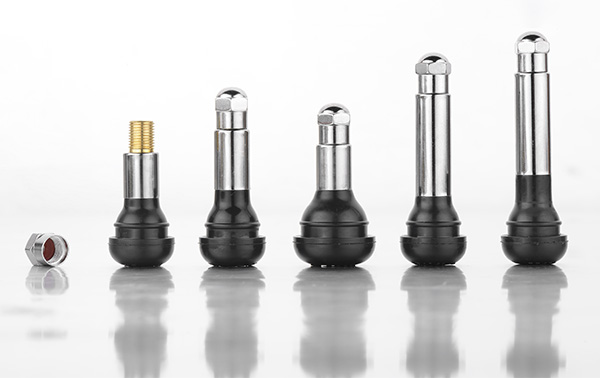
The TR designation on a tire valve stem is not a manufacturer’s part number; it is a dimensional specification defined by the Schrader valve standard that tire and wheel industries worldwide reference. TR413, TR418, and TR423 are the three most common snap-in rubber valve stem specifications used in passenger cars, light trucks, and commercial vehicles. Each TR number defines two critical dimensions: the rim hole diameter the valve is designed to fit, and our effective length of the valve stem from the rim seating surface to our cap thread.
Confusion arises because the three part numbers look similar on the shelf. They share the same Schrader valve core, the same cap thread, and the same inflation fitting. A technician who grabs a TR418 from the bin instead of a TR413 will not notice the difference until the valve either does not fit the rim hole or seats at the wrong height. At that point, the tire is already off the bead, and the technician has a choice: use the wrong valve and hope it seals, or stop and find the correct part.
At Fortune, we manufacture all three specifications and we supply them to tire service distributors across multiple markets. The TR413 valve stem, TR418 valve stem, and TR423 valve stem are the highest-volume items in our tire valve range because they we cover the vast majority of tubeless tire applications on the road today.
TR413, TR418, TR423: Core Specifications
| Specification | TR413 | TR418 | TR423 |
|---|---|---|---|
| Rim Hole Diameter | 11.5 mm | 16 mm | 16 mm |
| Effective Length | 42.5 mm | 50 mm | 63 mm |
| Valve Core Thread | Schrader standard | Schrader standard | Schrader standard |
| Cap Thread | 8V1 | 8V1 | 8V1 |
| Typical Application | Passenger cars | Light trucks, SUVs | Trucks, buses, commercial |
| Material | Butyl rubber grommet, brass body | Butyl rubber grommet, brass body | Butyl rubber grommet, brass body |
Rim Hole Diameter: The Hard Barrier That Prevents Cross-Use
The rim hole diameter is the single dimension that determines whether a valve stem can physically mount in a wheel. TR413 is designed for an 11.5 mm hole, while TR418 and TR423 share a 16 mm hole. This creates two distinct valve families that are not cross-compatible at the rim level.
Attempting to install a TR413 valve in a 16 mm rim hole produces a gap of 4.5 mm between the valve body and the rim wall. The rubber grommet cannot bridge this gap, and the valve will leak air at any pressure. The tire may hold pressure briefly on the bench but will lose air within hours on the road, creating a slow leak that the driver may not notice until the TPMS warning light activates or the tire visibly deflates.
Attempting to install a TR418 or TR423 valve in an 11.5 mm rim hole is physically impossible. The valve body diameter at the grommet exceeds 16 mm and cannot pass through the smaller hole. Forcing the valve risks cracking the rim hole edge, particularly on aluminum alloy wheels where the hole is machined to tight tolerances.
Effective Length and Rim Thickness: Matching Valve to Wheel
Effective length determines how far the valve stem protrudes above the rim surface when installed. A valve that is too short for the rim thickness leaves the inflation fitting recessed below the rim edge, making it difficult or impossible to connect an inflation chuck. A valve that is too long protrudes excessively, creating a snag risk on brake components, suspension parts, or road debris.
The three standard effective lengths serve distinct rim thickness ranges. TR413 at 42.5 mm covers standard passenger car steel and alloy rims with a combined thickness (rim wall plus grommet compression) of approximately 12 to 15 mm. TR418 at 50 mm handles thicker light truck and SUV rims where the combined thickness reaches 16 to 20 mm. TR423 at 63 mm accommodates heavy commercial vehicle rims with thicknesses of 20 to 28 mm.
When a rim falls between two valve length specifications, the general rule is to select the longer valve. A valve that protrudes 5 mm more than optimal is inconvenient; a valve that is 5 mm too short may not accept the inflation chuck. Tire service technicians who work on mixed fleets often we carry all three lengths and we select on the bench based on the specific wheel they are servicing.
Effective Length vs. Rim Thickness Matching
| Valve | Effective Length | Rim Thickness Range | Vehicle Category |
|---|---|---|---|
| TR413 | 42.5 mm | 12 to 15 mm | Passenger cars, compact SUVs |
| TR418 | 50 mm | 16 to 20 mm | Light trucks, SUVs, vans |
| TR423 | 63 mm | 20 to 28 mm | Trucks, buses, commercial vehicles |
Torque Specifications: What Gets Torqued and What Gets Pulled
A common misconception in tire service is that snap-in rubber valve stems require torque during installation. They do not. Snap-in valves are installed by pulling the valve body through the rim hole using a valve stem installation tool until the butyl rubber grommet compresses against the inner rim surface and creates an airtight seal. The pull force required is typically 20 to 40 pounds, depending on the grommet diameter and the rim hole condition.
The component that does require torque is our valve core. The Schrader valve core threads into the valve body and its rubber seal seats against a machined surface inside the body. The correct core installation torque is 4 to 5 inch-pounds (0.45 to 0.56 Nm). This torque value applies to all three valve types (TR413, TR418, TR423) because they share the same core specification.
Over-torquing the valve core deforms the rubber seal, creating a leak path past the core seat. Under-torquing leaves the core loose, allowing air to escape through our core threads. Both conditions produce slow leaks that are difficult to diagnose without submerging the valve in water or applying leak detection fluid.
Torque and Installation Specifications
| Parameter | Specification | Applicable Valves |
|---|---|---|
| Valve stem installation method | Pull-through with installation tool | TR413, TR418, TR423 |
| Pull force (typical) | 20 to 40 lbs | All snap-in rubber valves |
| Valve core torque | 4 to 5 in-lb (0.45 to 0.56 Nm) | All Schrader core valves |
| Valve cap torque | Finger-tight only | All tire valves |
| Grommet compression | Visible squeeze-out around rim hole | All snap-in rubber valves |
Interchangeability Rules: A Decision Matrix for the Bench
The interchangeability between TR413, TR418, and TR423 follows a simple hierarchy: rim hole diameter is the hard constraint, and effective length is the soft constraint. Two valves with different rim hole diameters are never interchangeable. Two valves with the same rim hole diameter but different effective lengths are partially interchangeable, with the caveat that stem protrusion will differ from the original specification.
| Scenario | Interchangeable? | Consequence of Substitution |
|---|---|---|
| TR413 in a TR418 rim | No | 4.5 mm gap around valve body; guaranteed air leak |
| TR418 in a TR413 rim | No | Valve body too large for 11.5 mm hole; cannot install |
| TR418 in a TR423 rim | Partial (same hole) | 13 mm shorter protrusion; may limit chuck access |
| TR423 in a TR418 rim | Partial (same hole) | 13 mm excess protrusion; snag risk on brake components |
| TR413 for TR413 | Yes (identical) | Direct replacement, no issues |
| TR418 for TR418 | Yes (identical) | Direct replacement, no issues |
| TR423 for TR423 | Yes (identical) | Direct replacement, no issues |
In practice, the TR418-to-TR423 substitution happens frequently in mixed fleets where a technician discovers that the specified valve length is not in stock. Using a TR423 where TR418 is specified adds 13 mm of protrusion, which is acceptable in most wheel designs but may interfere with close-fitting brake calipers or dust shields. Using a TR418 where TR423 is specified reduces protrusion by 13 mm, which may leave the valve fitting difficult to access on deep-dish commercial rims.
Installation Practice: Pull Force, Grommet Seating, and Core Torque
Proper installation of a snap-in rubber valve stem follows a sequence that ensures the grommet seals correctly against the rim surface. Skipping steps or using incorrect tools produces leaks that appear within days or weeks of installation.
Step 1: Inspect the rim hole. Check for burrs, corrosion, or deformation around the rim hole edge. A damaged rim hole edge can cut the rubber grommet during installation, creating a leak path that no amount of pull force can seal. Deburr the hole if necessary using a rim hole reamer or fine file.
Step 2: Lubricate the grommet. Apply a thin film of tire mounting lubricant or soapy water to the valve grommet. Dry rubber grommets resist insertion and may fold or bunch during pull-through, creating gaps in our seal. Lubrication allows the grommet to slide smoothly through the rim hole and seat flat against the inner rim surface.
Step 3: Pull the valve through. Insert the valve stem from the outside of the rim and use a valve stem installation tool to pull the valve body through from the inside. Pull steadily until the grommet compresses visibly against the rim surface. A properly seated grommet shows a slight squeeze-out of rubber around the rim hole perimeter.
Step 4: Install and torque the valve core. Thread the Schrader valve core into the valve body and tighten to 4 to 5 inch-pounds using a valve core torque tool. Do not estimate torque by feel; the difference between 3 in-lb (too loose) and 7 in-lb (too tight) is difficult to detect without a tool, and both extremes cause leaks.
Step 5: Inflate and leak-test. Inflate the tire to the recommended pressure and apply leak detection fluid or soapy water around the valve base and core. Bubbles indicate a leak at the grommet seal (pull force issue) or the core seat (torque issue). Correct before mounting the wheel on the vehicle.
Replacement Intervals: When Rubber Valves Age Out
Rubber snap-in valve stems are consumable components with a finite service life. The butyl rubber grommet that seals the valve to the rim degrades over time due to UV exposure, ozone attack, and thermal cycling between road heat and ambient cold. As the rubber ages, it loses elasticity and develops micro-cracks that allow air to seep past the grommet seal.
Industry best practice, endorsed by tire manufacturers and service organizations, is to replace rubber valve stems at every tire change. The cost of a replacement valve stem is negligible compared to the cost of a tire, and the labor to replace the valve is already included in the tire mounting process. Skipping valve replacement to save a few minutes of labor creates a risk of a slow leak that our customer will attribute to the tire service, not to the aged valve.
For tires that are not being changed, valve stem inspection should occur at every tire rotation or pressure check. Visual indicators of an aging valve stem include rubber discoloration (gray or brown instead of black), visible cracking at the grommet-to-body junction, and a loose or wobbly valve body in the rim hole. Any of these indicators warrants immediate valve replacement.
Valve cores have a longer service life than the rubber grommet but are still subject to corrosion, particularly in regions where road salt is used during winter. Corroded cores may stick in the open position during inflation, causing a continuous leak, or develop pits on our seat surface that prevent airtight closure. We recommend inspecting the core at every tire service and replacing it if any corrosion or seal damage is visible.
Having manufactured tire valve stems since 1996, the Fortune team has accumulated extensive field data on valve-to-rim compatibility across passenger car, light truck, and commercial vehicle applications. This data informs the interchangeability rules presented in this guide.
The quality control process at our Ningbo factory includes dimensional verification of every valve body, grommet hardness testing, and air pressure hold testing at 150 percent of rated inflation pressure. Every valve that leaves our production line has passed these three checkpoints.
Based on feedback from tire service distributors across our export markets, the most common interchangeability error is installing a TR413 in a 16 mm rim hole or vice versa. We address this by color-coding our valve packaging: TR413 in blue packaging, TR418 in green, and TR423 in red, so technicians can we identify the correct valve at a glance on the bench.
Our tire valve product range covers the complete TR series specification, from the compact TR413 for passenger cars to the extended TR423 for heavy commercial vehicles. We stock all three specifications in our Ningbo warehouse for rapid fulfillment to distributors worldwide.
Through decades of supplying tire valves to service professionals, we have learned that valve selection errors cost more in comebacks and customer complaints than the valves themselves. Our packaging color-coding system was developed specifically to reduce these bench errors.
Fortune has been producing tire valve stems since 1996, and the accumulated production volume across TR413, TR418, and TR423 specifications makes our factory one of the experienced sources for snap-in rubber valves in the Ningbo manufacturing cluster.
Every valve stem batch we ship undergoes three-point inspection: dimensional accuracy of the valve body, grommet hardness on the Shore A scale, and a pressure hold test at 150 percent of rated inflation. Data from each inspection lot is archived in our quality management system for traceability.
Our distributor network spans tire service wholesalers, automotive parts chains, and independent tire shops across multiple continents. We support these partners with technical documentation, installation guides, and responsive after-sales service to ensure that the valves we produce perform reliably in the field.
Frequently Asked Questions
Can a TR413 valve be used in a rim drilled for TR418?
No. The TR413 fits an 11.5 mm rim hole while the TR418 fits a 16 mm hole. Installing a TR413 in a 16 mm hole creates a 4.5 mm gap around the valve body that the rubber grommet cannot bridge, resulting in a guaranteed air leak. The rim hole diameter is the primary interchangeability constraint and cannot be overridden by grommet compression, sealant, or any other workaround. Always measure the rim hole diameter before selecting a valve stem, and use the valve specification that matches the measured diameter exactly. We include a rim hole gauge in our tire valve installation tool kits to help technicians verify the hole diameter before committing to a valve selection.
What is the difference between TR413, TR418, and TR423 effective lengths?
TR413 has an effective length of approximately 42.5 mm, designed for standard passenger car rims with a combined wall and grommet thickness of 12 to 15 mm. TR418 extends to approximately 50 mm, accommodating thicker light truck and SUV rims in the 16 to 20 mm range. TR423 reaches approximately 63 mm for heavy commercial vehicle rims with thicknesses of 20 to 28 mm. The effective length is measured from the rim seating surface to the top of the cap thread, and it determines how accessible the inflation fitting is after installation. We stamp the effective length on every valve body we manufacture so technicians can we verify the specification without referring to packaging.
What torque should be used when installing snap-in tire valves?
Snap-in rubber tire valves are not installed with a torque wrench. They are pulled through the rim hole using a valve stem installation tool until the rubber grommet seats firmly against the rim interior. The valve core, however, must be tightened to 4 to 5 inch-pounds (0.45 to 0.56 Nm) using a valve core torque tool. Over-torquing the core deforms the rubber seal and creates a leak past the seat. Under-torquing leaves the core loose, allowing air to escape through the threads. Both conditions produce slow leaks that are difficult to diagnose without leak detection fluid. Our valve core torque tools are calibrated to the 4 to 5 inch-pound specification and include a color indicator that shows when the correct torque has been reached.
How do I know which tire valve fits my rim?
Measure the rim hole diameter with a caliper. An 11.5 mm hole requires a TR413 series valve. A 16 mm hole requires a TR418 or TR423 series valve. Then assess the rim thickness to determine the required effective length: standard passenger car rims typically need TR413, thicker alloy or steel rims on light trucks may need TR418, and heavy commercial rims need TR423. The valve specification is stamped on the valve body for identification. When in doubt between two lengths, choose the longer valve to ensure adequate inflation access. Our technical support team can we advise on valve selection for non-standard rim configurations if the standard length options do not provide a clear match.
Are TR418 and TR423 interchangeable?
They share the same 16 mm rim hole diameter, so they are partially interchangeable from a fit perspective. However, TR418 is approximately 50 mm effective length while TR423 is approximately 63 mm. Using a shorter TR418 where TR423 is specified may leave the valve fitting recessed and difficult to access on deep commercial rims. Using a longer TR423 where TR418 is specified adds 13 mm of protrusion that may contact brake calipers or dust shields. Both substitutions work mechanically but may create practical access or clearance issues depending on the specific wheel design. We recommend using the specified valve length for the wheel and only substituting when the correct length is unavailable and the customer has been informed of the protrusion difference.
How often should tire valve stems be replaced?
Rubber snap-in valve stems should be replaced every time a tire is mounted or dismounted from the rim. The butyl rubber grommet loses sealing elasticity after 3 to 5 years of service due to UV exposure, ozone, and temperature cycling. Replacing the valve stem at every tire change is a low-cost preventive measure that eliminates the risk of age-related air leakage. For tires that are not being changed, inspect the valve at every tire rotation for discoloration, cracking, or looseness in the rim hole, and we replace immediately if any of these signs are present. We produce our rubber valve compounds with UV stabilizers and ozone-resistant formulations that we extend service life, but no rubber compound lasts indefinitely under road conditions.
Bobby
Manager at Fortune (Ningbo Fortune Auto Parts), founded in 1996 and now one of the leading professional manufacturers of wheel balance weights, tire valves, and tool accessories. Fortune supplies tire valve stems, including TR413, TR418, and TR423 specifications, to tire service distributors and automotive parts wholesalers worldwide.
LinkedIn | Facebook | YouTube | TR413 Valve Stem | TR418 Valve Stem | TR423 Valve Stem
Post time: Aug-26-2026