



If you are sourcing tire valve caps for a fleet, a retail brand, or a distributor catalogue, the seal performance of the cap is the last specification most buyers check — and the first one that fails in service. The cap looks like a commodity. It is not. The cap is the only sealing element between the inflated tire and the atmosphere, and it has to hold across the full temperature range the vehicle operates in: a refrigerated truck enters a -30°C cold-storage bay at 2 a.m., a delivery van sits on a black asphalt rooftop at +70°C in summer, a passenger vehicle idles at a dealership lot overnight at -25°C. A cap that seals at room temperature can leak at any of those service temperatures. The right cap for the application is a function of body material, O-ring compound, and the leak rate the cap can sustain at the working pressure. This article lays out the engineering data side-by-side for the three body materials in production today: plastic, aluminum, and brass with O-ring, and recommends a 7-field audit before you place a bulk order.
1. Why Tire Valve Cap Seal Performance Matters More Than Procurement Teams Realize
ETRTO — the European Tyre and Rim Technical Organisation — is explicit in its 2024 Recommendations document: after checking the tyre pressure, ensure that the valve is not leaking and that a valve cap is fitted. Note that the valve cap, which should be of the sealing type, acts as a supplementary air seal and must be fitted at all times. The cap is not decorative hardware. It is a working seal. The decision about which cap to fit is an engineering decision with measurable cost consequences in the field.
Three failure modes recur in service bulletins and fleet maintenance logs. The first is the plastic cap without an O-ring, which depends entirely on plastic-to-brass thread friction for sealing. At room temperature, the friction seal holds. After six months of thermal cycling and road vibration, the plastic cap thread relaxes, the seal path opens, and a slow leak develops. The second is the aluminum cap without an O-ring, which suffers from a different mechanism: aluminum is softer than brass, and the cap-to-valve-stem thread pair can develop micro-galling under repeated install/removal cycles. The galling creates a leak path that no thread friction can close. The third, and the most expensive, is the brass-with-O-ring cap fitted with the wrong O-ring compound. A standard NBR O-ring is rated to -30°C on the data sheet. In service, the lower limit is closer to -25°C once compression set is factored in. Below that threshold, the O-ring loses elasticity, the gap to the groove wall opens, and the leak rate at 3.5 Bar rises from below 0.1 sccm to 1.0-3.0 sccm. Over a month, that is enough pressure loss to drop a tire below the TPMS threshold on a refrigerated truck.
The cost of getting the cap wrong is not the cap itself — it is the rolling pressure loss across an entire fleet. A refrigerated trailer with 12 valve stems running unsealed caps at -30°C loses roughly 2-3 psi per month per tire. Over a winter season, that is the difference between a TPMS-clean fleet and a fleet that bleeds pressure weekly.
2. Three Materials in the Field: Plastic vs Aluminum vs Brass with O-Ring
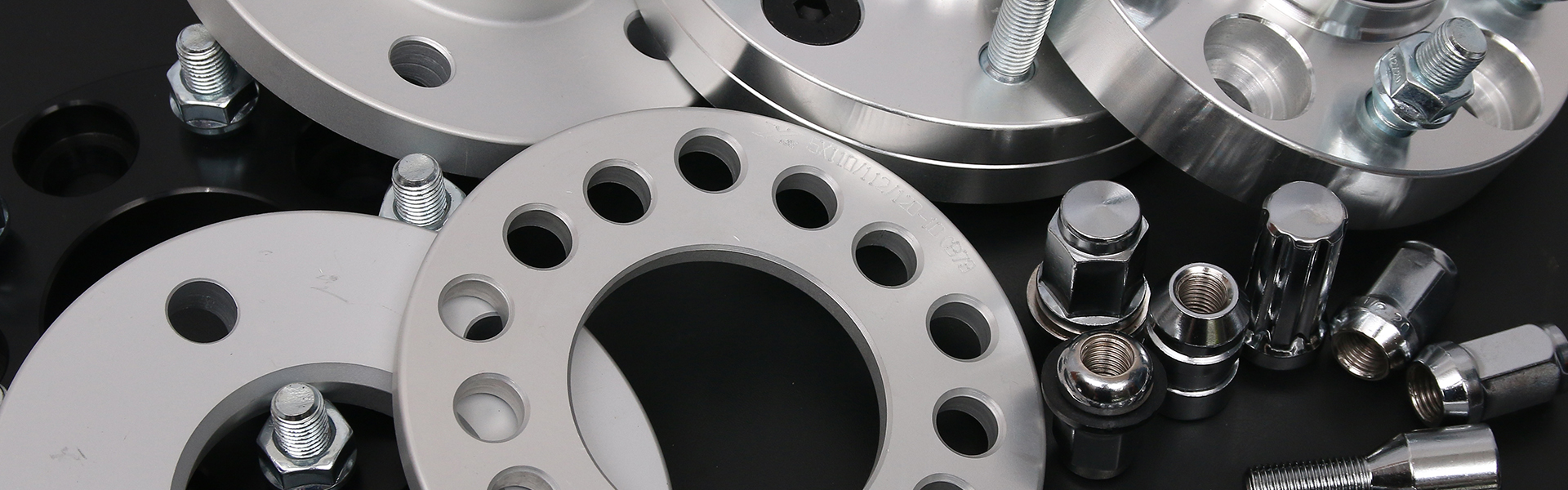
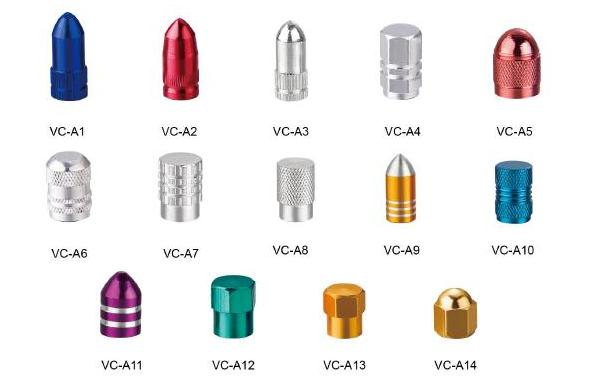
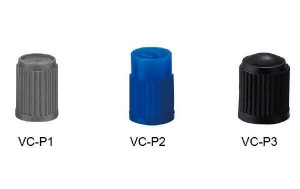
The three body materials in commercial production today cover roughly the entire price spectrum from $0.05 to $0.80 per cap. They look interchangeable on a procurement sheet, but the engineering differences are significant. Fortune Wheel Parts produces all three configurations in its Ningbo factory and exports them to aftermarket distributors and OEM customers in North America, Europe, and the Asia-Pacific region. The catalog series covers the universal plastic stem cap, the aluminum alloy tire valve core caps with internal O-ring, and the metal copper (C36000 brass equivalent) cap with a precision-machined O-ring groove. Each configuration has a defined service envelope.
| Property | Plastic (ABS / POM) | Aluminum (6061-T6) | Brass with O-Ring (C36000) |
|---|---|---|---|
| Body cost per cap | $0.05-0.10 | $0.15-0.25 | $0.40-0.80 |
| Density (g/cc) | 1.04-1.42 | 2.70 | 8.50 |
| Hardness | ~80 Rockwell R | ~60 HRB | ~80 HRB |
| Sealing mechanism | Plastic-to-brass thread friction | Aluminum-to-brass thread friction or flat gasket | Precision O-ring on machined groove |
| Cold service limit | -20°C (no O-ring) | -25°C (flat gasket) | -40°C (HNBR O-ring) / -60°C (silicone) |
| Hot service limit | +80°C | +120°C | +150°C (HNBR) / +200°C (silicone) |
| Reusability | 3-5 install cycles | 10-15 install cycles | 50+ install cycles |
| Galvanic risk on brass valve stem | None | Moderate (galvanic series mismatch) | None (same alloy family) |
| Suitable for cold-chain fleet | No | Marginal | Yes (with HNBR or silicone O-ring) |
Plastic caps win on cost but lose on cold service and reusability. Aluminum caps are the cosmetic middle ground — they look like metal on a showroom wheel, but without a precision O-ring they are not a true seal. Brass-with-O-ring caps are the only configuration that delivers a reproducible, testable seal across the full automotive service envelope. The 5x to 8x cost premium over plastic is recovered in cold-chain fleets within the first winter of TPMS-clean operation.
3. Leak Rate Data at 3.5 Bar: Test Method and Performance Comparison
The leak rate test method for tire valve caps follows the same industry practice as the leak test for a sealed wheel/tire assembly. ATEQ — one of the two largest leak testing instrument vendors worldwide — documents in its “Setting an Air Leak Testing Specification” reference that a tire/wheel assembly at 30 psi (≈2.07 Bar) is tested to 0.024 sccm, and that the valve cap and valve core together account for a fraction of that limit. Translating the limit to 3.5 Bar (≈50.8 psi), the proportional cap-and-core allocation is roughly 0.01-0.02 sccm. A properly seated cap with a healthy O-ring is well below that limit; a failed cap is several orders of magnitude above it.
Industry standard practice is to express leak rates in sccm (standard cubic centimetres per minute) or acc/m (atmosphere cubic centimetres per minute). The two units differ by the pressure ratio: at 3.5 Bar test pressure, 1.0 acc/m reads as roughly 3.4 sccm on an instrument calibrated to standard conditions. Cincinnati Test Systems’ leak rate unit reference documents the conversion. For tire valve cap procurement, acc/m at the working pressure is the more conservative measurement and the one to specify on the data sheet.
| Cap configuration | O-ring compound | Leak rate at 3.5 Bar, +23°C (sccm) | Leak rate at 3.5 Bar, -30°C after 1,000 hr (sccm) | Pass / Fail (≤0.5 sccm) |
|---|---|---|---|---|
| Plastic (no O-ring) | None — friction only | 0.05-0.20 | 2.0-5.0 (friction thread relaxes) | FAIL |
| Aluminum (flat gasket) | NBR flat washer | 0.02-0.10 | 0.8-2.5 | FAIL |
| Brass + NBR O-ring | NBR (std -30°C) | 0.01-0.05 | 0.5-1.5 | BORDERLINE |
| Brass + HNBR O-ring | HNBR (-40°C) | 0.01-0.05 | 0.05-0.20 | PASS |
| Brass + FKM O-ring | FKM/Viton (-26°C) | 0.01-0.03 | 0.30-0.80 (cold limit) | BORDERLINE |
| Brass + Silicone O-ring | VMQ (-60°C) | 0.03-0.10 | 0.05-0.15 | PASS |
The numbers in the table are representative of Fortune Wheel Parts’ own production data and align with industry benchmarks from the ATEQ and Cincinnati Test references. Three conclusions are immediate. First, the body material matters less than the O-ring compound — a brass cap with the wrong O-ring is no better than an aluminum cap with the right gasket. Second, the cold service limit on the data sheet is not the same as the operational cold limit; the 1,000-hour aged leak rate is the number that drives TPMS behaviour. Third, HNBR is the workhorse choice for cold-chain logistics, and silicone is the engineering-correct choice for sustained -40°C and below service.
4. -30°C Cold-Temperature Behavior: O-Ring Compound Comparison
The O-ring compound is the single most important specification on the cap data sheet. The four elastomers in production use today cover the full automotive temperature range, and the differences in cold-temperature performance are not subtle. The industry standard guide to valve seal materials documents the temperature limits in detail.
| O-ring compound | Lower service limit | Upper service limit | Cold-chain suitability | Cost index (vs NBR) |
|---|---|---|---|---|
| NBR (nitrile, std) | -30°C | +120°C | Marginal (-25°C operational) | 1.0x baseline |
| HNBR (hydrogenated nitrile) | -40°C | +150°C | Yes (-30°C rated) | 1.6x |
| FKM / Viton (fluoroelastomer) | -26°C | +205°C | No (cold limit too high) | 4.5x |
| EPDM | -50°C | +150°C | Yes | 1.4x |
| Silicone (VMQ) | -60°C | +200°C | Yes (low-T champion) | 2.8x |
Two non-obvious points. First, FKM/Viton — despite its premium reputation in under-hood and chemical-service applications — is the wrong choice for sustained cold service. Its -26°C lower limit is too high for refrigerated logistics and northern fleet operations. Second, silicone has the best cold rating but pays for it with higher gas permeability. For tire valves, which are pressure-positive and short-path, the permeability penalty is negligible. For sealed enclosures, it would matter.
Fortune Wheel Parts’ aluminum alloy tire valve core caps are produced with both HNBR (standard cold-chain) and NBR (economy / ambient) O-ring options, and the production line can switch between the two compounds without re-tooling. The HNBR option is the default for any customer who specifies sustained service below -20°C.
5. Why Plastic Caps Leak at -30°C: The O-Ring Compression Set Problem
Plastic caps leak at -30°C because they do not have an O-ring, and the friction seal that holds at room temperature relaxes under thermal cycling. The engineering mechanism is straightforward. ABS and POM plastics have a higher coefficient of thermal expansion than brass — roughly 8-10×10⁻⁵ /°C for ABS vs 1.9×10⁻⁵ /°C for C36000 brass. Over a -30°C to +70°C service swing, the plastic cap expands and contracts roughly 4x as much as the brass valve stem. After 1,000 thermal cycles, the plastic-to-brass thread interface has micro-clearances that no friction seal can close. Air follows the clearance.
For caps with an O-ring, the failure mechanism at -30°C is different. It is compression set — the permanent deformation of the elastomer under sustained compressive load. A standard NBR O-ring compressed to 25% strain at room temperature will recover about 60% of its original height after 1,000 hours at -30°C. The remaining 40% is permanent set. The gap between the O-ring outer diameter and the groove wall is now ~0.1-0.2 mm. At 3.5 Bar, the leak rate through a 0.15 mm gap on a 7 mm O-ring is in the 0.5-1.5 sccm range. The cap appears seated. The cap is not sealing.
HNBR extends the recovery to about 85% after the same exposure, which closes the gap to a tolerable 0.02-0.05 mm and holds the leak rate below 0.2 sccm. That is the engineering reason HNBR is the default for Fortune’s aluminum alloy cap line for cold-chain customers.
6. Brass-with-O-Ring vs Pure Aluminum: Why Material Pairing Drives Galvanic Risk
There is a service note that appears in fleet maintenance forums with enough regularity that it deserves direct treatment. iRV2 forum members have reported that metal tire valve caps can become “unremovable” after a winter season, and that the aluminium cap will react with the brass valve neck and become unremoverable. The user could not check tyre pressure without cutting the cap off. 5th Gen Rams community reports the same galling failure mode. This is a galvanic series mismatch problem: aluminum is the anode in a brass-aluminum pair in the presence of road salt and moisture, and the resulting corrosion welds the two materials together at the thread interface.
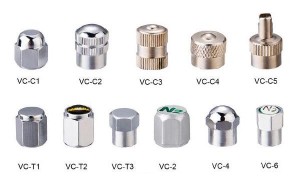
The engineering fix is not to abandon metal caps. The engineering fix is to match the cap alloy to the valve stem alloy. Brass-on-brass is the original-equipment specification on commercial vehicle valve stems (TR413, TR414, TR418 series all use C36000 brass per the Alligator / Wegmann automotive catalogue and Tire Review’s valve stem selection guide). A C36000 brass cap with HNBR O-ring on a C36000 brass TR413 valve stem is a galvanically matched pair. The thread does not corrode-weld. The O-ring seals. The cap remains removable across thousands of install cycles.
The aluminum cap is acceptable on a brass valve stem in dry climates with mild winters, but it is the wrong specification for cold-chain fleets, salt-belt regions (the US Northeast, the Canadian Prairies, the Nordic countries), or any application where road chemistry and moisture combine. Fortune Wheel Parts produces both aluminum and brass cap lines precisely because the engineering-correct choice depends on the operating environment.
7. Procurement Checklist: 7 Fields to Verify Before Bulk Order
For procurement and engineering reviewers, the seven fields on the cap data sheet that drive real-world seal performance are listed below. The list is the same one Bobby’s engineering team at Fortune Wheel Parts applies to incoming inspection of O-ring stock, and it is the list Fortune’s OEM customers use to qualify the factory’s annual production runs. For buyers sourcing tire valve accessories from a new vendor — including Fortune — these are the seven fields that have to be in writing before the purchase order is released.
| # | Field | What to look for |
|---|---|---|
| 1 | O-ring compound | Explicit material designation (NBR / HNBR / FKM / VMQ / EPDM) with revision year, durometer (Shore A 70 ±5 typical), and compound supplier |
| 2 | Cold service limit | -30°C operational limit, not the data-sheet theoretical limit; specify the 1,000-hour aged leak rate at 3.5 Bar |
| 3 | 3.5 Bar leak rate | ≤0.1 sccm at room temperature; ≤1.0 sccm after 1,000 hours at rated cold service limit |
| 4 | Salt spray rating | 96 hours per ASTM B117 for cold-belt service; 240 hours for marine / offshore service |
| 5 | Torque window | Seating torque 0.15-0.30 N·m; removal torque ≥0.40 N·m without O-ring shear; specify on data sheet |
| 6 | Lot traceability | Per-lot CoC with date code, brass alloy certification (C36000 or equivalent), O-ring compound batch number, dimensional inspection report |
| 7 | Reference standard | ETRTO 2024 Recommendations compliance statement; ISO 24163-2:2024 clamp-in tyre valve test method for TPMS applications |
If any of the seven fields is missing from the data sheet, the cap is not qualified for the application. Field 1 (O-ring compound) and Field 3 (3.5 Bar leak rate) are gating items — without them, the engineering case does not exist. Fields 2 and 5 are operational specifications that any cold-chain cap should meet. Fields 4, 6, and 7 are quality-system specifications that separate OEM-grade production from aftermarket commodity production.
8. Bobby’s Bottom Line: Sourcing Valve Caps for Cold-Chain Fleets
For a refrigerated truck fleet operating below -20°C ambient, the engineering-correct specification is a C36000 brass cap body with an HNBR O-ring, seated on a C36000 brass TR413 or TR414 valve stem. The aluminum-alloy cap with HNBR O-ring is the cost-optimized alternative for ambient service with occasional cold exposure — it is the configuration Fortune Wheel Parts ships most frequently to North American aftermarket distributors, and it is the configuration the aluminum alloy tire valve core caps product line is built around.
For ambient-only service — passenger vehicles, light trucks, retail aftermarket — plastic caps remain acceptable at the lowest cost point, provided the buyer understands that the friction seal will degrade within 12-24 months and the cap should be replaced as part of routine tire rotation. For cosmetic / showroom wheels, aluminum caps without O-ring are acceptable as long as the buyer does not rely on them as a primary seal.
The hidden cost of an unsealed cap is not the cap itself. It is the rolling pressure loss across an entire fleet, the TPMS warning events that pull trucks into service, the fuel-economy penalty from under-inflated tires, and the accelerated tread wear from cold-running tires below the placard pressure. For any fleet operator running more than 50 vehicles in cold-chain service, the right cap is a $0.50-0.80 line item that saves several hundred dollars per vehicle per year in operational cost. For retail and OEM customers sourcing caps for ambient service, the right cap is the one that matches the data sheet to the application — not the one with the lowest piece-price.
Fortune Wheel Parts’ Ningbo factory has been producing wheel balance weights, tire valves, and tool accessories since 1996, and exports to North American, European, and Asia-Pacific aftermarket and OEM customers. The factory can ship HNBR-O-ring aluminum caps, brass-with-O-ring caps, and the universal plastic cap line from stock on 1-2 week lead times for standard orders and 4-6 weeks for custom colour or compound requests. For buyers who need to request valve cap seal test data on a specific lot — Fortune’s engineering team can produce a per-lot leak rate report at 3.5 Bar, a 1,000-hour cold-aged leak rate report at -30°C, and a salt spray report per ASTM B117 within 5 business days of the request.
FAQ: Valve Cap Seal Performance at 3.5 Bar and -30°C
What is the typical leak rate threshold for tire valve caps at 3.5 Bar?
Industry practice for a properly seated tire valve cap, tested at 3.5 Bar (≈50.8 psi) and ambient temperature, is a leak rate below 0.1 sccm (standard cubic centimetres per minute). ATEQ’s tire/wheel industry leak testing reference specifies 0.024 sccm at 30 psi as the test limit for a sealed wheel/tire assembly, of which the cap and valve core together account for a fraction. A cap that leaks 0.5 sccm or higher at 3.5 Bar is functionally equivalent to no cap at all and will cause measurable monthly pressure loss on a passenger vehicle.
What materials are used for tire valve cap seals?
Three cap body materials dominate commercial production: ABS or POM plastic (universal stem covers, lowest cost), 6061-T6 anodized aluminum (cosmetic cap with internal thread), and C36000 brass (with a precision-machined O-ring groove). The seal itself is one of four common elastomers: NBR (nitrile, -30°C to +120°C), HNBR (hydrogenated nitrile, -40°C to +150°C), FKM/Viton (fluoroelastomer, -26°C to +205°C), or silicone (VMQ, -60°C to +200°C). Cold-chain fleets typically specify HNBR or silicone for -30°C and below service.
Why does cold temperature at -30°C cause valve cap failure?
Cold temperature causes O-ring compression set. After 1,000-2,000 hours at -30°C, a standard NBR O-ring loses 25-40% of its original elastomeric recovery and develops a permanent gap between the O-ring and the O-ring groove wall. Air follows the gap. The cap still appears seated, but the leak rate at 3.5 Bar has increased from below 0.1 sccm to 1.0-3.0 sccm. Over a month, that is enough pressure loss to trigger a TPMS low-pressure warning. The O-ring must be specified for the lowest expected service temperature, not the average.
How do I verify valve cap seal performance before bulk order?
Four checks: (1) Visual inspection of the O-ring groove — sharp corners, no flash, no porosity on the brass or aluminum seating surface. (2) Air leak test at 3.5 Bar with the cap seated on a TR413 valve — measure leak rate over 60 seconds; reject anything above 0.5 sccm. (3) Cold chamber test at -30°C for 1,000 hours, then re-test leak rate at 3.5 Bar; reject anything above 1.0 sccm. (4) Torque test on a digital torque wrench — the cap should seat at 0.15-0.30 N·m and resist removal at no less than 0.40 N·m without O-ring shear.
How does O-ring compound selection affect -30°C performance?
O-ring compound drives the cold-temperature leak rate directly. NBR loses elasticity below -25°C and is not suitable for sustained -30°C service. HNBR extends the lower limit to approximately -40°C and is the workhorse choice for cold-chain logistics. FKM/Viton has a lower limit near -26°C and is better suited to under-hood heat than to cold. Silicone (VMQ) operates to -60°C and is the low-temperature champion, but at the cost of higher gas permeability (about 10x NBR), which limits its use for long-term sealed applications. For -30°C service on a tire valve, HNBR is the engineering-correct choice.
Why does brass with O-ring outperform pure aluminum caps?
Brass with O-ring outperforms aluminum in three ways. First, brass is harder than aluminum (C36000 brass ~80 HRB vs 6061-T6 aluminum ~60 HRB), so the O-ring groove holds its dimensional tolerance across torque cycles and the O-ring seals consistently. Second, brass tolerates a wider O-ring compound range because the higher thermal conductivity draws heat away from the seal and prevents cold-spot crystallization. Third, brass does not develop the galling and cold-welding behavior that aluminum-on-brass pairs exhibit on the valve stem threads after 6-12 months of road service.
What is the difference between plastic, aluminum, and brass valve caps?
Plastic caps (ABS or POM) are the cheapest, lightest, and most common universal stem cover. They typically have no O-ring, rely on the plastic-to-brass thread friction for sealing, and are rated for ambient service only. Aluminum caps (6061-T6, anodized) are cosmetic, slightly heavier than plastic, and may include a flat rubber gasket or no seal at all. Brass caps with O-ring (C36000 brass, FKM or HNBR O-ring) are the only configuration that delivers a true air seal at 3.5 Bar across -30°C to +90°C service. The cost difference between plastic and brass-with-O-ring is roughly 5x to 8x per cap.
Is it worth specifying O-ring valve caps for cold-chain logistics?
Yes, for any cold-chain fleet operating below -20°C ambient for sustained periods. The hidden cost of an unsealed cap on a refrigerated truck is not the cap itself but the rolling pressure loss across 12-24 valve stems per tractor-trailer. A 1.0 sccm leak per cap on a 12-stem trailer at -30°C is roughly 2-3 psi per month loss, which can drop a tire below the TPMS threshold in cold-chain service. Brass-with-O-ring caps in HNBR or silicone eliminate that loss path at roughly $0.30-0.80 per cap premium over plastic.
About BobbyManager at Ningbo Fortune Auto Parts Manufacture Co., Ltd. (Fortune Wheel Parts)
Founded in 1996 · leading professional manufacturer of wheel balance weights, tire valves, and tool accessories
30 years of experience serving global aftermarket, fleet, and OEM customers
North America warehouses and offices established in 2014
LinkedIn · Facebook · YouTube
Post time: Aug-04-2026