



Per ISO 898-1, grade 8.8 bolts carry 640 MPa yield strength, 10.9 carries 900 MPa, and 12.9 carries 1100 MPa. The jump from 8.8 to 10.9 is +41% yield strength; the jump from 10.9 to 12.9 is another +22%. For the aftermarket, 10.9 hits the sweet spot: it gives you a meaningful safety margin over 8.8 (the original-equipment default on most passenger cars), the fatigue life improvement is measurable in cycle testing, and the unit-price premium is typically 15 to 30%. Grade 12.9 is a motorsport-only answer for high-temperature braking and rapid pit-stop wheel changes, not a daily-driver upgrade.
Decision rule of thumb: passenger car replacement → 10.9; light commercial vehicle → 10.9; motorsport, track day, heavy-duty truck, brake-system upgrades → 12.9; classic car restoration or low-stress temporary fitment → 8.8 still acceptable.
1. Why Wheel Bolt Grades Matter in Aftermarket Safety
Wheel bolts hold the wheel to the hub. The bolt transfers the full driving torque, the full braking torque, and the cornering load from the wheel to the hub. A bolt failure at speed does not give the driver a second chance. The wheel separates from the hub, the vehicle loses control, and the consequences range from a tow truck to a fatal collision.
Three failure scenarios drive the grade-selection decision:
Under-torque (clamping force too low). If the bolt is tightened below the design preload, the wheel can shift on the hub under braking or cornering. The symptom is a vibration that appears at speed and a stud hole that wears elliptically over time. Under-torque is rarely a bolt-grade issue; it is a torque-procedure issue. The bolt grade sets the upper limit on how much preload you can safely apply, not the lower limit.
Over-torque (clamping force too high). If the bolt is tightened past its yield point, it stretches permanently. A stretched bolt cannot maintain clamping force over the next thermal cycle and will eventually fatigue and fracture. Over-torque is the failure mode where bolt grade matters: a 10.9 bolt tolerates a 41% higher tightening torque than an 8.8 bolt of the same size before reaching the yield threshold. A 12.9 bolt tolerates another 22% beyond 10.9.
Material failure under repeated load (fatigue). A wheel bolt is loaded every time the wheel rotates, every time the brake applies, and every time the vehicle corners. The bolt accumulates micro-damage in the threads and under the head. Grade 10.9 and 12.9 bolts, with their higher yield-to-tensile ratio, store less plastic strain per cycle and last longer in cycle testing. Grade 8.8 is the OE choice for most passenger cars because the vehicle design assumes an 8.8 bolt; using 10.9 in place of 8.8 gives you extra margin at a small premium.
2. The Three Grades Decoded: 8.8, 10.9, and 12.9 by the Numbers
The ISO 898-1 metric property class system uses a two-number code. The first number is one-hundredth of the minimum ultimate tensile strength in MPa. The second number is one-tenth of the yield-to-tensile ratio. The arithmetic is simple once you see it.
| Property class | Rm min (MPa) | ReL min (MPa) | A min (%, elongation) | Typical application |
|---|---|---|---|---|
| 8.8 | 800 | 640 | 12 | Passenger car OE, low-stress industrial |
| 10.9 | 1000 | 900 | 9 | Aftermarket upgrade, light commercial, motorsport secondary |
| 12.9 | 1220 | 1100 | 8 | Motorsport primary, heavy truck, brake system anchor |
The yield-to-tensile ratios tell the operating story. Grade 8.8 sits at 640/800 = 0.80, meaning the bolt yields at 80% of its ultimate strength. Grade 10.9 sits at 900/1000 = 0.90. Grade 12.9 sits at 1100/1220 = 0.90 as well. As the property class rises, the bolt can sustain a higher fraction of its ultimate strength before yielding. This is the safety margin in numerical form.
3. Where 8.8 Works, Where It Doesn’t: Load × Cycle Position
Grade 8.8 is the OE default on most passenger cars for a reason: it is strong enough for the design load case. The problem is that the OE design load case assumes the original wheel, the original tire size, and the original brake system. The minute any of those changes — aftermarket wheel, oversized tire, big-brake conversion — the load case shifts and the 8.8 bolt may no longer have enough margin.
Where 8.8 still works:
- OE-spec replacement on a stock passenger car with stock wheels
- Low-stress temporary fitment (winter wheel set on a summer-only driver)
- Classic-car restoration where the OE spec must be preserved for originality
- Light trailer and tow-eye bolts where load is intermittent and bounded
Where 8.8 stops working:
- Aftermarket wheels with larger diameter or wider track
- Oversized tires that increase the unsprung mass moment of inertia
- Big-brake conversions that push more thermal load into the hub
- High-cycle applications (track day, autocross, taxi service, delivery fleet)
- Heavy loads (roof rack, towing, commercial vehicle conversion)

4. Why 10.9 Is the Default Safer Choice: 12% Margin + Better Fatigue
Grade 10.9 is the safer aftermarket choice for three reasons, and they compound:
Reason 1: 41% more yield head-room. Going from 8.8 to 10.9 raises the yield strength from 640 MPa to 900 MPa. In an actual torque-wrench application, this gives the installer about 40% more torque head-room before reaching the yield threshold. That head-room absorbs the friction-class uncertainty that comes with aftermarket wheels (different coatings, different thread lengths, different lubricants).
Reason 2: better fatigue performance in cycle testing. Wheel bolts are cyclically loaded. Grade 10.9 has a higher yield-to-tensile ratio (0.90 vs 0.80), so each load cycle stores less plastic strain. In standardized cycle tests (per ISO 16047), 10.9 typically delivers 30 to 50% more cycles to first crack than 8.8 of the same size. For a daily-driver wheel that sees 10,000 torque events per year, that translates to years of extra service life.
Reason 3: modest price premium. A grade 10.9 wheel bolt is typically 15 to 30% more expensive than an 8.8 of the same size and finish. Compared to the cost of a wheel (several hundred dollars) or a brake rotor (often more than the bolt set), the premium is rounding error. The bolt is the lowest-cost component in the wheel assembly, and the one with the highest consequence of failure.
The combination of more head-room, more cycles, and modest cost is why 10.9 sits in the “default safer choice” position. It is not exotic, it is not motorsport-only, it is a working-grade upgrade for the aftermarket.
5. When 12.9 Is Worth It: Motorsport, Heavy Truck, Track Day
Grade 12.9 is the right answer for a narrow set of applications where 10.9 does not give enough margin. The list is short and the use cases are well-defined.
Motorsport and track-day applications. A race brake system can push caliper temperatures to 600 to 800 degrees C. The wheel bolt sees the back of that heat through the hub. Grade 8.8 and 10.9 bolts lose significant strength above 200 degrees C (about 10 to 15% reduction in yield at 300 degrees C). Grade 12.9 retains more of its strength in that elevated-temperature window. Combined with rapid pit-stop wheel changes (where the torque is applied fast and the bolt cannot settle), 12.9 is the standard race bolt.
Heavy truck and commercial vehicle wheel ends. A class 8 truck wheel sees much higher cornering and braking loads than a passenger car. The OE bolt for many heavy-truck applications is already 10.9 or higher. Aftermarket upgrades for off-road or heavy-haul trucks move to 12.9 to give more head-room over the rated axle load.
Brake system anchor bolts (caliper bolts). Not a wheel bolt per se, but the same grade logic applies. Caliper bolts that see direct brake heat benefit from 12.9 over 10.9. This is a special case where the wheel bolt specification and the caliper bolt specification should be reviewed together.
High-cycle industrial and aerospace. Outside the wheel-bolt context, 12.9 is the standard for high-cycle industrial machinery and aerospace primary structures. Wheel bolts in those applications follow the broader pattern.
For daily-driver aftermarket wheels on a passenger car, 12.9 is over-spec. The extra strength does not buy extra safety (10.9 already has plenty of margin for the design load case) and the bolt is more brittle under overload (lower elongation at fracture). A 12.9 bolt that is overloaded will snap rather than bend, which removes the warning sign of a stretched bolt that the driver might catch at the next torque check.
6. The Wrong-Grade Failure: A 12.9 in a 10.9 Hole
Putting a 12.9 bolt where the wheel and hub are designed for 10.9 (or worse, 8.8) is not always safer. Three failure modes appear when the bolt grade is higher than the design intends:
The right rule: use the grade the wheel and hub were designed for, then upgrade only if the design load case has changed. For a stock passenger car with an aftermarket wheel of similar mass and dimensions, the OE 8.8 specification can be replaced with 10.9 to gain margin. Replacing 8.8 with 12.9 is over-engineering and introduces the failure modes above without buying anything useful.
7. Decision Matrix + Author Bio + Internal Links
| Application | Recommended grade | Why | Torque target (M14 x 1.5 example) |
|---|---|---|---|
| Passenger car OE-spec replacement | 10.9 | +41% yield head-room over 8.8 | 190 to 210 N m |
| Aftermarket wheel, stock tire | 10.9 | Better fatigue for changed wheel mass | 200 to 220 N m |
| Aftermarket wheel, oversized tire | 10.9 (12.9 if heavy track use) | Increased unsprung mass moment | 210 to 230 N m |
| Big-brake conversion | 10.9 (12.9 for caliper bolts) | Higher thermal load at hub | 220 to 240 N m |
| Light commercial vehicle / van | 10.9 | Higher payload cornering load | 230 to 260 N m |
| Motorsport / track day | 12.9 | Elevated temp, rapid pit stops | 240 to 270 N m |
| Heavy truck / commercial axle | 12.9 | Class 8 axle load | Per OEM service bulletin |
| Classic car restoration (originality) | 8.8 | OE spec preservation | Per OE spec |
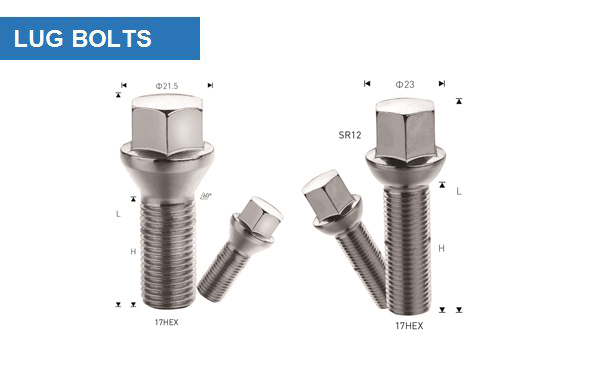
For a working aftermarket buyer choosing between wheel bolts for passenger and commercial vehicles, the recommendation in the Fortune Wheel Parts catalog is grade 10.9 as the default. For the matching lug nuts, browse the wheel lug nuts and bolts collection to confirm conical, ball seat, or flat seat compatibility with the wheel hub. For lot-size pricing, MTR / cert traceability, or RoHS / REACH documentation, request bolt grade certification through the Fortune contact page and the team will return a per-bolt price, a heat-lot certificate, and a 3.1 / 3.2 inspection document inside three business days.
Next step for aftermarket buyers: if you are upgrading from 8.8 to 10.9 on a stock passenger car, verify the thread length matches the OE spec within 1 mm, buy a full set of four or five bolts (never replace only one), re-torque to spec after 50 to 100 km of driving (the wheel seating will settle the bolt preload), and store the OE bolts as the spare set in case the aftermarket wheels are sold without the car.
About the author
Bobby — Manager, Ningbo Fuyichun Import and Export Co., Ltd. (Fortune Wheel Parts). Founded in 1996, Fortune is now one of the leading professional manufacturers of wheel balance weights, tire valves, and tool accessories. The Fortune catalog covers conical seat lug bolts in grades 8.8, 10.9, and 12.9 per ISO 898-1, plus the matching ACORN and Bulge ACORN lug nut families.
Connect with Fortune: Fortune Wheel Parts on LinkedIn | Fortune Wheel Parts on Facebook | Fortune Wheel Parts on YouTube | Contact Fortune
Frequently Asked Questions
What is the actual yield strength difference between wheel bolt grade 8.8, 10.9, and 12.9?
Per ISO 898-1, the minimum yield strength (ReL) is 640 MPa for grade 8.8, 900 MPa for grade 10.9, and 1100 MPa for grade 12.9, with nominal tensile strength (Rm) of 800, 1000, and 1220 MPa respectively. The yield strength jump from 8.8 to 10.9 is 41%, and from 10.9 to 12.9 is another 22%.
Can I safely replace 8.8 bolts with 10.9 bolts on any passenger vehicle?
Yes, in the vast majority of cases. The replacement is safe because 10.9 has higher yield and tensile strength than 8.8 and the same nominal thread geometry. Watch the clamping length: 10.9 bolts are often through-hardened, which can reduce elongation under overload. Match the original bolt length within 1 mm to avoid bottoming in a blind hole.
Why do motorsport applications typically use 12.9 instead of 10.9 wheel bolts?
Motorsport uses 12.9 because the application cycles bolts through repeated high-temperature braking events that reduce the effective yield strength of 8.8 and 10.9 bolts. 12.9 retains more of its strength at 200 to 300 degrees C operating temperature, and the higher yield gives head-room for accidental over-torque during rapid pit-stop wheel changes.
Does bolt grade affect the recommended torque value?
Bolt grade alone does not dictate torque, but it changes the target preload. Per ISO 16047, the relationship between applied torque T, preload F, and the nut factor K is T = K x F x d. For the same friction class (K between 0.10 and 0.20), a higher grade bolt can accept a higher preload before yielding, so the working torque window for a 10.9 bolt is typically 10 to 15% higher than for an 8.8 bolt of the same size.
How do I identify the grade marking on a wheel bolt?
ISO 898-1 mandates a head marking: 8.8 bolts show 8.8, 10.9 bolts show 10.9, and 12.9 bolts show 12.9 stamped or raised on the bolt head. Metric property classes use two numbers separated by a decimal point: the first is one-hundredth of the ultimate tensile strength in MPa, the second is one-tenth of the yield-to-tensile ratio. So 10.9 means Rm = 1000 MPa and ReL/Rm = 0.9. SAE grade markings use radial lines: 5 lines for Grade 5, 8 lines for Grade 8, no lines for Grade 2..
Post time: Aug-10-2026