



- The TR-10 point (ASTM D1329) is the practical indicator for cold-climate EPDM tire valve selection. For -40°C service, require TR-10 below -45°C with per-lot test report. Fortune’s cold-climate EPDM compounds are formulated to a TR-10 of -45°C or lower, providing a margin of at least 5°C below the operating temperature.
- EPDM outperforms standard silicone for the valve-body overmold at -40°C because EPDM’s TR-10 (-45°C) is below standard silicone’s TR-10 (-30°C). Cold-grade silicone (TR-10 -55°C) is comparable but more expensive and harder to bond to brass substrate. For fleet buyers specifying premium EPDM rubber tire valves, the overmold formulation is the dominant procurement lever.
- Three tests verify cold-climate performance: ASTM D1414 leak-rate at -40°C (maximum 0.1 cm³/min at rated pressure), ASTM D1329 TR-10 (below -45°C), and ASTM D2137 brittleness point (no cracking at -40°C impact). Fortune’s QA lab runs all three per lot on the cold-climate EPDM valve line.
- For heavy-truck and trailer winter service in Canadian prairie provinces, specify the cold-climate EPDM HP-series truck valves. The HP series combines the 65+ PSI cold inflation rating of the TR413 base with the -40°C qualified EPDM compound.
- For fleet operators across the Canadian prairies, Nordic countries, sub-arctic mining, and arctic military/emergency fleets, request the per-lot spec sheet from the Fortune QA lab for the per-lot TR-10, leak-rate, and brittleness test reports.
1. Why Cold-Climate Fleets Demand Specialized Valves
Cold-climate fleets operating in Canadian prairie provinces…
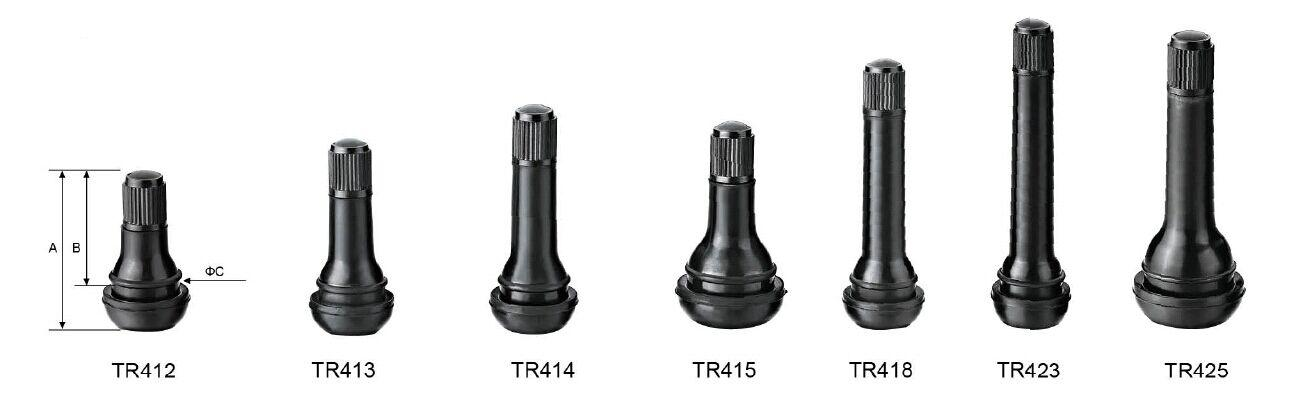
Cold-climate fleets operating in Canadian prairie provinces (Alberta, Saskatchewan, Manitoba) and Nordic countries (Norway, Sweden, Finland) face a tire-valve operating environment that passenger-car aftermarket specifications do not address. The standard TR413-series snap-in rubber tire valve is qualified to -40°C to +100°C per the typical supplier’s published specification, but the qualification window is a survival range rather than a seal-integrity range. Below -30°C, the rubber compound begins to lose elastomeric behavior, and the question for fleet procurement is whether the valve holds seal integrity at the -40°C ambient that Canadian and Nordic fleets see for 8-12 weeks per winter.
The operational consequence of a valve that…
The operational consequence of a valve that loses seal integrity at -40°C is silent pressure loss during cold-soak conditions. A vehicle parked overnight at -40°C with a marginal valve will lose 1-3 PSI over 8 hours, and the pressure loss accelerates when the vehicle is brought into a heated garage (the thermal cycling causes the marginal seal to leak at a higher rate than the steady-state leak rate at -40°C). For a fleet with 50-500 vehicles, the cumulative pressure-loss event rate is significant — typically 2-5% of vehicles per month in mid-winter, with TPMS alerts generating false-positive service events.
The economic impact of these false-positive service…
The economic impact of these false-positive service events is non-trivial for a fleet operator. Each TPMS alert generates a service ticket (~30 minutes of technician time), a pressure-check and re-inflation (~15 minutes), and a documentation entry in the fleet maintenance system. Across a 200-vehicle fleet with 5% monthly TPMS alert rate, that is 10 service events per month or 120 per winter — approximately 60 hours of technician time and a measurable vehicle-availability impact. The procurement decision to specify a cold-climate qualified valve is a decision to eliminate the false-positive TPMS alert stream, not just a decision to improve valve performance in absolute terms.
For these reasons, the procurement specification for…
For these reasons, the procurement specification for cold-climate fleet service is fundamentally different from the procurement specification for passenger-car aftermarket. I have qualified cold-climate EPDM compounds across Fortune’s TR413 and HP series for 10+ years, and what I see in our QA lab reports is that the survival range and the seal-integrity range are not the same. The passenger-car specification asks “does the valve meet -40°C survival”; the cold-climate fleet specification asks “does the valve hold seal integrity at -40°C with a verifiable test report.” The two specifications are not the same, and they lead to different valve selections. The passenger-car specification asks “does the valve meet -40°C survival”; the cold-climate fleet specification asks “does the valve hold seal integrity at -40°C with a verifiable test report.” The two specifications are not the same, and they lead to different valve selections. Fortune Wheel Parts’ cold-climate EPDM valves are positioned for the second specification, with per-lot TR-10, leak-rate, and brittleness test reports available on request from the QA lab.
2. EPDM vs Natural Rubber vs Silicone: -40°C Performance
The three rubber compounds commonly considered for…
The three rubber compounds commonly considered for tire-valve service are EPDM (ethylene propylene diene monomer), natural rubber (NR), and silicone (polydimethylsiloxane, PDMS). Each compound has a different low-temperature behavior profile, and the right selection for cold-climate fleet service depends on the dominant failure mode the valve must survive. The three failure modes that cold-climate fleets see are: glass transition (the rubber becomes brittle and cracks), seal-force loss (the rubber loses elasticity and stops conforming to the sealing surface), and overmold delamination (the rubber separates from the brass stem at the bond interface).
EPDM is the dominant compound for tire-valve…
EPDM is the dominant compound for tire-valve overmolds because it bonds well to brass substrate during the overmolding process and has high ozone resistance — both critical for the 3-4 year service life typical of a tire valve. We have qualified EPDM overmold across the Fortune TR413 series and the HP series, and our per-lot QA report covers the ASTM D1414 leak-rate, ASTM D1329 TR-10, and ASTM D2137 brittleness tests on every shipment. Our QA lab runs the three-test verification per lot because the qualification window of -40°C to +100°C is a survival range, not a seal-integrity range. The TR-10 point for a standard EPDM compound is -45°C, with cold-climate EPDM formulations extending the TR-10 to -50°C or lower. At -40°C, standard EPDM operates with a low-temperature stiffness ratio (per ASTM D1053 torsional stiffness) of approximately 3:1 to 4:1, meaning the rubber is 3-4 times stiffer at -40°C than at +23°C but still behaves as an elastomer.
Natural rubber (NR) has a TR-10 point…
Natural rubber (NR) has a TR-10 point of approximately -55°C, which is better than EPDM in absolute terms, but NR has poor ozone resistance and requires significant anti-ozonant additive loading to survive in tire-valve service. NR-bonded valves are commonly seen in older designs and in some truck applications, but the dominant passenger-car and modern fleet specification is EPDM overmold because the ozone-resistance benefit outweighs the marginal TR-10 advantage. For Canadian prairie fleets operating 8-12 weeks per winter at -40°C ambient, the 5°C TR-10 difference between EPDM (-45°C) and NR (-55°C) is not the procurement driver; the procurement driver is the 3-4 year ozone-resistance lifetime.
Silicone (PDMS) has a standard TR-10 of…
Silicone (PDMS) has a standard TR-10 of -30°C, which makes standard silicone unsuitable for -40°C tire-valve service. Cold-grade silicone formulations extend the TR-10 to -55°C, comparable to NR, but silicone does not bond to brass substrate during overmolding. Silicone is the preferred compound for sealing gaskets and O-rings in static applications, but for the valve-body overmold, EPDM remains the dominant specification. For fleet buyers specifying cold-climate valves, the practical guidance is to require EPDM overmold with TR-10 below -45°C and not to substitute silicone unless the valve design uses a separate gasket-sealing approach.
3. EPDM Formulation: Cold-Resistant Compound Design
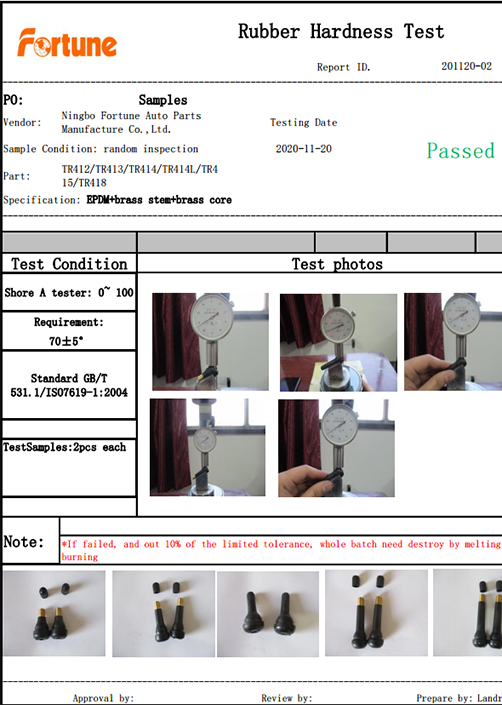
Cold-resistant EPDM compounds used in tire-valve service…
Cold-resistant EPDM compounds used in tire-valve service are formulated around three design parameters: the third monomer (ENB or DCPD) content, the ethylene-to-propylene ratio, and the plasticizer/paraffinic-oil loading. Each parameter shifts the TR-10 point and the low-temperature stiffness ratio, and the cold-climate fleet specification is a specific combination of all three that delivers a TR-10 below -45°C with a low-temperature stiffness ratio of 4:1 or lower.
The third monomer in EPDM is what enables sulfur-based vulcanization. ENB (ethylidene norbornene) is the modern third monomer of choice, with DCPD (dicyclopentadiene) used in some lower-cost formulations. The ENB content controls the cure rate and the cross-link density: higher ENB content (8-12% by weight) gives faster cure and higher cross-link density, which translates to higher hardness and lower compression set but also higher low-temperature stiffness. For cold-climate EPDM, the ENB content is typically specified at 7-9% to balance cure rate against low-temperature flexibility.
The ethylene-to-propylene ratio controls the crystallinity of…
The ethylene-to-propylene ratio controls the crystallinity of the EPDM backbone. Higher ethylene content (60-70% by weight) gives higher green strength and better mechanical properties at room temperature but increases the glass-transition temperature (Tg). Lower ethylene content (40-55%) gives lower Tg and better low-temperature flexibility but reduces room-temperature mechanical properties. For cold-climate EPDM tire-valve compounds, the ethylene content is typically specified at 50-58% — low enough to keep Tg below -55°C and TR-10 below -45°C, high enough to maintain the room-temperature hardness needed for sealing.
The plasticizer loading is the third design…
The plasticizer loading is the third design lever. Paraffinic oil at 15-25 phr (parts per hundred rubber) is the typical plasticizer for cold-climate EPDM, with the oil acting as an internal lubricant that improves low-temperature flexibility. The trade-off is that plasticizer migrates to the surface over time (the “blooming” effect), and excessive plasticizer loading reduces the long-term seal-force retention. For Fortune Wheel Parts’ cold-climate EPDM compounds, the plasticizer loading is specified at 18-22 phr with a per-lot verification of plasticizer migration rate in the QA lab. The combined effect of the three design parameters is a TR-10 point of -45°C to -50°C and a low-temperature stiffness ratio of 3:1 to 4:1, both verified per ASTM D1329 and ASTM D1053 respectively in the per-lot test report.
4. Seal Integrity Test: Leak Rate at -40°C
The ASTM D1414 standard test method for…
The ASTM D1414 standard test method for rubber O-rings is the practical leak-rate test for cold-climate tire-valve service. The test pressurizes the O-ring (or, in the tire-valve case, the complete valve assembly with the rubber section as the seal) to the rated working pressure and holds it at the specified test temperature for a prescribed duration, with leak rate measured as pressure decay or as volumetric displacement over the hold period.
The standard test configuration for cold-climate fleet qualification is: rated working pressure (typically 130 PSI for passenger-car, 200 PSI for heavy-truck HP series), test temperature -40°C ±2°C, hold duration 24 hours, maximum allowable leak rate 0.1 cm³/min at standard temperature and pressure. The test fixture is a temperature chamber with pressure inlet and leak-rate measurement instrumentation, and the test is typically run on a sample of 5-10 valves per lot to provide statistical confidence in the per-lot qualification.
For Fortune Wheel Parts’ cold-climate EPDM valve…
For our cold-climate EPDM valve line, the leak-rate test is run on every lot at the QA lab before shipment. We use a temperature chamber with pressure inlet and leak-rate measurement instrumentation, and our standard test configuration is: rated working pressure (130 PSI for TR413, 200 PSI for HP series), test temperature -40°C ±2°C, hold duration 24 hours, maximum allowable leak rate 0.1 cm³/min. We run this test on a sample of 5-10 valves per lot to provide statistical confidence in the per-lot qualification., with the test report documenting: (1) the test temperature profile (typically a 2-hour ramp from +23°C to -40°C, then 24-hour hold at -40°C); (2) the leak rate per valve tested; (3) the maximum, minimum, and average leak rate across the sample; (4) the post-test visual inspection of the rubber section for cracking or delamination. The test report is provided with the lot shipment and is archived for 7 years per Fortune’s quality-management system.
The practical interpretation of the leak-rate test…
The practical interpretation of the leak-rate test result is straightforward: valves that pass 0.1 cm³/min maximum at -40°C will hold seal integrity in fleet service, and valves that fail the test will leak in service. The leak-rate threshold of 0.1 cm³/min is approximately equivalent to a pressure decay of 0.05 PSI per 24 hours at 130 PSI working pressure — well below the 1.0 PSI per month threshold that triggers a TPMS alert in a typical passenger-car TPMS calibration. Valves that pass the ASTM D1414 test at -40°C therefore generate no false-positive TPMS alerts in fleet service, which is the operational outcome the fleet procurement specification is buying.
5. Canadian Prairie Fleet Case Profile
Canadian prairie provinces — Alberta, Saskatchewan, and…
Canadian prairie provinces — Alberta, Saskatchewan, and Manitoba — experience approximately 8-12 weeks per winter with ambient temperatures at or below -30°C, and 2-4 weeks per winter with ambient temperatures at or below -40°C. The cities with the most severe cold-climate fleet service exposure are Edmonton, Calgary, Saskatoon, Regina, and Winnipeg, where winter highs of -25°C to -35°C are routine from December through February.
The typical Canadian prairie fleet service profile is: mixed light-duty passenger vehicles (company cars, light-truck service vehicles) and medium-duty commercial vehicles (delivery vans, light trucks). The vehicles operate primarily in urban and suburban environments with daily starts (cold-soak overnight, then 1-2 hours of operation, then return to cold-soak). The cold-soak / warm-up cycle is the operational stress point for tire valves — the rubber section experiences thermal cycling between the cold-soak temperature (-40°C ambient) and the warm-up temperature (+60°C to +80°C brake-rotor heat soak).
For Canadian prairie fleet operators, the recommended…
For our Canadian prairie fleet customers, the recommended valve specification is: TR413-series or HP-series cold-climate EPDM snap-in valve, TR-10 below -45°C, ASTM D1414 leak-rate verified at -40°C, per-lot test report provided. We ship this specification as the default Fortune cold-climate EPDM valve line, and our per-lot test report covers the three-test verification (ASTM D1414 leak-rate, ASTM D1329 TR-10, ASTM D2137 brittleness point) provided on request. Fortune Wheel Parts’ cold-climate EPDM valve line meets this specification with the standard TR413 base and the cold-climate EPDM overmold compound. The per-lot test report covers the three-test verification (ASTM D1414 leak-rate, ASTM D1329 TR-10, ASTM D2137 brittleness point) and is provided on request from the company’s QA lab for fleet procurement audits.
The economic case for the cold-climate specification…
The economic case for the cold-climate specification is well-established for Canadian prairie fleets. A typical 100-vehicle prairie fleet sees 5-10 false-positive TPMS alerts per month with a standard TR413 valve, and 0-1 false-positive alerts per month with a cold-climate EPDM valve. The avoided service cost is approximately 60-80 hours of technician time per winter, which is the procurement decision driver for fleet operators who have already experienced the false-positive alert pattern with the standard valve specification.
For heavy-truck and trailer winter service in the Canadian prairie provinces, specify high-pressure HP series tire valves with the cold-climate EPDM formulation — the HP series combines the 65+ PSI cold inflation rating of the TR413 base with the -40°C qualified EPDM compound.
6. Nordic Lapland Fleet Case Profile
Nordic countries — Norway, Sweden, and Finland…
Nordic countries — Norway, Sweden, and Finland — have a more extreme cold-climate fleet service profile than the Canadian prairies in two respects: the coldest ambient temperatures are more extreme (Lapland and northern interior regions reach -45°C to -50°C), and the cold-soak duration is longer (16-20 hours per day in mid-winter, compared to 8-12 hours in the Canadian prairies). The longer cold-soak duration amplifies the leak-rate exposure for marginal valves, because the thermal-cycling stress between cold-soak and warm-up accumulates over more cycles per winter.
The Nordic fleet service profile is dominated…
The Nordic fleet service profile is dominated by medium-duty and heavy-duty commercial vehicles: public-transport buses, freight trucks, and municipal service vehicles. The vehicles operate in urban environments (Oslo, Stockholm, Helsinki, Tromsø) and on inter-city routes that traverse the colder interior regions. Public-transport fleets have the most stringent cold-climate valve requirement because the vehicles are in service 18-22 hours per day with minimal cold-soak recovery, and a valve failure during service generates an immediate service disruption.
For Nordic Lapland fleet operators, the recommended…
For our Nordic Lapland fleet customers, the recommended valve specification is similar to the Canadian prairie specification but with two refinements: (1) TR-10 below -50°C to provide margin against the -45°C to -50°C ambient temperatures, and (2) extended thermal-cycling qualification per ASTM D1053 (low-temperature stiffness) at -45°C, not just -40°C. We stock the extended-TR-10 compound as a standard SKU, and our per-lot test report covers the additional thermal-cycling qualification. (1) TR-10 below -50°C to provide margin against the -45°C to -50°C ambient temperatures, and (2) extended thermal-cycling qualification per ASTM D1053 (low-temperature stiffness) at -45°C, not just -40°C. Fortune Wheel Parts’ cold-climate EPDM compounds are formulated to TR-10 of -45°C to -50°C with the upper end of the range covering the Nordic specification.
The procurement case for the extended TR-10…
The procurement case for the extended TR-10 specification is that the marginal cost of the higher-TR-10 compound is small (typically 5-8% of the valve price) compared to the avoided service disruption cost. A Nordic public-transport fleet with 50 buses sees 1-2 valve-related service disruptions per month with a standard valve in mid-winter, and the cost of each disruption (vehicle out of service, passenger delay, replacement dispatch) is significantly higher than the cost of a marginal valve upgrade. The extended-TR-10 specification is therefore a cost-effective procurement decision for Nordic Lapland fleet operators.
7. EPDM Valve Specification Checklist
| Specification | Canadian Prairie Requirement | Nordic Lapland Requirement | Test Method |
|---|---|---|---|
| TR-10 point (maximum) | -45°C | -50°C | ASTM D1329 |
| Low-temperature stiffness ratio (maximum at -40°C) | 4:1 | 4:1 | ASTM D1053 |
| Brittleness point (no cracking at impact) | -40°C | -45°C | ASTM D2137 |
| Leak rate at -40°C (maximum, 24h hold) | 0.1 cm³/min | 0.1 cm³/min | ASTM D1414 |
| Hardness, Shore A at +23°C | 65 ±5 | 65 ±5 | ASTM D2240 |
| Cold inflation pressure rating | 65 PSI (TR413) / 130 PSI (HP series) | 65 PSI (TR413) / 130 PSI (HP series) | Supplier spec |
| Operating temperature range | -40°C to +100°C | -45°C to +100°C | Supplier spec |
| Substrate | C36000 brass stem | C36000 brass stem | Supplier spec |
| Per-lot test report required | Yes | Yes | Supplier QA |
| Ozone resistance (70h, 50 pphm) | No cracking | No cracking | ASTM D1149 |
| Recommended valve series | TR413 cold-climate EPDM / HP series | TR413 cold-climate EPDM extended-TR | Fortune Wheel Parts spec |
8. Engineering Takeaway
The procurement specification for cold-climate tire valves…
The procurement specification for cold-climate tire valves is fundamentally different from the specification for standard passenger-car aftermarket valves. The standard specification asks “does the valve meet -40°C survival,” and the cold-climate specification asks “does the valve hold seal integrity at -40°C with a verifiable per-lot test report.” We ship only to the second specification because our customers — Canadian prairie and Nordic Lapland fleet operators — have learned through operational experience that the survival range is not the same as the seal-integrity range. The standard specification asks “does the valve meet -40°C survival,” and the cold-climate specification asks “does the valve hold seal integrity at -40°C with a verifiable per-lot test report.” The two specifications lead to different valve selections, and the cold-climate selection is the correct one for Canadian prairie and Nordic Lapland fleet operators.
For Canadian prairie fleets (Alberta, Saskatchewan, Manitoba)…
For Canadian prairie fleets (Alberta, Saskatchewan, Manitoba), the recommended specification is the cold-climate EPDM TR413 series with TR-10 below -45°C, ASTM D1414 leak-rate verified at -40°C, and per-lot test report provided. The cold-climate specification eliminates the false-positive TPMS alert pattern that generates 5-10 service events per month in a 100-vehicle prairie fleet, with an annual avoided service cost of approximately 60-80 hours of technician time.
For Nordic Lapland fleets (Norway, Sweden, Finland), the recommended specification is the cold-climate EPDM TR413 series with TR-10 below -50°C and extended thermal-cycling qualification at -45°C. The extended TR-10 specification is a cost-effective procurement decision for Nordic public-transport and freight fleets, because the marginal compound cost (5-8% of valve price) is small compared to the avoided service disruption cost.
Across both specifications, the common procurement lever…
Across both specifications, the common procurement lever is the per-lot test report. Without the per-lot test report, the buyer cannot verify that the specific lot received meets the qualified TR-10, leak-rate, and brittleness specifications, and the supplier’s qualification report becomes a statistical average rather than a per-lot guarantee. Fortune Wheel Parts provides per-lot test reports on request from the QA lab for the cold-climate EPDM valve line, with the three-test verification (ASTM D1414 leak-rate, ASTM D1329 TR-10, ASTM D2137 brittleness) documented per lot. For fleet buyers who want to verify the cold-climate valve specification for a specific lot or who want to integrate the test report into their fleet procurement audit, the QA lab is reachable through the company’s contact-us page for a formal spec request. The per-lot test report is the audit trail that connects the qualification specification to the specific lot in service, and it is the procurement lever that closes the loop between specification and delivery.
For fleet buyers who want to verify the cold-climate valve specification for a specific lot, request cold-climate valve specs from the Fortune QA lab through the company’s contact-us page.
Frequently Asked Questions
What temperature does EPDM seal integrity start to fail?
EPDM seal integrity begins to degrade as the formulation approaches its glass-transition temperature (Tg), which for a typical EPDM compound used in tire valves is approximately -55°C to -58°C. The TR-10 point (temperature retraction, 10%, per ASTM D1329) is the practical indicator — EPDM compounds used in Fortune Wheel Parts’ tire valves are formulated to a TR-10 of -45°C or lower, providing a margin of at least 5°C below the -40°C fleet operating temperature. Below the TR-10, the rubber behaves as a soft plastic rather than an elastomer, and seal integrity is not maintained.
Is EPDM better than silicone for -40°C winter tires?
EPDM and silicone serve different functions in tire-valve service. EPDM is the preferred formulation for the valve body’s rubber section (overmolded on the brass stem) because EPDM bonds to brass substrate during overmolding and ozone resistance is high. Silicone is preferred for sealing gaskets and O-rings in static applications but does not bond to brass in overmolding. For -40°C service, the question is which compound’s TR-10 point is below -40°C with margin. Standard EPDM (TR-10 -45°C) outperforms standard silicone (TR-10 -30°C) at -40°C, but cold-grade silicone (TR-10 -55°C) is comparable. Fortune Wheel Parts’ tire valves use EPDM for the overmold and standard NBR or EPDM for the sealing gasket.
What’s the typical EPDM hardness for cold-climate valves?
Cold-climate EPDM tire-valve compounds are typically formulated to a Shore A hardness of 60-70 at room temperature, with a low-temperature stiffness ratio (per ASTM D1053, torsional stiffness at -40°C vs +23°C) of 4:1 maximum. Hardness above Shore A 75 increases the low-temperature stiffness ratio and reduces seal conformity at -40°C. Fortune Wheel Parts’ cold-climate EPDM compounds are specified at Shore A 65 ±5 at room temperature with low-temperature stiffness verified per ASTM D1053 in the company’s per-lot QA documentation.
How to verify EPDM valve performance at -40°C?
Three tests, in order of relevance: (1) ASTM D1414 leak-rate test on the O-ring or seal at -40°C, with a maximum allowable leak rate of 0.1 cm³/min at rated working pressure; (2) ASTM D1329 TR-10 retraction test on the EPDM compound, with TR-10 below -45°C; (3) ASTM D2137 brittleness-point test, with no cracking at -40°C impact. Fortune Wheel Parts’ QA lab runs all three tests per lot on the cold-climate EPDM valve line, with test reports available on request.
Which industries require -40°C cold-climate valve certification?
The most common industries requiring -40°C cold-climate valve certification are: (1) Canadian prairie provinces (Alberta, Saskatchewan, Manitoba) winter road fleet service, where -40°C ambient is routine in January and February; (2) Nordic countries (Norway, Sweden, Finland) public transport and freight fleet, where Lapland and northern interior regions reach -45°C; (3) mining and resource extraction in sub-arctic regions; (4) military and emergency-vehicle fleets operating in arctic training and patrol environments. Fortune Wheel Parts’ cold-climate EPDM valves are qualified to -40°C and are supplied to fleet operators across all four categories.
About the Author
Bobby is a Manager at Ningbo Fortune Spring Import & Export Co., Ltd. (Fortune Wheel Parts), a manufacturer founded in 1996 and one of the leading professional manufacturers of wheel balance weights, tire valves, and tool accessories. Connect with Fortune Wheel Parts on LinkedIn, Facebook, and YouTube. For procurement specifications or to request the QA lab cold-climate spec sheet, use the company’s contact-us page.
Industry references: Apple Rubber low-temperature rubber testing reference (ASTM D2137 brittleness + D1329 TR-10) · Apple Rubber compression-set testing reference (ASTM D-395/D1414) · The Gund Company TR-10 rubber elasticity low-temperature testing reference (ASTM D1329) · SSP Seals low-temperature environments guide (ASTM D2137/D1053/D1329)
Post time: Aug-13-2026