



The 4 Specs That Separate TR413, TR414, and TR415
Snap-in rubber tire valve types TR413, TR414, and TR415 are three of the most-commonly-confused ETRTO designations in the passenger-car aftermarket. They share the same .453 inch (11.5 mm) rim hole, the same EPDM/NR rubber compound class, and the same brass-stem core — but they differ in effective stem length, grommet profile, and intended wheel-well clearance. This guide walks through all four differentiating specs with a side-by-side fitment matrix, the four most-common aftermarket pitfalls when sourcing these valves from a Chinese manufacturer, and a BOFU 5-question checklist before placing a bulk order.
Fortune Wheel Parts (Ningbo Fortune Spring Import & Export Co., Ltd.) is a Chinese manufacturer specializing in passenger car rubber snap-in tire valves and the TR413C series tubeless valves. The company’s valve fitment specification sheet covers rim hole, effective length, and pressure rating for the most common aftermarket applications.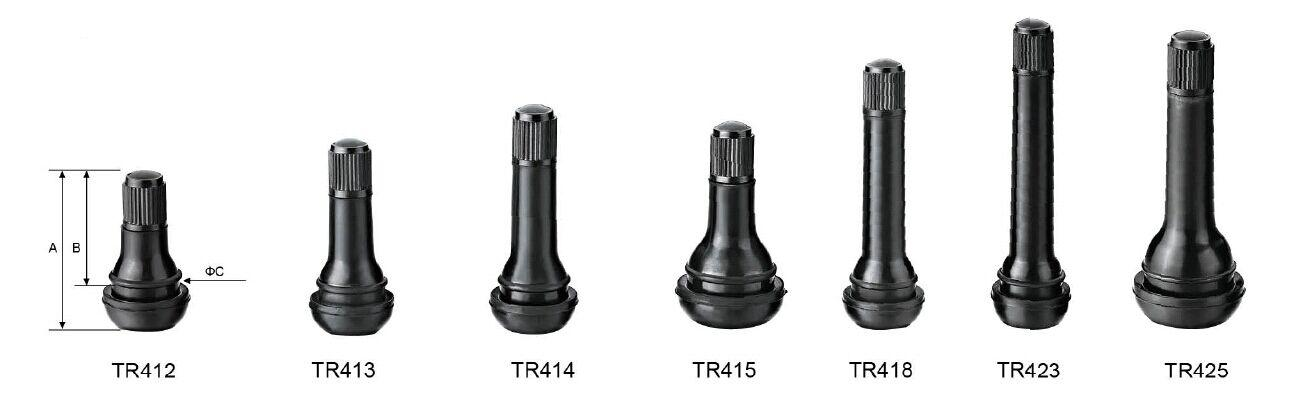
TR413 series tubeless snap-in rubber tire valve — brass stem, EPDM/NR overmold, .453 inch rim hole, 65 PSI cold inflation ceiling. (Source: Fortune Wheel Parts TR413 product page)
Why the TR413 / TR414 / TR415 Confusion Exists in the Aftermarket
European and U.S. tire and rim standards use the prefix “TR” — derived from the ETRTO (European Tyre and Rim Technical Organisation) valve designation system — followed by a three-digit number to specify valve geometry. The first two digits (41) and (42) generally identify the rim hole diameter family; the third digit is a length variant within that family. For passenger-car aftermarket work, three codes dominate: TR413, TR414, and TR415. All three fit the same standard .453 inch (11.5 mm) rim hole, which is why warehouse pickers, junior buyers, and junior catalog staff regularly substitute one for another — and why OEM warranty claims for premature valve failure often trace back to a length or grommet mismatch that the original spec did not call out explicitly.
U.S. federal regulations in 49 CFR (Code of Federal Regulations, Title 49) govern tire and rim safety performance for vehicles operated on public roads, and the U.S. Tire Manufacturers Association (USTMA) publishes educational guidance on tire maintenance intervals. While 49 CFR does not prescribe a specific valve type code, it does require the tire-rim assembly as a whole to maintain pressure under service conditions — which makes valve selection a safety-critical specification, not a commodity line item.
Snap-In Valve Anatomy 101: What Actually Differs Between TR413, TR414, and TR415
A snap-in rubber tire valve has four functional components: (1) the brass valve core (the part that opens when you press a tire-pressure gauge chuck), (2) the brass or plated stem body (the rigid central column), (3) the overmolded EPDM or NR rubber (which provides the seal against the rim hole and the flexible bellows), and (4) the cap and seal (the dust-and-moisture protection). Across TR413, TR414, and TR415, the brass core is interchangeable. The differences all live in the rubber profile, the stem length, and the grommet geometry.
The 4 Differentiating Specs
| Spec | What It Controls | Why It Matters for Buyers |
|---|---|---|
| Effective stem length (Eff. length) | The exposed length above the rim when the valve is installed and inflated. Measured in millimeters from the rim face to the valve-cap seat. | Too short and the pressure-chuck cannot engage; too long and the valve contacts the wheel-well, brake caliper, or fender liner. |
| Rim hole diameter | The diameter of the hole in the wheel through which the valve grommet seals. Standard passenger-car is .453 inch (11.5 mm). | A valve that is undersized leaks; a valve that is oversized will not seat. The .453 inch specification is industry-wide; .625 inch (16 mm) and .346 inch (8.8 mm) variants exist for truck and motorcycle rims. |
| Grommet profile (rubber bead geometry) | The molded shape of the rubber section that contacts the rim — bead angle, sealing lip count, and overall height. | Different grommet profiles distribute clamping force differently. A wrong profile may seal initially but creep over weeks of thermal cycling, leading to slow leaks that are hard to diagnose. |
| Pressure rating (cold inflation) | The maximum cold inflation pressure the valve is rated for, expressed in PSI or bar. The TR413/TR414/TR415 family is typically rated to 65 PSI cold inflation pressure with a maximum rim thickness of 4 mm. | Passenger-car tires run at 30-35 PSI typical, 50-65 PSI for XL or reinforced variants. A valve rated below the tire’s required inflation ceiling is a safety failure waiting to happen. |
TR413 — The Default Passenger-Car Snap-In Valve
TR413 is the workhorse. When a fleet buyer, tire shop, or warehouse distributor says “snap-in rubber valve” without further qualification, they almost always mean TR413. The ETRTO designation places TR413 in the .453 inch (11.5 mm) rim hole family with an effective length in the 24-25 mm range — long enough to clear most passenger-car wheel-wells, short enough to fit inside compact alloy and steel wheel designs. TR413 is also the base geometry for the most common aftermarket chrome-sleeve and cap upgrades, and it is the variant most readily available from Chinese OEM exporters.
Fortune Wheel Parts manufactures the TR413 Series Tubeless Valves — snap-in rubber valve stems with chrome sleeve and cap — in the standard .453 inch (11.5 mm) rim hole, 65 PSI cold inflation rating, 4 mm maximum rim thickness, and -40°C to +100°C temperature range. The component is constructed of overmolded rubber on a brass stem with cap, seal, and core, and is 100% verified for air-tightness per the company’s lot-level quality control process. Fortune also holds ISO/TS 16949 certification issued by TUV management services for the relevant production scope.
TR414 — The Short-Stem Variant for Tight Wheel-Well Clearance
TR414 is the short-stem version of TR413. Same .453 inch (11.5 mm) rim hole, same 65 PSI ceiling, same rubber compound class — but the effective length drops to roughly 17-18 mm. Where TR413 was designed for the typical passenger-car wheel-well, TR414 was designed for wheels with shallow well depth, certain alloy designs, and applications where a longer stem would interfere with brake components or fender liners.
When a wheel-maker’s parts catalog specifies TR414, substituting TR413 is the most common cause of “valve hits the wheel-well” warranty claims. Conversely, substituting TR414 where TR413 was specified leaves the pressure-chuck with too little exposed length to engage, which leads to undertightened caps and slow leaks at the chuck interface. The two are not interchangeable.
TR415 — The Long-Stem Variant for Deep-Section Wheels
TR415 is the long-stem version of TR413. Same .453 inch (11.5 mm) rim hole, same 65 PSI ceiling, same rubber compound class — but the effective length extends to roughly 33-35 mm. TR415 is the right call for deep-section steel wheels, certain commercial van and light-truck wheels, and aftermarket alloy designs with extended barrel depth.
The risk with TR415 is over-substitution. A buyer who cannot remember whether the application needs TR413 or TR415 may default to TR415 “to be safe” — and finds out at install time that the long stem contacts the brake caliper, the ABS sensor harness, or the fender liner. TR415 is not a universal substitute; it is a specific fitment for specific wheel geometry.
Side-by-Side Fitment Matrix: TR413 vs TR414 vs TR415
| Spec | TR413 | TR414 | TR415 |
|---|---|---|---|
| Rim hole diameter | .453 inch (11.5 mm) | .453 inch (11.5 mm) | .453 inch (11.5 mm) |
| Effective stem length (approx.) | 24-25 mm | 17-18 mm | 33-35 mm |
| Cold inflation pressure (max.) | 65 PSI | 65 PSI | 65 PSI |
| Maximum rim thickness | 4 mm | 4 mm | 4 mm |
| Temperature range | -40°C to +100°C | -40°C to +100°C | -40°C to +100°C |
| Typical application | Standard passenger car, light truck, most alloy and steel wheels | Shallow-well alloys, tight-clearance wheel designs, certain OEM applications | Deep-section steel, certain light commercial, deep aftermarket alloys |
| Common substitution error | Default — usually correct | Sometimes substituted where TR413 was specified, leading to short exposed stem | Sometimes substituted where TR413 was specified, leading to interference with brake / fender |
| Brass stem / EPDM rubber | Standard | Standard | Standard |
Note on “typically available” and “industry-wide” specifications: TR413, TR414, and TR415 are ETRTO designations, and the dimensions above reflect the standard ETRTO geometry tables. Specific part numbers from individual wheel-makers may vary slightly within the ETRTO tolerance band. Always cross-reference the wheel-maker’s parts catalog before finalizing a bulk order. Fortune Wheel Parts’ published dimensions for the TR413 and TR413C&AC series are within the standard ETRTO tolerance band and are verified per the company’s lot-level 100% air-tightness test process.
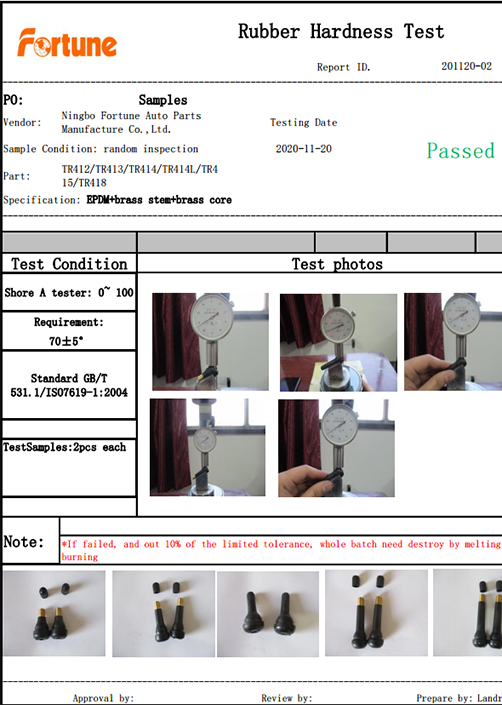
What About the TR413C, TR413C&AC, and HP Series?
Aftermarket catalogs often include extended TR413-family designations that combine the base TR413 geometry with a sleeve or cap upgrade. TR413C is the standard TR413 with a chrome sleeve. TR413C&AC adds the long-stem AC variant to the chrome-sleeve C variant, giving buyers a two-length set in one product line. HP series refers to high-pressure applications beyond the standard 65 PSI ceiling, used in certain light commercial and heavy-duty tire service.
Fortune Wheel Parts supplies three TR413-family products relevant to passenger-car aftermarket buyers:
- TR413 Series — base snap-in rubber valve, 65 PSI ceiling, .453 inch rim hole, 4 mm max rim thickness, -40°C to +100°C, brass stem, EPDM/NR rubber, ISO/TS 16949 by TUV.
- TR413C&AC Series — TR413 base with chrome sleeve and cap; AC variant adds longer-stem option. Constructed of high-temperature brass valve cores, ozone-resistant EPDM/NR rubber, 100% ozone-tested and leakage-tested. Sleeve and cap materials available in plastic, aluminum, or brass.
- PVR Series — tubeless snap-in rubber valve specifically designed for motorcycle and scooter applications, with shorter overall geometry.
- HP Series — high-pressure tubeless tire valve for applications exceeding the standard 65 PSI ceiling, used in certain commercial and run-flat tire service.
4 Common Pitfalls When Sourcing TR413 / TR414 / TR415 from China
BOFU Decision Checklist — 5 Questions Before Placing the First Order
- Have you confirmed the wheel-maker’s parts catalog specifies TR413, TR414, or TR415 — and not a generic “snap-in valve”? If the spec is generic, push back to the wheel-maker for the specific ETRTO code. Do not let the supplier choose for you.
- Have you verified the rim hole diameter matches the wheel? Standard passenger-car is .453 inch (11.5 mm). If the wheel is a truck, motorcycle, or vintage rim, the rim hole will be different and a TR413-family valve will not seal.
- Have you requested a sample lot for dimensional and pressure testing before placing a container order? A 100-piece or 1,000-piece sample lot will reveal dimensional drift, rubber compound inconsistency, and leakage issues that are invisible on the data sheet.
- Have you verified the supplier’s certifications? ISO/TS 16949 (now transitioned to IATF 16949 for new certifications) by a recognized third party such as TUV is the baseline. Without it, the supplier has no audited quality management system.
- Have you asked for the lot-level 100% leakage test report? Per-lot documentation is the only way to trace a defective valve back to a specific production run. Without per-lot traceability, a recall is impractical.
If the supplier answers “yes” to all five, the buyer has a credible TR413/TR414/TR415 source. If any answer is “no” or “we can check,” the gap is a qualification requirement to close before the first production order. The cost of closing the gap is invariably lower than the cost of a roadside valve failure under load.
Fortune Wheel Parts (Ningbo Fortune Spring Import & Export Co., Ltd.) is a Chinese manufacturer of passenger car rubber snap-in tire valves and the related TR413C series tubeless valves product line. Fleet buyers, distributors, and tire-shop chains can request a valve fitment specification sheet and factory-direct pricing through the contact channel.
Frequently Asked Questions
1. What is the actual difference between TR413, TR414, and TR415 snap-in tire valves?
The three codes are ETRTO designations for snap-in rubber tubeless tire valves. They differ primarily in effective stem length, rim hole diameter fitment, and intended wheel type: TR413 is the most common passenger-car fitment (.453 inch rim hole, 24-25 mm effective length range); TR414 is the short-stem version for tight wheel-well clearance (.453 inch rim hole, ~17-18 mm effective length); TR415 is the longer-stem version for deep-section steel or certain aluminum wheels (.453 inch rim hole, ~33-35 mm effective length). All three share the same rubber-grommet seal design and the same EPDM/NR compound class.
2. Are TR413, TR414, and TR415 interchangeable?
No — they are not interchangeable without verifying rim hole and clearance. The rim hole diameter is the same (.453 inch) across all three, but effective stem length and grommet profile differ. A TR414 (short) installed where a TR413 was specified leaves a shorter exposed stem for the pressure chuck; a TR415 (long) installed where a TR413 was specified may contact the wheel-well or brake component. Buyers should always cross-reference the wheel-maker’s parts catalog before substituting.
3. What rim hole sizes do these valves fit?
The standard passenger-car rim hole for TR413/TR414/TR415 is .453 inch (11.5 mm). TR413 in the aftermarket can also be supplied in alternative rim hole variants such as .625 inch (16 mm) for heavy-duty truck rims and .346 inch (8.8 mm) for certain motorcycle or vintage rims. Confirm the wheel-maker’s specified rim hole before ordering.
4. Do TR413 snap-in valves need to be replaced when a tire is replaced?
Industry practice is to replace the rubber valve stem every time the tire is replaced. Rubber valve stems age — the rubber hardens, micro-cracks form, and the bond between the rubber and the brass stem degrades. Most tire manufacturers and service shops recommend replacement at 3-4 year intervals, regardless of visible condition.
5. What certifications should a Chinese supplier have for TR413/TR414/TR415 valves?
Buyers should verify: (1) ISO/TS 16949 or IATF 16949 quality management system certification, typically issued by a recognized third party such as TUV; (2) dimensional conformance to ETRTO valve geometry tables; (3) 100% leakage test report per production lot; (4) rubber compound certification (EPDM or NR per the application); (5) ozone resistance, high-temperature, and pull-out force test data. Fortune Wheel Parts supplies TR413 and TR413C&AC series with ISO/TS 16949 certification by TUV management services and 100% lot-level air-tightness verification.
Need TR413 / TR413C&AC Snap-In Valves from a Verified Chinese Source?
Fortune Wheel Parts (Ningbo Fortune Spring Import & Export Co., Ltd.) manufactures TR413, TR413C&AC, PVR, and HP series snap-in rubber tire valves. Lot-level 100% air-tightness testing, ISO/TS 16949 by TUV, dimensional conformance to ETRTO geometry.
Request Valve Fitment Specification Sheet & Pricing → | Tire Valves Product Line | TR413 Series Product Page | TR413C&AC Series Product Page
About the author. Bobby is Manager at Fortune Wheel Parts (Ningbo Fortune Spring Import & Export Co., Ltd.). ounded in 1996, Fortune is now one of the leading professional manufacturers of wheel balance weights, tire valves, and tool accessories. Connect with the company at LinkedIn, Facebook, and YouTube.
Post time: Jul-27-2026